
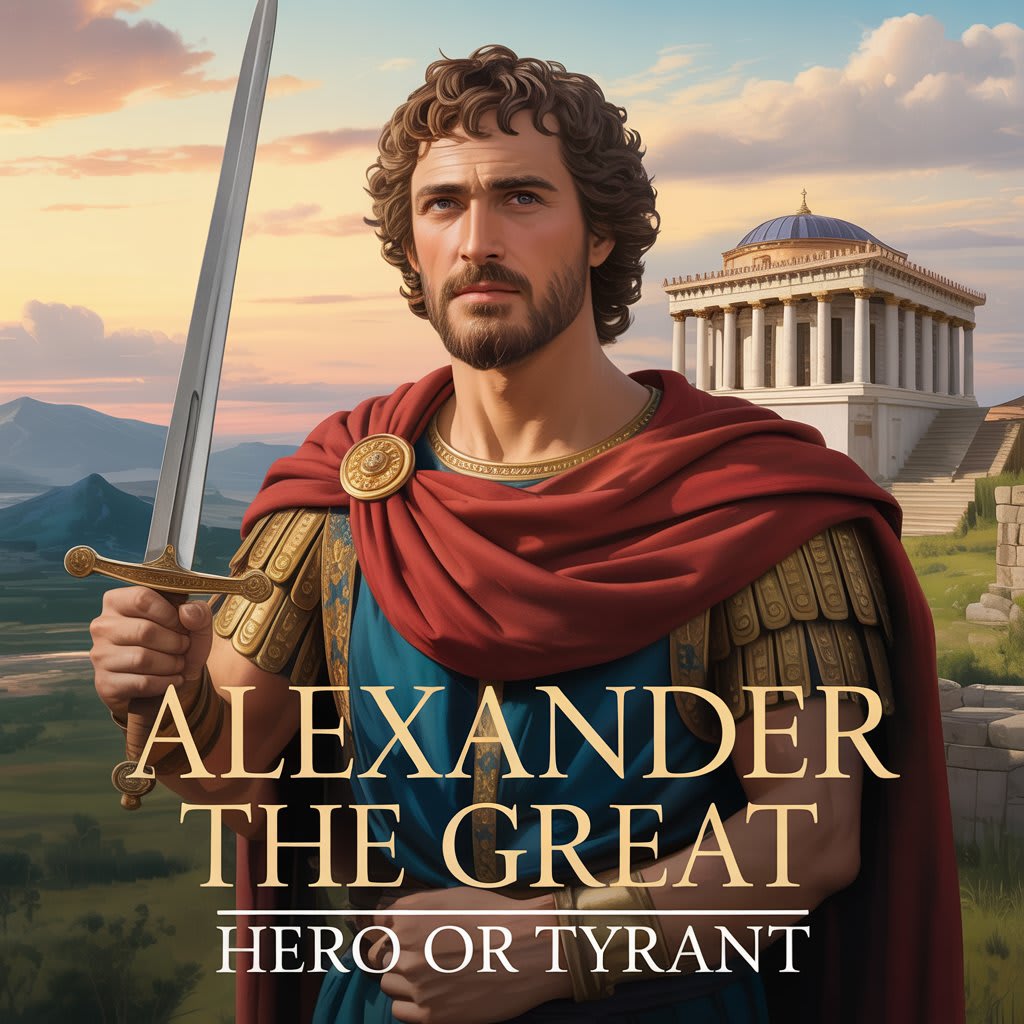
Alexander the Great: Hero or Tyrant?
A Critical Examination of the Legacy of One of History’s Most Controversial Conquerors.
Introduction
Few historical figures are as polarizing as Alexander the Great. Born in 356 BCE in Macedonia, he created one of the largest empires in the ancient world before dying at just 32 years old. Lauded by some as a military genius and visionary leader who spread Hellenistic culture, and condemned by others as a ruthless conqueror who left chaos and death in his wake, Alexander’s legacy is a complex mosaic of heroism and tyranny. This article critically examines both aspects to determine whether Alexander deserves the title of “Great” — or something else entirely.
---
The Heroic Narrative: Visionary Leader and Cultural Pioneer
To his admirers, Alexander is the embodiment of a heroic ideal. Taught by Aristotle, he was not only a skilled warrior but also an intellectual. He led his troops from Greece through Asia Minor, Egypt, Persia, and into India, often participating directly in battles and inspiring fierce loyalty from his soldiers.
One of Alexander’s most celebrated achievements was the spread of Hellenistic culture across three continents. By founding over 20 cities (most famously Alexandria in Egypt), he helped blend Greek, Persian, Egyptian, and Indian traditions. This cultural fusion led to advances in art, science, and philosophy, laying the groundwork for centuries of intellectual development.
Additionally, Alexander often adopted elements of local customs and religions rather than imposing his own. In Persia, for instance, he began wearing Persian dress and married Roxana, a Bactrian princess, to legitimize his rule and unify different cultures under one empire. This behavior has been interpreted by some as visionary — an early attempt at global integration.
---
The Tyrant’s Case: Conqueror, Not Liberator
However, not everyone sees Alexander as a hero. Many historians argue that his conquests were driven less by idealism and more by personal ambition and thirst for glory. His military campaigns resulted in widespread death and destruction. The city of Tyre was besieged and destroyed after resisting his army; men were slaughtered, and women and children enslaved. Similarly, in India, his brutal campaign against the Mallians led to mass casualties and showed little regard for native populations.
Alexander’s behavior also became increasingly erratic and tyrannical as his power grew. After the death of his close companion Hephaestion, he reportedly executed several people he blamed for the tragedy. He also murdered his friend and general, Cleitus the Black, in a drunken rage — an act that horrified even his most loyal followers.
Moreover, Alexander’s policy of forcibly integrating peoples through military conquest and intermarriage has been criticized as a form of imperialistic domination. While he promoted cultural exchange, it was under the shadow of warfare and subjugation.
---
Legacy: Greatness at What Cost?
The question of whether Alexander was a hero or a tyrant is not easily answered. His military genius is undeniable; he never lost a battle and revolutionized warfare. The Battle of Gaugamela is still studied in military academies for its brilliant use of tactics and terrain.
Yet, greatness in conquest does not necessarily equate to moral greatness. While he built an empire, it did not survive long after his death, fracturing into competing kingdoms ruled by his generals — the Diadochi. His sudden death in 323 BCE, possibly due to fever, poison, or overindulgence, left a power vacuum that plunged much of the known world into chaos.
---
Conclusion
Alexander the Great’s life and legacy defy easy categorization. He was a brilliant military leader and a unifier of cultures, yet also a ruthless conqueror whose ambition caused immense suffering. Whether one views him as a hero or a tyrant often depends on perspective: Was he a pioneer of globalization, or simply another imperial warlord?
Perhaps the most honest answer is that Alexander was both — a visionary whose achievements shaped the world, and a despot whose methods came at a terrible cost. History remembers him as "Great," but with that greatness came complexity, contradiction, and consequence.
About the Creator
Keep reading
More stories from Haris khan and writers in History and other communities.
"The Rise and Fall of the Ottoman Caliphate"
History of Khilafat-e-Usmania (Ottoman Caliphate) The Khilafat-e-Usmania, or the Ottoman Caliphate, was the last widely recognized Islamic Caliphate and one of the most enduring empires in world history. Established at the dawn of the 14th century, it lasted over 600 years, exerting tremendous influence across Europe, Asia, and Africa. It began as a small principality in Anatolia under Osman I, and by the 16th century, it had evolved into a global empire and the political center of the Muslim world.
By Haris khan8 months ago in History
An unidentified female dynasty is revealed in a tomb with the biggest collection of beads in the world.
The Montelirio Tholos Tomb is a vaulted building located beneath the present-day town of Valencina de la Concepción in Southwestern Spain that has the remains of residents who lived there between 2875 and 2635 BCE.
By Francis Damia day ago in History
Ludacris and Nelly draw backlash over bookings at MAGA-coded music festival
Ludacris and Nelly headlining a mostly right-wing event is good for them. It’s also great for the genre of hip hop. The two rap veterans have showcased their talents on other stages. Why can’t they perform for mostly MAGA folks and grab that bag?
By Skyler Saunders6 days ago in Beat


Comments
There are no comments for this story
Be the first to respond and start the conversation.