
Rosette Nebula
Exploring the Enigmatic Beauty of the Rosette Nebula
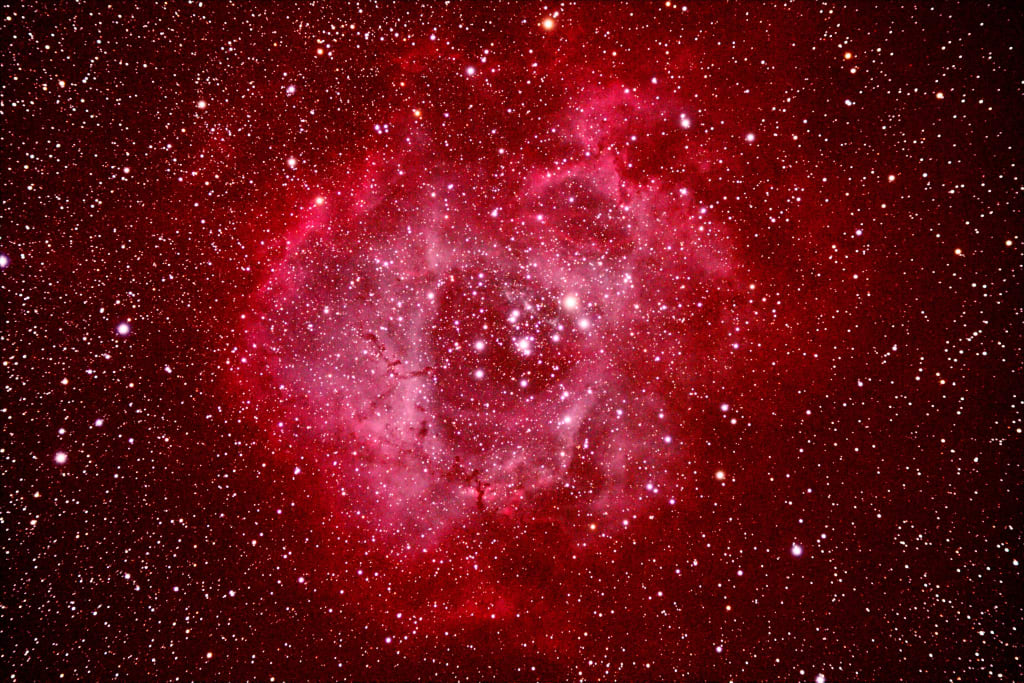
The universe never ceases to amaze us with its celestial wonders, and one such marvel is the Rosette Nebula. Located in the Monoceros constellation, this stunning emission nebula captivates astronomers and stargazers alike. With its intricate structures and vibrant hues, the Rosette Nebula offers a glimpse into the awe-inspiring complexity of our universe. In this article, we will delve into the captivating features, scientific significance, and the mysteries surrounding this fascinating cosmic phenomenon.
Unveiling the Rosette Nebula
Spanning approximately 130 light-years in diameter, the Rosette Nebula, also known as Caldwell 49, is a vast cloud of gas and dust. Situated about 5,000 light-years away from Earth, this stellar nursery is predominantly composed of hydrogen gas, with traces of other elements like oxygen, sulfur, and nitrogen. Its distinctive rose-like shape, from which it derives its name, is the result of the energetic radiation from a cluster of hot, young stars at its core, ionizing and illuminating the surrounding gas.
A Stellar Nursery
The Rosette Nebula is a hotbed of stellar birth and evolution. Deep within its nebulous expanse, young and massive stars are formed, their intense radiation sculpting the surrounding gas and dust into mesmerizing shapes. This celestial nursery harbors numerous protostars—contracting clouds of gas and dust on the verge of becoming stars—alongside young stellar objects. These nascent stars illuminate the nebula, creating its ethereal glow and intricate filamentary structures. The immense pressure and energy released by these stellar newborns trigger the creation of shockwaves and supersonic jets, further shaping the nebula's gorgeous features.
Scientific Significance
The Rosette Nebula serves as an invaluable laboratory for astronomers to study the intricacies of star formation and the dynamics of interstellar matter. Its proximity to Earth and its relatively young stellar population make it an ideal target for observational studies. Astronomers employ various instruments, such as telescopes and spectrographs, to analyze the nebula's emissions and gain insights into the physical processes at work.
Moreover, the Rosette Nebula houses a cluster of several hundred stars, designated NGC 2244, born from the same cloud of gas and dust. These stars offer a unique opportunity for astronomers to investigate stellar evolution and the impact of massive stars on their environment.
Mysteries and Future Exploration
Despite extensive research, the Rosette Nebula still holds many mysteries waiting to be unraveled. Scientists are particularly intrigued by the interaction between the young stars and the surrounding nebula, as well as the mechanisms that drive the formation of massive stars in such environments.
Future exploration missions, such as the James Webb Space Telescope (JWST), hold promise for unveiling new insights into the Rosette Nebula. The JWST's advanced instruments will allow scientists to observe the nebula in unprecedented detail, peering through the veil of dust and unveiling the secrets hidden within its intricate structures.
The cluster and nebula lie at a distance of 5,000 light-years from Earth and measure roughly 130 light years in diameter. The radiation from the young stars excites the atoms in the nebula, causing them to emit radiation themselves producing the emission nebula we see. The mass of the nebula is estimated to be around 10,000 solar masses.
Previously only 36 young stars had been discovered in NGC 2237, but the Chandra work has increased this sample to about 160 stars. The presence of several X-ray emitting stars around the pillars and the detection of an outflow — commonly associated with very young stars — originating from a dark area of the optical image indicates that star formation is continuing in NGC 2237 (the outflow and some of the pillars are labeled in a close-up view). By combining these results with earlier studies, the scientists conclude that the central cluster formed first, followed by expansion of the nebula, which triggered the formation of the neighboring clusters.
The Rosette Nebula stands as a testament to the immense beauty and complexity of the cosmos. Its stunning appearance and scientific significance make it a captivating subject for astronomers and stargazers alike. As our understanding of the universe deepens, the Rosette Nebula continues to inspire curiosity.
About the Creator
3 Harmless Habits That Once Caused Absolute Chaos
Most habits are comfortingly dull. You chew gum. You clap at events. You check your phone. You assume—reasonably—that these actions will not destabilize governments, bankrupt industries, or end lives. Society depends on this assumption. If every small habit carried catastrophic potential, we would never leave the house.
By Enoch Sagini6 days ago in History
Brosley Punch — The Strike That Shook Fate
Brosley was never taught how to throw a punch. He learned it the hard way—through hunger, through survival, through a childhood spent on a world that showed no mercy. Long before the universe would whisper his name in fear, Brosley was just a boy standing on cracked red stone, staring at a sky that never answered his questions.
By The best writer 4 days ago in History



Comments
There are no comments for this story
Be the first to respond and start the conversation.