
Revolt at the Edge of the World: María Angata’s Fight for Rapa Nui
In 1914, a spiritual leader rose against colonial rule on Easter Island. Her name was María Angata— and her rebellion shook the soul of a forgotten kingdom.

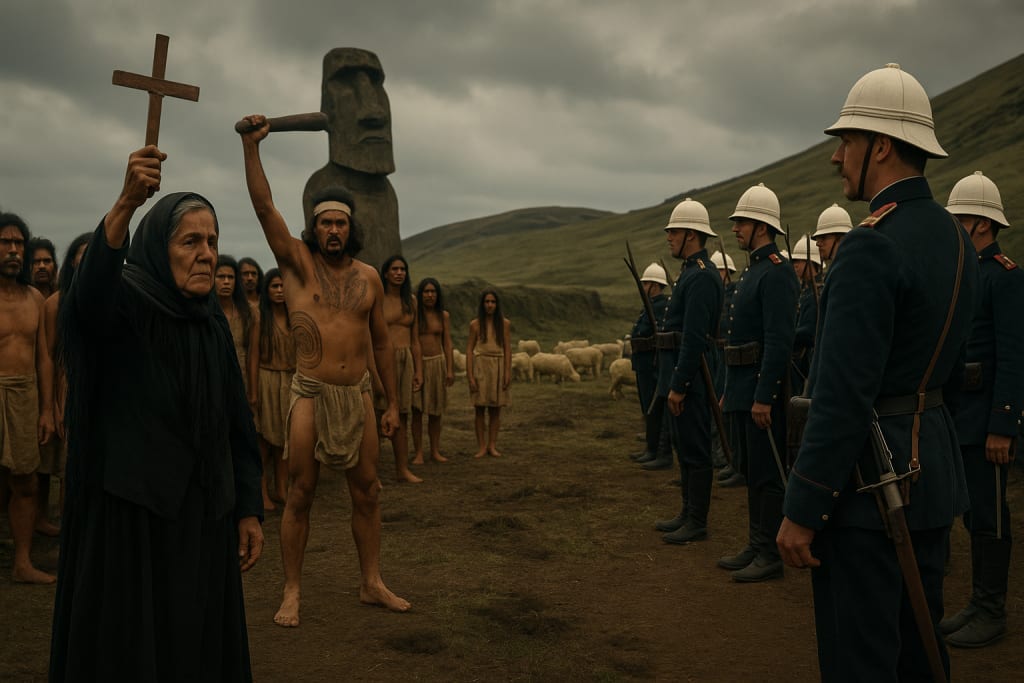
The sun had just begun to rise over the wind-blasted cliffs of Easter Island when the old woman appeared. Wrapped in a black shawl, she stood like a specter beside the ahu, the sacred stone platform where the ancestors once stood tall in volcanic silence. In her hand, she held a wooden cross. In her eyes, the fury of generations.
Below, villagers waited in reverent stillness. They had heard the dreams. They had felt the unease. Now the prophet was ready to speak.
“It is time,” María Angata said. “The land belongs to us—not to the sheep, not to the whites. God has commanded it.”
The wind tore across the plain, raking over fences and herded flocks, lifting the skirts of the watchers, and carrying her words like smoke into the high Pacific sky. A revolution had begun—not with bullets, but with belief.
From Kingdom to Captivity
For centuries, Rapa Nui had thrived in elegant isolation. Polynesian voyagers settled the island around 1200 CE, crafting a rich spiritual culture and carving the world-famous moai—monolithic statues that served as guardians of tribal lands and ancestors. They built terraced farms, fished the seas, and lived under the rule of ariki, divine chiefs descended from the first settler king, Hotu Matu‘a.
Then came the outsiders.
In the 1800s, European ships brought disease, missionaries, and slavery. In 1862, Peruvian slavers abducted hundreds of Rapanui, including nearly all literate men and elders. The survivors who returned brought smallpox. The population fell to just over a hundred. Culture, language, even the reading of rongorongo (Rapa Nui’s unique script) began to vanish.
In 1888, Chile annexed the island through a treaty signed under unclear circumstances. Not long after, the Chilean state leased the entire island to the Williamson-Balfour Company, a British-Chilean enterprise that turned Rapa Nui into a massive sheep ranch.
The Rapanui were herded into a single fenced village—Hanga Roa—surrounded by barbed wire and armed guards. They were forbidden from leaving without a pass. Ancient sites were fenced off. Access to fishing grounds and gardens was denied.
They were made strangers on their own land.
The Woman and the Wind
María Angata Veri Tahi was born during the twilight of the Rapanui monarchy. Though details of her early life are sparse, she was a devout Catholic, trained by French missionaries and one of the few women with status and education. Her mother, Maurata, was of chiefly blood—a direct link to the island’s sacred leadership.
Angata worked as a lay catechist, nursing the sick, leading prayers, and comforting the dying. But by 1914, her devotion took on a more radical tone. She claimed to have received visions—divine messages commanding her to reclaim the land from the company that had desecrated it.
She was not alone. Rapanui villagers, fed up with forced labor, starvation wages, and the inability to visit their own ancestors’ graves, began to follow her. She became a figure of resistance, wielding both religious and ancestral authority.
Together with her son-in-law, Daniel Maria Teave, and chief Enrique Ika, Angata formed a council that challenged the foreign administrator's authority. They demanded the return of land and flocks to Rapanui control.
Their demand was met with disdain.
The Flames of Revolt
By August 1914, the rebellion had begun in earnest. Angata’s followers began seizing sheep, herding them back into village enclosures. They refused to work for the company, defied curfews, and began preaching in the hills outside the fence.
This was not a military insurrection—it was a spiritual war. Angata had promised divine protection. Some believed she could command the weather. Others said she could call down sickness on the ranchers.
But it was the Chilean government that answered. A warship, the Baquedano, arrived from the mainland. Marines stormed the village. Shots were fired. The movement—ill-equipped and unarmed—was quickly crushed.
Several leaders were arrested and sent into exile. Daniel Maria Teave was among them.
Angata was not imprisoned, but her power was broken. By the end of 1914, she died—some say from illness, others from despair.
Between God and the Gun
The revolt was buried in official silence. Chilean administrators dismissed it as a “minor disturbance.” No formal investigation was held. No monument was built.
But the Rapanui remembered.
They remembered the fence that turned their island into a prison. The sacred caves desecrated by grazing animals. The prayers Angata whispered into the wind.
Her rebellion may have failed in the eyes of history books—but it lit the fire for decades of defiance.
Resistance Never Died
Even after Angata’s death, resistance continued—quiet, persistent, defiant. Islanders tore down fences. They stole sheep. They taught the language in secret. They revived songs and dances long forbidden.
In the 1950s, after increasing pressure, the Chilean government canceled the Williamson-Balfour lease and took direct control of the island. It wasn’t liberation—but it was a crack in the wall.
By the late 20th century, Rapanui activists began pushing for autonomy, cultural revival, and legal recognition of ancestral land rights. Today, debates continue over land ownership, identity, and the island’s future. But it all began with the voice of a woman who dared to dream aloud.
The Prophet of the Forgotten
There is no statue of María Angata beside the moai. Her name is not etched in bronze. Her grave is unmarked. And yet, her spirit remains among the windswept slopes of Rapa Nui.
She was a prophet, a mother, a rebel. She stood against empire with a cross in one hand and the weight of her ancestors in the other.
And when the wind howls across the island, rustling the grass where sheep once trampled sacred bones, you can still feel her presence.
Still calling.
Still dreaming.
Still defying.
References
Foerster, R. (2013) Strikes, insubordination, theft, and disobedience: Between the rebellion of Angata and Rapanui struggles for civil rights. ResearchGate. Available at: https://www.researchgate.net/publication/259564431_Strikes_insubordination_theft_and_disobedience_Between_the_rebellion_of_Angata_and_Rapanui_struggles_for_civil_rights (Accessed: 5 July 2025).
Popular Timelines (n.d.) Easter Island Timeline. Available at: https://populartimelines.com/timeline/Easter-Island/full (Accessed: 5 July 2025).
Young, J. (2020) Strikes and indigenous resistance on Rapa Nui. Academia.edu. Available at: https://www.academia.edu/5708646/Strikes_insubordination_theft_and_disobedience_Between_the_rebellion_of_Angata_and_Rapanui_struggles_for_civil_rights_Forms_of_indigenous_resistance_on_Rapa_Nui_1917_1936_ (Accessed: 5 July 2025).
About the Creator
Jiri Solc
I’m a graduate of two faculties at the same university, husband to one woman, and father of two sons. I live a quiet life now, in contrast to a once thrilling past. I wrestle with my thoughts and inner demons. I’m bored—so I write.
Can the United States Leave NATO?
Can the United States Leave NATO? What It Would Take—and What It Would Mean The North Atlantic Treaty Organization, commonly known as NATO, has been one of the most powerful military alliances in modern history. Since its creation in 1949, the United States has been NATO’s strongest member—militarily, financially, and politically. But in recent years, debates have grown louder about whether the U.S. should remain in the alliance. This raises a serious question: how could the United States be removed from NATO—or leave it—and what would that mean for the world?
By Wings of Time 8 days ago in History



Comments
There are no comments for this story
Be the first to respond and start the conversation.