
The Night Los Angeles Bombed the Sky: The Phantom Air Raid of 1942
In February 1942, Los Angeles unleashed a storm of gunfire into the night sky, believing it was under attack. But there was no enemy—only fear.

The Night Los Angeles Bombed the Sky
The first explosion rattled the windows of Jane Thompson’s house in the Hollywood Hills shortly after 3 a.m. She shot upright in bed, the last echoes of the air-raid siren still shivering through the canyon air. Her husband stood at the window, rigid, one hand clutching the curtain. The city outside didn’t sparkle the way it usually did. It looked like it was holding its breath.
Then, the sky lit up.
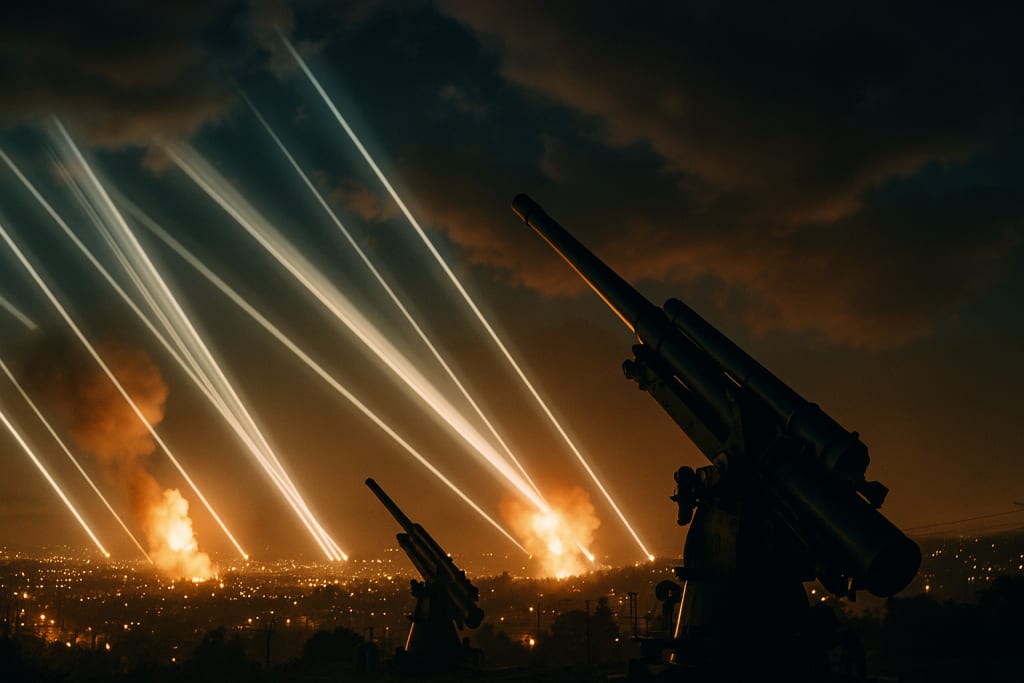
Searchlights slashed across the darkness in fevered arcs, their pale beams converging on invisible targets. Anti-aircraft fire erupted like thunder from the hills, bursts of orange and white flashing against the clouds. Jane thought she saw shapes up there—V-shaped wings, maybe, or silver dots gliding in eerie silence over the ocean. It was happening. The invasion they’d all feared since Pearl Harbor. The war had come to their front yard.
She ran to her children's bedroom and gathered them in her arms. The city around her was roaring. But the bombs never fell.
They never would.
February 1942: A Nation Wound Tight
The United States was still stunned from the attack on Pearl Harbor less than three months earlier. The West Coast had turned into a region of paranoia and tension. Air-raid drills were routine. Cities kept blackout curtains close at hand. Rumors of Japanese spies and saboteurs swirled like smoke.
Then, on the night of February 23, 1942, a Japanese submarine surfaced off the coast of Santa Barbara and shelled an oil refinery near Ellwood. It caused minimal damage—but maximum anxiety. If they could reach California with artillery, what would stop them from bombing Los Angeles?
Just two nights later, the answer seemed to arrive.
A Sky Full of Gunfire
At around 2:00 a.m. on February 25, radar operators detected what they believed to be enemy aircraft approaching the coast, about 120 miles out. Moments later, visual reports of flashing lights or flares offshore added to the alarm. Sirens screamed. Blackout orders were issued. Anti-aircraft crews manned their stations.
At 2:21 a.m., Los Angeles opened fire on... something.
Searchlights tracked movement in the sky. Coastal batteries roared. For the next hour, over 1,400 shells exploded in the night air. Tracer rounds drew burning arcs. Shell fragments rained down across residential streets. Civilians, watching from windows and rooftops, swore they saw planes—hundreds of them. Others claimed to see glowing orbs, silver disks, or even paratroopers descending over Culver City.
But there were no explosions. No enemy bombs. No fallen aircraft. Just shrapnel, broken windows, and rising panic.
By sunrise, the sky was clear. And so was the truth: no enemy had ever arrived.
The Invisible Invaders
Initial military reports claimed several aircraft had flown over the city but escaped unscathed. Yet as the smoke cleared, officials found no wreckage, no crash sites, no fuel leaks—nothing. The entire firefight had apparently been one-sided.
Within days, the military walked back its story. The Navy suggested it had been a false alarm. The Army claimed it might have been a weather balloon. Secretary of the Navy Frank Knox blamed "war nerves." Secretary of War Henry Stimson floated a theory about a possible Japanese reconnaissance mission—but even he admitted there was no evidence.
In 1983, a U.S. Air Force report concluded that the radar alert was a misreading. A single weather balloon, launched at the worst possible moment, may have reflected the searchlights and triggered mass confusion. Once the guns began firing, panic fed on itself. Crews likely mistook their own flak bursts for enemy movement and kept shooting.
Five Dead, No Enemy
The fallout was grim. Five civilians died—three in car accidents during the blackout, two from heart attacks likely triggered by fear. Dozens of buildings were damaged by shell fragments. The city’s air defenses had fired at least $500,000 worth of munitions into empty sky.
Newspapers roasted the military for its incompetence. The Los Angeles Times published a scathing editorial: “The only thing shot down last night was an inflated ego.” Public trust in coastal defense faltered, and rumors spread like wildfire.
Birth of a Legend
Among those rumors was the grainy black-and-white photograph that would later become infamous. In it, converging searchlight beams seem to illuminate a metallic disc—an image often cited by UFO enthusiasts. Though later analysis proved the photo was heavily retouched by editors to enhance contrast, it became central to early flying saucer lore.
Books, documentaries, and conspiracy theories took root. Hollywood embraced the tale, satirized in Steven Spielberg’s chaotic war comedy 1941 and reimagined in the sci-fi war film Battle: Los Angeles. For decades, people have speculated: Were there secret enemy aircraft? Experimental Nazi technology? Or visitors from another world?
But history remains clear on one point: no enemy planes were ever found.
A City at War With Its Shadow
The Battle of Los Angeles wasn’t really a battle. It was a collective hallucination—a city at war with its own anxiety. It revealed how easily fear could override reason, how quickly paranoia could turn the night sky into an enemy.
Yet, for the people who huddled in bathtubs or watched from rooftops, it was terrifyingly real. For the families who lost loved ones, it was a tragedy. And for the rest of the country, it was a warning: even in the absence of an enemy, war can find a way to arrive.
Sometimes, it just needs a little help from the imagination.
Sources
1. Harrison, S. From the Archives: The 1942 Battle of L.A. Los Angeles Times, Feb. 23, 2017. Available at: https://www.latimes.com/visuals/framework/la-me-fw-archives-1942-battle-la-20170221-story.html
2. “Did Enemy Aircraft Threaten Los Angeles During World War II?” HistoryNet, May 2018. Available at: https://www.historynet.com/the-battle-of-l-a/
3. Andrews, E. A. “World War II’s Bizarre ‘Battle of Los Angeles’.” History.com, Feb. 23, 2017. Available at: https://www.history.com/news/world-war-iis-bizarre-battle-of-los-angeles
4. “The Battle of Los Angeles: The Enemy Attack That Never Happened.” War History Online, May 2021. Available at: https://www.warhistoryonline.com/instant-articles/battle-of-los-angeles-the-attack-that-never-happened.html
About the Creator
Jiri Solc
I’m a graduate of two faculties at the same university, husband to one woman, and father of two sons. I live a quiet life now, in contrast to a once thrilling past. I wrestle with my thoughts and inner demons. I’m bored—so I write.
World War I
The morning fog lay thick over the trenches of northern France, clinging to the earth as if it too feared what was about to happen. Private Thomas Hale pulled his coat tighter around himself, though it did little to stop the cold from seeping into his bones. He had been in the trenches for six months, yet the damp smell of mud, smoke, and fear still felt unfamiliar, like a nightmare he could not wake from.
By Maavia tahir6 days ago in History
Chicago Hospital Held Newborn Baby for 8 Months Over an Unpaid Medical Bill
Debts were handled much differently in the 19th and early 20th century. Back then, people who accrued debt had more to fear than letters and calls from collection agencies the same way we do today, especially if they owed a hospital or doctor money.
By Criminal Matters7 days ago in History
How to Succeed at the Benson Directory®
Congratulations and welcome to the Benson Directory® employee #22391! As our newest call handler, you will have the privilege of speaking with dozens of unique and interesting people on a daily basis as well as the opportunity to earn bonuses for high performance. Contained within this handbook you will find a set of ease to follow instructions designed to help you settle in to your new role and begin paving the way to success.
By S. A. Crawford2 days ago in Fiction



Comments
There are no comments for this story
Be the first to respond and start the conversation.