
“Resonances of Terror: The Catastrophe of the Nanjing Massacre”
The Nanjing Massacre, also referred to as the Rape of Nanjing, remains one of the most distressing chapters of mass violence in human history. Taking place over a six-week period commencing in December 1937, when Japanese forces seized control of the Chinese capital of Nanjing during the Second Sino-Japanese War, this tragedy led to the deaths of an estimated 200,000 to 300,000 civilians and unarmed military personnel. This article examines the events leading up to the massacre, the horrifying actions carried out, and the global response. It also contemplates the enduring wounds it inflicted on Chinese collective memory and global history.

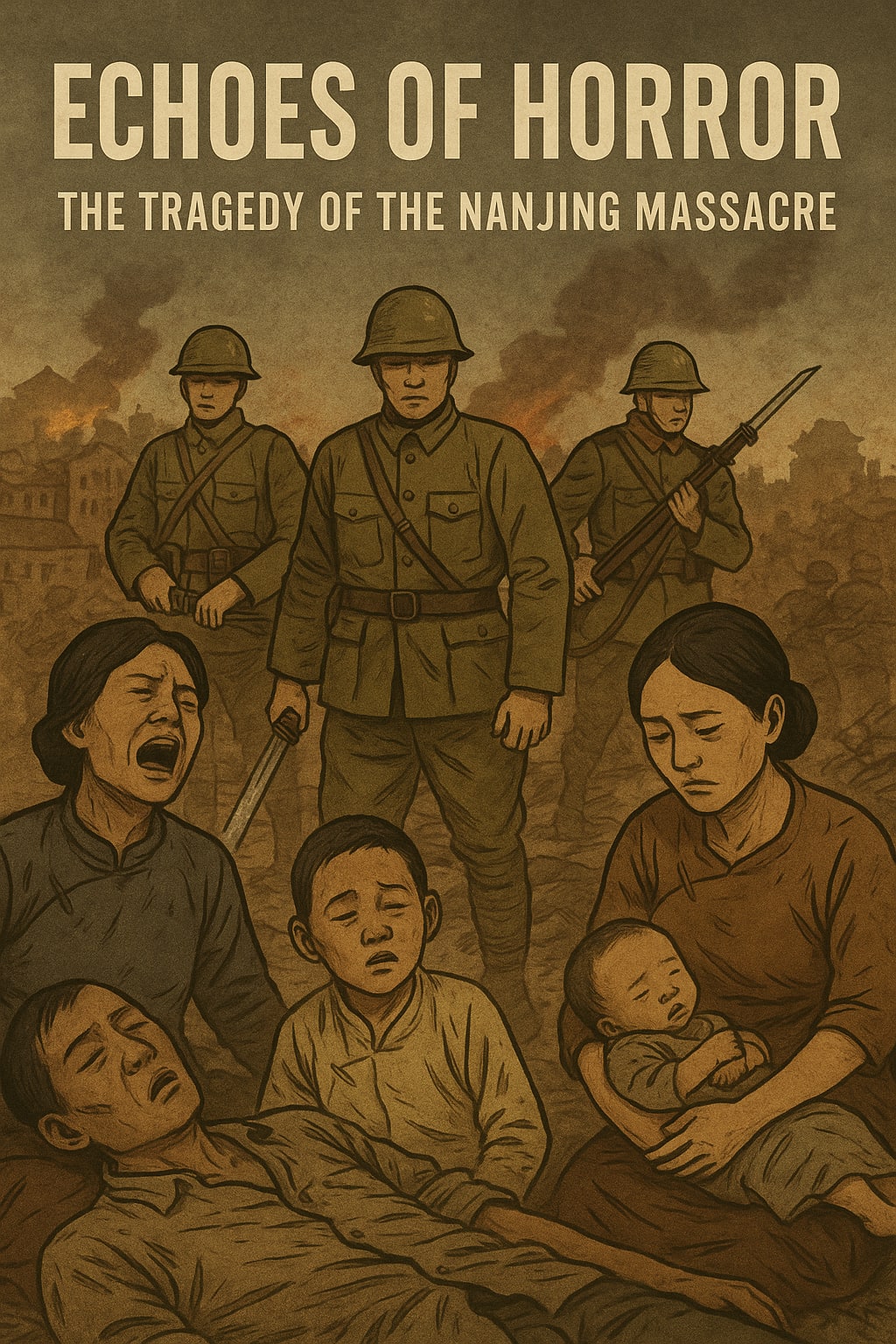
apanese forces entered Nanjing on December 13, 1937, it signified the onset of one of history’s bleakest and most savage massacres. Over the course of approximately six weeks, the ancient Chinese city endured incomprehensible violence, leaving a legacy of terror that continues to resonate in the hearts of millions today.
The Collapse of the Capital
Nanjing, once the capital of the Ming Dynasty and a symbol of Chinese culture, had transformed into the capital of the Republic of China in the early 20th century. As Japan initiated its aggressive campaign against China in 1937, Nanjing evolved into a primary military and symbolic target. The Battle of Shanghai had already exhausted Chinese resources, and by the time Japanese forces advanced toward Nanjing, resistance was fragmented.
On December 12, the Chinese military formally retreated. The following day, Japanese troops invaded the citywhat ensued was not a typical occupation, but a methodical massacre.
A City in Misery
Eyewitness testimonies depict the plunge into despair. Japanese soldiers initiated a terror campaign directed not only at the remaining Chinese troops but at the entire populace of the city. Civilians were rounded up by the thousands, executed en masse, and buried in shallow graves or discarded into the Yangtze River. Many were subjected to brutal torture before their demise.
Historical assessments indicate that between 200,000 and 300,000 individuals were killed, although the precise number may never be ascertained due to the obliteration of records and the vast expanse of the atrocity.
Atrocities Against Humanity
The Rape of Nanjing is not solely denoted for the killings. During the massacre, an estimated 20,000 to 80,000 women were assaultedsome as young as 8 years old, others were elderly. Numerous victims were mutilated, tortured, and subsequently murdered. Pregnant women were also among those targeted. Entire families were executed while being compelled to witness the suffering of one another.
Children were not exempt from the brutality. Infants were hurled into the air and impaled on bayonets as a form of amusement. Historical photographs and survivor accounts reveal a reality of unfathomable cruelty.
The World Observes
Westerners residing in Nanjing at the timemissionaries, businesspersons, and diplomatssought to intervene. A German businessman and member of the Nazi party, John Rabe, played a crucial role in establishing the Nanjing Safety Zone, which offered refuge to thousands of civilians. While these initiatives salvaged numerous lives, the atrocities persisted just beyond the confines of the safety zone.
News of the slaughter ultimately reached the globe through reports by correspondents and correspondence dispatched by observers. Despite the accumulating proof, international reaction was tepid due to the escalating global tensions that would shortly ignite into World War II.
Justice Delayed
Following World War II, the International Military Tribunal for the Far East and the Nanjing War Crimes Tribunal prosecuted and sentenced several Japanese officials for war offenses, including those perpetrated in Nanjing. General Iwane Matsui, who directed the forces during the massacre, was convicted and executed. Nevertheless, numerous offenders were never held accountable.
To this day, Japan’s formal recognition of the massacre persists as a subject of political discord. While certain Japanese leaders have rendered apologies, others refute or minimize the event, creating ongoing friction in Sino-Japanese relations.
The Legacy of Suffering
The Nanjing Massacre is not solely a Chinese catastrophe but a universal one. It stands as a stark reminder of the depths to which humanity can descend when unchecked militarism, racism, and imperial ambition converge. For China, Nanjing evolved into a symbol of resilience, remembrance, and the significance of historical accuracy.
Memorials, such as the Nanjing Massacre Memorial Hall, have been established to ensure that the voices of the victims are forever honored. Each year, December 13 is designated as National Memorial Day in China, observed with silence, contemplation, and a call for peace.
Conclusion
The Nanjing Massacre was not an incidental consequence of warfare, but a calculated campaign of terror. It remains one of the largest and most savage massacres in contemporary history. Its legacy continues to influence international relations, historical consciousness, and the ongoing effort to ensure that such atrocities are never repeated.
History must not only be remembered but also addressed. In witnessing tragedies like Nanjing, we are reminded of our collective responsibility to protect humanity from itself.
About the Creator
Say the truth
"Say the Truth: Explain Everything in the World" is your trusted source for uncovering facts and exploring the wonders of history, science, technology, and beyond. We simplify complex ideas and reveal truths to inspire curiosity .
Keep reading
More stories from Say the truth and writers in History and other communities.
Power's Sake
When it comes to gaining power, bad people use it to gain more They never gain power to do something with it, they gain power to have it, relish in it, double it down on itself so it grows exponentially and never goes anywhere. Even if you see the people in power commit an atrocity, that is never the true goal. It is a deplorable action for sure but the action itself usually doesn't matter it's the outcome.
By Donny Foley5 days ago in History
How Case Documents Are Maintained in Philadelphia County
Case documentation forms the backbone of judicial accountability in Philadelphia County. Every filing, order, transcript, and judgment plays a defined role in preserving procedural accuracy and historical reference. The methods used to preserve these materials reflect long-standing legal standards combined with structured administrative practice. This article explains how case documents are created, organized, stored, reviewed, and preserved within Philadelphia County, with a clear focus on factual processes rather than commentary or promotion.
By Owen Perryabout 11 hours ago in History



Comments
There are no comments for this story
Be the first to respond and start the conversation.