
Remembering Challenger Commander Dick Scobee (Part 2: Sky Challenger)
The second installment in the biography of Dick Scobee, Commander of Space Shuttle Challenger.


Please See Part 1 of This Story:
Astronaut Selection and NASA Life
With the blessings of his wife and both of his children, Dick Scobee mailed in his application to NASA's new space shuttle program. A call came a few weeks thereafter, inviting him to Brooks Air Force Base in San Antonio for a medical exam and other tests. Another call followed, summoning him to Houston to be interviewed by a panel. As part of his assignment, Dick was asked to write a few sentences as to why he wanted to be an astronaut. He penned the following proposal:
Why do I want to be an astronaut? Probably my most compelling reasons for wanting to become an astronaut are the desire to extend and use the engineering and test pilot experience I've gained, to hopefully aid the success of the space program, and for my own satisfaction in realizing a very longstanding personal ambition. I thoroughly enjoy being a test pilot and performing flight-related tasks, and the astronaut program is, to me, a logical extension of that function into new frontiers.

He went onto emphasize his belief in manned space exploration as a means of satisfying a "basic need of mankind to explore and probe the unknown." It was his desire to simply "be an integral part of that exploration."
NASA official, George Abbey, soon phoned Dick Scobee with an exciting question: "Are you still interested in the job at NASA?"
Dick was one of 35 chosen from more than 8,000 applicants. News quickly spread around Edwards Air Force Base where he worked. He was met with mostly genuine congratulations, though there was the odd colleague here and there who seemed surprised or told him he was "just lucky." Still, nothing dampened his spirits.
Dick's immediate family was especially delighted, and drove two cars from California to Houston that summer of 1978 and bought a modest Texas-style home in Clear Lake City, a Houston suburb adjacent to the Johnson Space Center that has long been home to many NASA astronauts during their careers in the space program.
Dick Scobee's astronaut class was the first selected by NASA in over a decade. The class would not only be the first selected specifically for the space shuttle program, but also included the first women and minorities. Several would go on to become household names with perhaps the most famous of all being Sally Ride, first American woman in space. They named themselves the "Thirty-Five New Guys," or the "TFNG" for short.

They were a close-knit group, and immediately bonded during their first year of astronaut training. They were divided into two teams -- red and blue -- for classroom training, flight training, and other activities. Dick Scobee's leadership qualities were instantly recognized by his classmates, as they appointed him as the designated leader of the blue team.
All 35 trainees wore t-shirts in their team color with a "TFNG" symbol on the front designed by classmate (and later Challenger crewmate) Judy Resnik. The emblem depicted the orbiter in space with the cargo bay open and 35 cartoon figures working and hanging all over the vehicle.
Flying and Education: A Family Affair
Meanwhile, flying was quickly becoming a family affair in the Scobee household. Dick, along with a fellow astronaut, bought an experimental aircraft called a Starduster II. He and June regularly visited the Hangar so that he could tweak the engine while his wife cleaned and polished the exterior.
Dick also taught his wife the basics of flying and acrobatics, while their son, Rich, who had been building a life-sized Burt Rutan plane with his father prior to their move to NASA, also caught the flying bug.
Rich Scobee not only had an interest in following in his father's footsteps and getting a pilots' license, but also in joining an aerobatics competition team. He went on to become quite an expert, and won trophies regularly. Daughter Kathie never quite took to flying like her parents and brother and instead elected to devote her energies to creative writing with aspirations to study journalism in college.
June Scobee, during this time, was wrapped up in educational aspirations of her own. Having realized her lifelong dream of becoming a teacher, she was now working towards her PhD in education. After a year, however, she began to wonder if her attempts to balance education and family life were a mistake. Sensing she was failing as a wife and mother, June began to write a letter of resignation to her major professor at Texas A&M University, where she was pursuing her doctorate.
Son Rich, however, would hear nothing of it and presented her with a present wrapped in brown paper and string. June opened it to find a long block of polished wood, and turned it over to reveal a name plate bearing the inscription, Dr. June Scobee. "You can't quit now, or it won't come true," Rich declared (the rest of the family had been saving the gift for when she graduated which, after prodding from her devoted husband and children, took place May of 1983).
Chase Team: Scobee's First Real-Life Shuttle Experience
As Dick and his classmates completed their first year of astronaut training, the inaugural flight of the space shuttle, designated as STS-1, took place April of 1981. It was commanded by veteran astronaut John Young with Bob Crippen as his pilot.
Dick Scobee and most of his class of 35 watched from the Cape Canaveral launch site. However, according to Sally Ride, who had not yet launched into history, they were more than mere spectators. They had a special assignment as part of the STS-1 "chase team." Ride recalled the experience in a NASA Oral History report in 2002:
"Everybody was part of the chase crew on STS-1!" she exclaimed. "Yes, I was with Dick Scobee. He and I were paired in a T-38 chasing at the Cape. IF STS-1 had to come back and land at the cape on RTLS [Return to Launch Site], we would have been one of the chase planes following them in."
Instead of following STS-1 down the runway, at Kennedy Space Center, they watched the shuttle fly off the pad from about 18,000 feet in the air in their T-38. Dick later described it as a "very interesting view," but admitted to preferring the riveting sensations of observing from the ground.

Scobee Flies the Shuttle Carrier
In 1982, Dick began training to fly the NASA 747 Shuttle Carrier Aircraft (SCA) that would ferry the orbiter cross-country, from Edwards Air Force Base to Kennedy Space Center.
In May of the following year, Dick, along with others, flew the SCA with the NASA prototype, Enterprise, on top. They made trips across the country, as well as to Europe, which included the Paris Air show.
"I actually flew the plane around the periphery of Paris," he reminisced to his wife at a French cafe following his assignment. "We did it. It was unbelievable! We took the plane over the city circling around the Eiffel Tower and Notre Dame. The view was spectacular! What an amazing opportunity!"
When June inquired as to whether it occurred to him that he and his crew were making history, Dick, as usual, responded as a humble but consummate professional: "No, I just didn't want to screw up," he said. "The responsibility was demanding. All I could do was focus on the flight pattern."

It definitely occurred to those watching down below, however. Countless onlookers in shops and cafes spoke at great lengths, with one hand over the other to gesture the orbiter riding piggyback on the SCA, some even gesturing toward the heavens with their arms outstretched.
These types of assignments would become somewhat commonplace for the little boy from Cle Elum, Washington whose aeronautical dreams began with playing on an airplane-shaped swing that hung from a cherry tree in his family's backyard. He was now considered the best of the 15 pilots from NASA's 1978 intake. Old guard astronauts Alan Bean and John Young, as well as flight operations director George Abbey, saw a rare talent in Dick Scobee despite not being the youngest or of the fighter jock pedigree.
Dick Scobee's First Shuttle Mission
NASA's second space orbiter, Challenger, arrived at Kennedy Space Center in July of 1982. Dick served as co-pilot of the SCA that delivered her. He also served as capsule communicator (CAPCOM) during the launch of her maiden voyage, STS-6, in April of 1983.
Above: On June 18, 1983, Dick Scobee spoke with news anchor, Jane Pauley, about Sally Ride and STS-7, the 2nd flight of Challenger. He also spoke briefly about his own NASA career, emphasizing that part of the apprehension associated with a space mission is not only the risks involved but also not wanting to fail. "You don't want to fail yourself or the program or anything else," he said.
Dick's own chance to fly the shuttle would come in April of 1984. He would be the pilot of Challenger, second in command to Bob Crippen, the aforementioned first pilot of the shuttle who was by then commanding his second flight.

The objective of the mission was to rendezvous in orbit with the Solar Max satellite. It was to be the first direct ascent trajectory into orbit for a shuttle mission. It was an important and risky mission, as it involved leaving the orbiter to perform a spacewalk in the untethered Manned Maneuvering Unit (MMU) to repair the satellite. Mission specialist George "Pinky" Nelson was to be the spacewalker.
As the 13th flight scheduled for the shuttle, the mission was originally designated as STS-13. NASA, however, changed their mission numbering system, evidently out of superstitions surrounding the number plus the memory of the near-disastrous Apollo-13 mission. As a result, Scobee's flight would instead become STS-41C. The first number stood for the last digit of the flight's scheduled fiscal year, the second for the launch site ("1" for Cape Canaveral, "2" for Vanderberg Air Force Base in California which was never used), and the letter designating the planned launch order (though flights seldom went in their planned order).

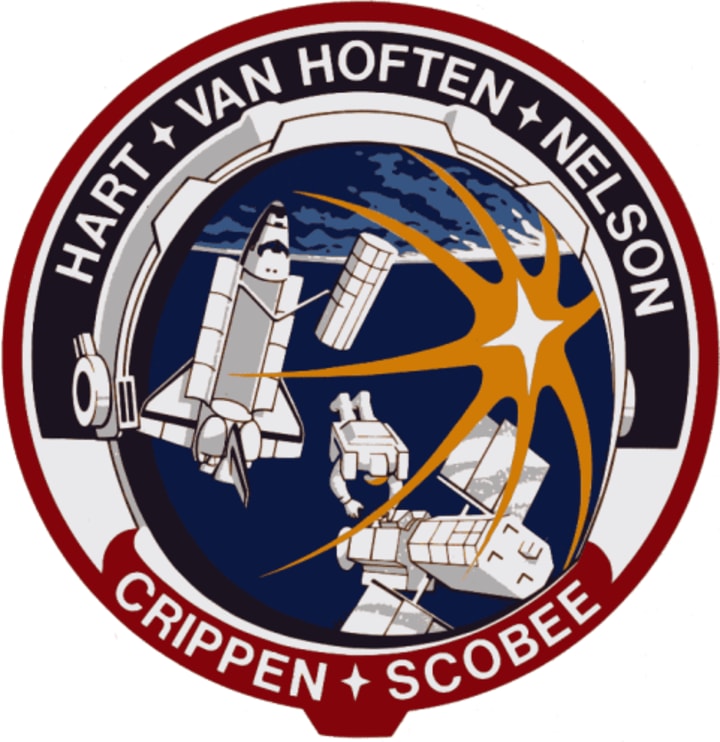
Dick Scobee and his crew could not have cared less about the number, however. In fact, to show they were not the least bit intimidated or superstitious, they created an alternate crew patch for their mission depicting a black cat with the number "13" superimposed over its body. They also distinguished themselves with t-shirts depicting "Men at Work" and hard hats to represent their satellite repair assignment.
STS-41C was one busy mission, and the most complex and challenging ever flown as of that date. The extensive checklist included the following:
- Deploying the Long Duration Exposure Facility (LDEF), a 12-sided cylinder of about 30 feet long that carried 5 experiments by researchers in 8 countries. It would be retrieved on a later flight.
- The first and foremost objective of capturing, repairing, and re-deploying the Solar Max satellite that was launched in 1980.
- Administering a student experiment with honeybees to see how they make honeycomb cells in a microgravity environment.

The capturing of the Solar Max proved such a chore that it appeared for a while as thought he crew had not escaped the #13 curse, even though they were ultimately the 11th flight to launch. Pinky Nelson flew the MMU out to the satellite and attempted to grasp it as planned, but after three attempts, the Solar Max began tumbling on multiple axes. Disappointed and anxious, Commander Crippen called off the effort.
NASA's Goddard Space Center proceeded to take control of the Solar Max during the night by sending commands to stabilize its tumbling into a slow, regular spin. With the spacewalk effort proven futile, Dick along with Commander Crippen maneuvered Challenger back to the Solar Max so that fellow mission specialist TJ Hart could grasp it with the shuttle's robotic arm and place it in the cradle of the orbiter's payload bay.

Pinky Nelson, along with third mission specialist Jim "Ox" van Hoften, then repaired the broken satellite and deployed it back into orbit. Still a mechanic at heart, Dick insisted that the crew wear signs bearing the phrase "Ace Satellite Repair Co." for a photo opportunity. They also documented bits and pieces of their journey with a big IMAX camera to help create the IMAX film, The Dream is Alive.
The crew landed at Edwards Air Force Base after completing the 7-day mission after bad weather derailed the originally planned landing at the Cape.
Once home in Houston, Dick opted to surpass the barrage of reporters gathered outside of his house and slip away with June to their favorite restaurant on the lake; he wanted his wife to be the first to know about his adventure.

He spoke of eating and sleeping in zero gravity, watching the honeybees, and the metallic noises from the orbiter. And though his feet, by now, were firmly on the ground, his mind was -- at least partially -- still among the stars. The couple took a selfie (before selfies were a thing) to celebrate the occasion and Dick, not yet fully removed from the habit of weightless space life, simply let go of the camera instead of setting it down (it fell). According to his wife, he also kept tucking his napkin underneath his dinner plate, afraid it might float away.
Though June was mesmerized by Dick's enthusiasm, she remained curious about one thing: was he at all angered when President Reagan called the crew to congratulate them and mentioned every crew member's name but his? Dick insisted that he wasn't in the slightest. "What was important was the mission," he said. "We got the job done! That's all that mattered. We had a great mission."
Above: The post-flight press conference for STS-41C with video footage of mission highlights. In the beginning, Dick Scobee likens the early stages of the launch to a "rough railroad track," perhaps as a nod to his railroad engineer father.
What Dick Scobee had accomplished was any pilot's dream. Though to him, his biggest accomplishment of all was his family. When his daughter, Kathie, graduated from college that summer, her university's president invited Dick to give the commencement speech. Although Dick had never been one to seek out speaking engagements, his soft spot for his daughter prompted him to make an exception. Kathie had graduated with a degree in English and journalism and Dick, naturally, was impressed by her "tremendous talent" for writing.
Dick was equally enthralled with the endeavors of his son Rich, a budding pilot himself who by then was in his second year in the Air Force Academy. "Son, you're a great pilot," he told him. "Your instincts are good. You're already a better pilot than I'll ever be."
About the Creator
Liesl Grunewald
6G NOLA Native . Dancer, Diver, & Martial Artist for life . Aspiring athletics & movement polymath . Creative techie . Slightly reformed neurotic.
Keep reading
More stories from Liesl Grunewald and writers in History and other communities.
Remembering Challenger Commander Dick Scobee (Part 1: From "Swift Water" to Starlifters)
Introduction From twisting wrenches to flying the space shuttle... it seems an unlikely feat. But for Challenger commander, Dick Scobee, it was something he seemed destined for, even if those who knew him best never saw it coming.
By Liesl Grunewald2 months ago in History
The Tidewater Creole People
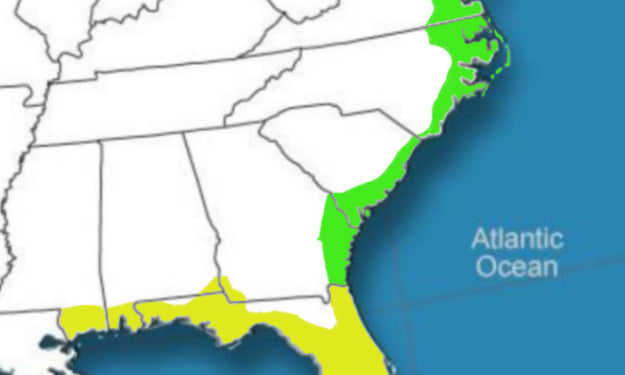
The Tidewater Creole people are descendants of early Black communities of the Tidewater Region from the 1620s and onwards into the future in coastal Virginia, the Carolina Coast, coastal Georgia, coastal Maryland and Delaware, and the Southern New Jersey Shore.
By Gracebelle White3 days ago in History



Comments
There are no comments for this story
Be the first to respond and start the conversation.