
Remembering Challenger Commander Dick Scobee (Part 1: From "Swift Water" to Starlifters)
A biography of Dick Scobee, commander of Space Shuttle Challenger


Introduction
From twisting wrenches to flying the space shuttle... it seems an unlikely feat. But for Challenger commander, Dick Scobee, it was something he seemed destined for, even if those who knew him best never saw it coming.
From the time Dick Scobee could talk, airplanes fascinated him. And rather than prove a fleeting phase, his enchantment with planes and all things aviation carried on through high school and beyond.
While friends from his youth paint the picture of an ordinary boy from Auburn, Washington, Dick Scobee would go on to show the world -- albeit quietly -- that he was a man on a mission.
Dick Scobee's story is one of humility, true grit, and flying high. More than anything, however, the recurring theme can be found in the following adage circulating social media memes:
The things that excite you are not random.
They are connected to your purpose.
Follow them...
With that in mind, this is the first installment of the biography of space shuttle Commander Dick Scobee.
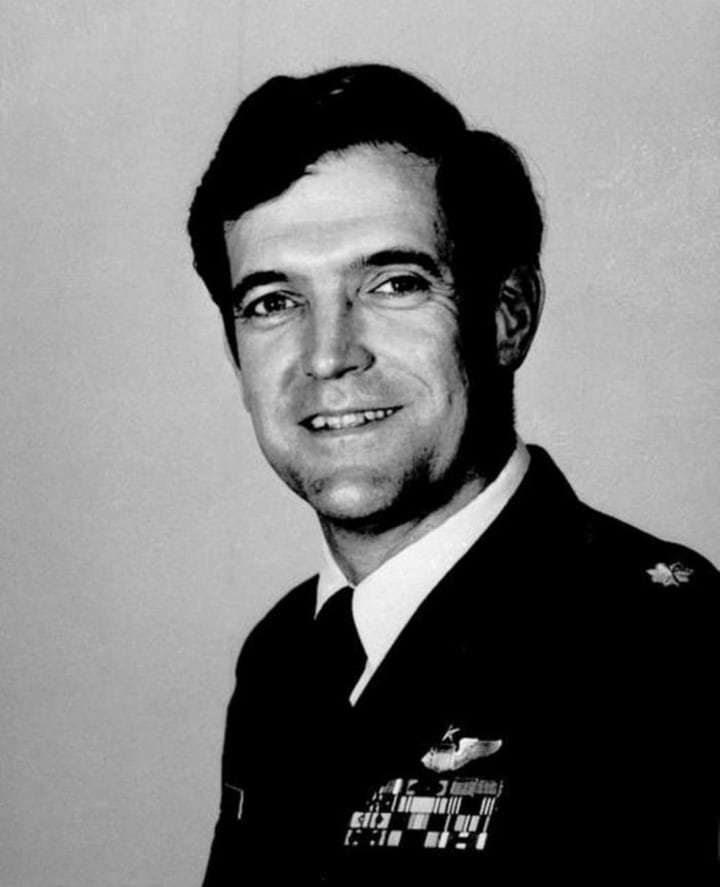
Early Life
Francis Richard ("Dick") Scobee was born May 19, 1939 in the heart of the Cascades, in Cle Elum, Washington. His father, Francis William ("Frank") Scobee, was an engineer and trainmaster for the Northern Pacific Railroad, and he and his wife Edlynn ("Eddie") raised their two sons in nearby Auburn, a small railroad town outside of Seattle.
Fun fact: "Cle Elum" means "swift water"
It was a comfortable and close-knit upbringing. The Scobee's lived in a modest two-story wood-framed house on Fourth Street. Young Dick often went fishing on the nearby Green River.
His devotion to his family was genuine. When Dick got his first job, he spent his very first paycheck on presents for his mother and brother.

By high school, Dick Scobee's days were typically consumed by playing football, running track, and picking beans in the field to buy school clothes (later, he worked as a bag boy at a Safeway Grocery). A near straight-A student, he took his studies seriously as well and spent whatever free time he had hanging out with friends at the Rainbow Cafe, a favorite local haunt.
Dick's biggest passion, by far, however, was aviation and the world of flight. It was a fascination he displayed almost as soon as he could talk -- according to his family, one of the first words he learned to speak was "airplane." And when he was just a toddler, he asked his mother for a toy wind-up version he saw in a Sears-Roebuck catalog.
Not long thereafter, at age three, Dick's aunt Tene gifted him a toy riding plane with pedals -- much like a tricycle -- for Christmas. It instantly became his favorite toy, and he rode it all around the family property until the wheels wore out.
Rather than dispose of the remaining plane structure, Dick's father hung it from a cherry tree in the family's backyard. His countless hours swinging in it gave him an even stronger euphoria that never diminished. Airplanes, coupled with the dream of flying the real thing, remained Dick's strongest motivation through his high school years. Often, he multi-tasked during class time as he sketched airplanes on his notebook paper while studying.
Building model airplanes of wood and plastic was more than just a hobby. Miniature spitfires, P-38's, and numerous other classes of aircraft hung from his bedroom ceiling. They were literally his labor of love. One aunt even recalled that despite young Dick's normally quiet and considerate nature, if you touched one of his model planes, "he had a fit."
Those who knew the childhood and adolescent Dick Scobee tend to echo two sentiments. The first is that he was good -- but never outstanding -- in all he did. The second was perseverance, which by all accounts was probably his most marked trait throughout his life.
According to his high school athletic coach, Dick was "not outstanding in any way except maybe his attitude, which was real great," he said. "He did not excel in athletics; he was kind of a big, slow kid. It would have been very easy to quit, but he never gave up.
His teachers remembered him similarly, as a good, "but not brilliant" student, who worked very hard."
Dick's high school friends, who described him as a social late bloomer (he never dated during his school years), never saw him as having any notable ambition to speak of. They assumed he would follow his father into the railroad business.
Though professional athletics or a life dedicated to academia may not have been his calling, Dick Scobee's subsequent accomplishments defy the perception that he was a young man of mediocre talent. And the reserved airman-to-be proved to be far more ambitious than his peers had initially believed. His perseverance, however, remained consistent.

College, Air Force, and Married Life
Dick Scobee's real -- if not widely known -- ambition was to attend a military academy after high school. His high school counselor told him, however, that he did not have what it took to apply to an academy (meaning he didn't know a senator who could personally recommend him). He took a job at Boeing Air Field until he could enlist in their Air Force. With a high score on the entrance exam, Dick was asked to go into intelligence but requested to be assigned closer to the airplanes. And so, he began his Air Force career as a mechanic, stationed at Kelly Air Force Base in San Antonio.
While in San Antonio, the nineteen-year-old Dick met sixteen-year-old Virginia "June" Kent at a hayride event at the Mayfield Baptist Church of which Kent and her family were members. June, it turned out, also had a lifelong interest in airplanes, along with rockets and space science, and the two bonded immediately. They were married at the church the following year. During their first Christmas together, they learned of Chuck Yeager breaking the sound barrier.
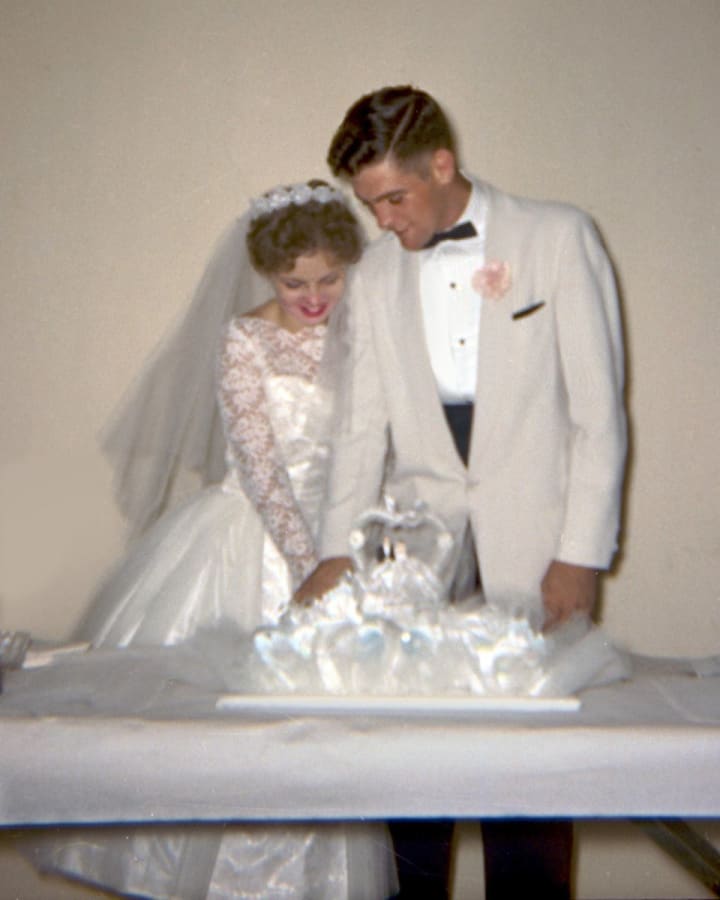
Both had the goal of going to college, and despite being struggling newlyweds, decided to invest whatever resources they could into making that happen. They enrolled in the local community college, and Dick -- seeking a more secure financial future for his family -- eventually doubled up on his coursework in night school. He also worked weekends, and then the night shift with the Air Force so that he could attend school full time during the day to take the courses not offered at night.
That January, of 1961, Dick and June welcomed their first child, a daughter, Kathie Renee.
Later that year, the United States became involved in the Bay of Pigs invasion and Dick became more and more immersed in his military duties. He was promoted to Seargent First Class.
During this time, President Kennedy made his famed announcement proposing the plan to land on the moon. Dick kept up with the historic space flights of Alan Shepard and John Glenn, and particularly admired Glenn's "serious candor."
Ever the family man, Dick continued to seek out ways to better the livelihood of his family but was still not ready to give up on his dream of flying. In pursuit of that long-elusive dream, he looked into two Air Force training programs. The first was Officer Candidate School (OCS), in which he would go through training and then be commissioned as an officer. The second, the Airman's Education and Conditioning Program & Air Force Institute of Technology (AFIT), would send him to a university to study and upon graduating from a technical field, send him for officer's training and commissioning.
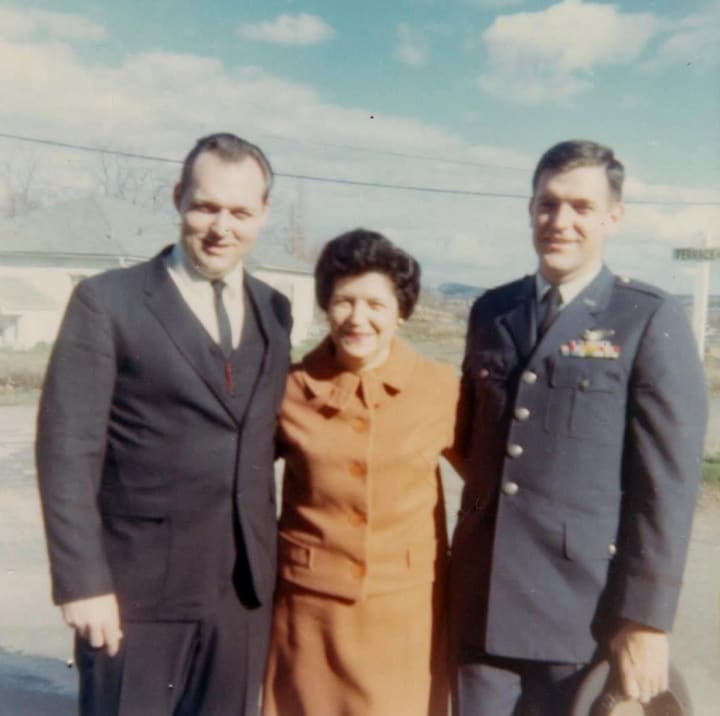
At the time, the US was in turmoil on the international front. The nation faced a major cold war with the Soviet Union, who were on record for having increased their support for Castro's regime in Cuba. President Kennedy made a major speech regarding the situation and announced that all military jobs were frozen. No one was allowed to retire after serving twenty years or after their four-year commitments.
That announcement solidified Dick's decision. Realizing that he was most likely in for a long career in the Air Force, he opted for-- and was selected for-- the AFIT program and was assigned to study at the University of Arizona in his first choice of major, which was aeronautical engineering.
Dick received a promotion to Seargeant the following summer. He worked extra diligently in his studies, sometimes sleeping on the living room sofa (so as not to disturb the rest of his family) with an alarm set for the middle of the night for extra hours of studying.
In the spring of 1964, Dick and June Scobee added to their family with the birth of a son, Richard William.
Dick graduated from college the following year. By this point, he'd held out very little hope that he would get to fly airplanes as had been his wish since infancy. But he was happy to resign himself to the role of Airplane Maintenance Officer.
Vietnam and NASA's Announcement
During his time in officer training school, Dick Scobee finally received the news he'd been awaiting his whole life: that the Air Force needed pilots. And better, that he qualified for flight training at Moody Air Force Base in Valdosta, Georgia.
He moved out to Georgia and quickly advanced through his series of assigned pilot instructors and aircraft, which included the T-34, T-37, and T-38. Dick graduated from pilot training in 1966 near the top of his class, and his superior performance gave him his choice of planes to fly, which included both fighter planes and cargo jets.
Dick decided to fly a newer aircraft, a C-141 jet called a Starlifter. He moved with his family once again for training, this time to Oklahoma, followed by an assignment at Charleston Air Force Base. In Charleston, Dick and June bought their first house, and Dick flew around the world on C-141 cargo missions.
A year-long assignment in Vietnam soon followed, during which Dick flew the C-7 Caribou, a short take-off and landing aircraft. During this assignment, Dick was stationed in Vung Tau, in the 535th tactical airlift squadron. His performance was superior, earning him promotion to the title of Captain, as well as such decorations as Distinguished Flying Cross, and the Air Medal, among others.
During Christmas, Dick Scobee and his crew painted the nose of their plane to resemble Rudolph the Red-Nosed Reindeer and flew across Vietnam delivering packages and food to troops in remote areas. Though risking his life to protect his squadron mates with his masterful handling of the unwieldly Caribou (designed to carry cargo, not orchestrate enemy fire) was valiant, Dick could only speak of the first-rate performance of his flight crew.
After arriving home safely the following April, Dick Scobee's next assignment was to fly a new aircraft, the giant C-5 Galaxy, which he flew all over Europe, Asia, and the Middle East. It was filled with cargo, equipment, and military personnel. Dick happened to be flying it back home during Neil Armstrong's "giant leap for mankind" upon the lunar surface, in the summer of 1969, which he celebrated with his family upon his return.
By the spring of 1970, Dick received the opportunity to attend the highly competitive Air Force Test Pilot School (AFPS) in the Muroc Desert out in California. He would be following in the footsteps of some of his idols; the likes of the aforementioned Chuck Yeager and Neil Armstrong had also flown there and set speed and altitude records.
Upon graduating from AFPS, Dick landed a job testing airplanes at Edwards Air Force Base. He flew a variety of experimental aircraft, exploring the limits of each one's altitude and speed as well as their wings, engines, and brakes. The job also involved writing reports and giving speeches on his test results.
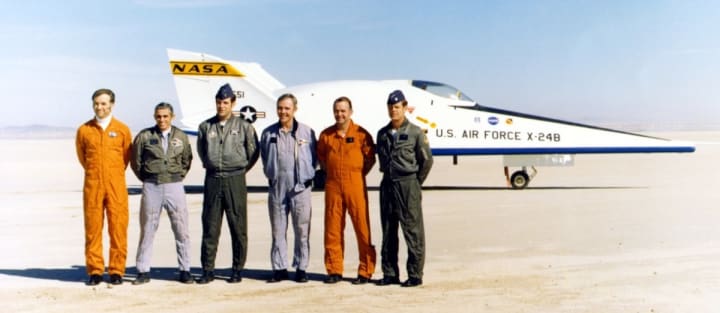
Dick Scobee went on to log over 6,500 hours of flight time in more than 45 types of aircraft. He was especially proud of his participation in the design team and test flight of the space shuttle carrier aircraft. His ultimate test flying experience by far, however, was being selected to fly the X-24B lifting body, the prototype for the space shuttle. Though Dick would never speak highly of himself, his fellow test pilots claimed that he flew it "flawlessly."
It was a testimony just in time for what he would find in the L.A. Times classified section not long thereafter: NASA was seeking astronauts for their new space shuttle program.
Please See Part 2 of This Story:
About the Creator
Liesl Grunewald
6G NOLA Native . Dancer, Diver, & Martial Artist for life . Aspiring athletics & movement polymath . Creative techie . Slightly reformed neurotic.
Keep reading
More stories from Liesl Grunewald and writers in History and other communities.
Several hundred residents of the village lived in the basement for a month
The city of Chernihiv was surrounded in the first days of the war, and it was liberated only in early April. The surrounding villages were even less fortunate — russian troops entered there on February 24. The village of Yahidne, located south of Chernihiv and 150 kilometres from Kyiv, was occupied in early March. About 400 local residents were taken prisoner, they sat for a month in the dark, cramped basement of a small local school. The occupiers looted homes, took away clothes, linen, and household appliances. Sometimes residents were allowed to leave the basement and cook some food on the fire. During the occupation, the Russians shot, according to various sources, 20 civilians. Journalist Ilya Kabachynskyi came to Yahidne to see the conditions in which the locals lived, talked to them about what was happening, and went down to the same basement where 11 people died.
By Ilya Baranov3 days ago in History


Comments
There are no comments for this story
Be the first to respond and start the conversation.