
Ravana: The King of Wisdom and Power
This artwork captures the essence of King Ravana, the legendary ruler of Lanka. Seated on a golden throne, adorned with royal attire and holding a veena, Ravana symbolizes a blend of knowledge, strength, and devotion. His ten heads reflect his mastery of the scriptures and unparalleled intellect. The background showcases the grandeur of his prosperous kingdom, emphasizing his legacy as a wise and powerful ruler. The image encapsulates the balance of Ravana’s divine devotion and earthly might, portraying him as a complex and multifaceted figure in history.

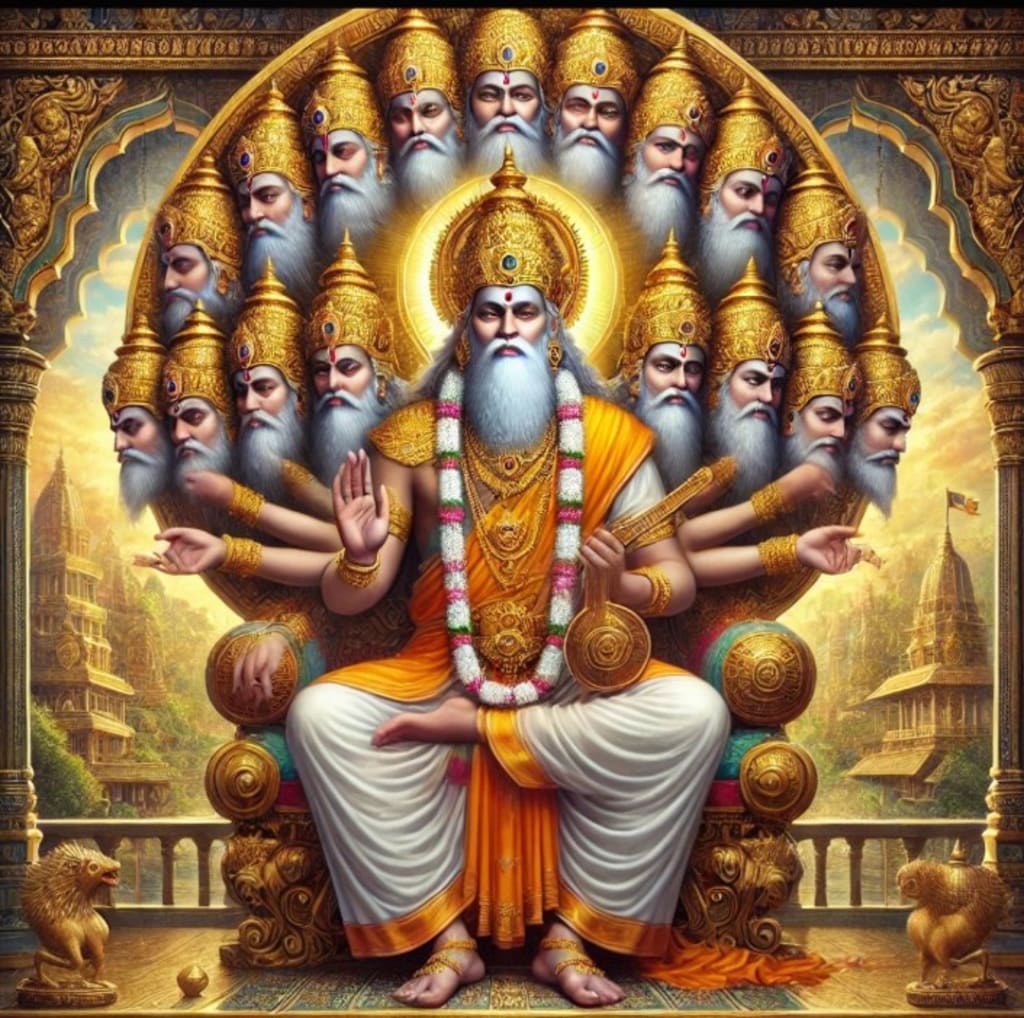
"Ravana: The Hidden Story of Sri Lanka’s Legendary King"
Introduction
King Ravana, a central figure in the Indian epic Ramayana, is often portrayed as the antagonist in the tale of Lord Rama. However, beyond his depiction as a demon king, Ravana is revered in many traditions for his unparalleled knowledge, wisdom, devotion, and governance. In Sri Lanka, Ravana is celebrated as a learned ruler, a master of arts and sciences, and a devoted follower of Lord Shiva. This article explores the hidden facets of Ravana's life, shedding light on his multifaceted personality and contributions.
Ravana’s Origins and Wisdom
Ravana was born to the sage Vishrava and the Rakshasa princess Kaikesi. His lineage combined the divine wisdom of sages and the physical might of Rakshasas, making him a unique figure in mythology. Named "Dashanana" for his ten heads, Ravana’s heads symbolized his vast intellect and mastery over the six shastras (scriptures) and four Vedas.
He was a polymath, excelling in fields such as Ayurveda, astrology, music, and architecture. Ravana is credited with authoring the Ravana Samhita, a treatise on astrology, and is believed to have advanced medical knowledge that he used to create life-saving potions and remedies.
The Rule of Lanka
Ravana ascended to the throne of Lanka, transforming it into a land of unparalleled prosperity. Under his rule, Lanka was a thriving kingdom with advanced architecture and infrastructure. The golden city of Lanka, described in the Ramayana, was a testament to his vision and leadership. It was said to be adorned with gold, jewels, and structures that defied the imagination.
Ravana was a just ruler who cared deeply for his people. He ensured that his subjects lived in harmony and that the kingdom flourished economically and culturally. His governance was marked by discipline and innovation, setting a standard for other rulers of his time.
Ravana’s Devotion to Lord Shiva
One of Ravana’s most defining characteristics was his unwavering devotion to Lord Shiva. Ravana is often depicted as a devout Shiva bhakta (devotee), and his acts of devotion are legendary.
According to mythology, Ravana composed the Shiva Tandava Stotram, a hymn that praises the glory of Lord Shiva. This composition reflects his deep spiritual understanding and poetic genius.
In one tale, Ravana attempted to lift Mount Kailash, the abode of Shiva, to demonstrate his strength and devotion. When Shiva pressed the mountain down with his toe, pinning Ravana beneath it, the king played his veena (a stringed instrument) and sang praises to Shiva. Pleased by his devotion, Shiva granted him the Chandrahas, a celestial sword, as a boon.
Ravana’s Love and Relationships
Ravana’s personal life was marked by love and complexity. He was a devoted family man, deeply caring for his siblings and children. His brother, Vibhishana, and sister, Surpanakha, played crucial roles in the events of the Ramayana.
Ravana’s love for his wife, Mandodari, was profound. Mandodari, known for her wisdom and virtue, often advised Ravana to avoid unnecessary conflict and adhere to dharma. Despite his flaws, Ravana’s respect and admiration for Mandodari highlight his human side, showing that he was not merely a tyrant but a man capable of great love and devotion.
The Abduction of Sita
The most controversial act associated with Ravana is the abduction of Sita, Lord Rama’s wife. While this act is central to his portrayal as the antagonist in the Ramayana, alternative interpretations suggest that Ravana’s actions were driven by complex motives, including familial loyalty and perceived injustice.
Ravana never harmed Sita during her captivity in Ashok Vatika, a gesture that some interpret as a sign of respect and adherence to a code of conduct. His treatment of Sita reflects the complexity of his character—a balance between arrogance and a sense of honor.
Ravana’s Downfall and Redemption
Ravana’s downfall was ultimately a result of his ego and refusal to heed wise counsel. Despite warnings from Mandodari, Vibhishana, and others, Ravana’s pride prevented him from releasing Sita and avoiding war with Lord Rama.
The epic battle between Rama and Ravana is one of the most celebrated episodes in the Ramayana. Despite his defeat, Ravana’s death is portrayed as a moment of redemption. Rama, recognizing Ravana’s greatness, instructed Lakshmana to learn statecraft and governance from the dying king. This act underscores the respect Ravana commanded, even from his adversaries.
Ravana’s Legacy in Sri Lanka
In Sri Lanka, Ravana is celebrated as a cultural hero. Folklore and traditions honor him as a symbol of knowledge, strength, and devotion. The Ravana Ella Falls, Ravana Cave, and other landmarks are associated with his legacy, attracting tourists and devotees alike.
Sri Lankan versions of the Ramayana often depict Ravana in a more sympathetic light, emphasizing his achievements and human qualities rather than his flaws. This perspective highlights the cultural significance of Ravana beyond the traditional narrative.
Lessons from Ravana’s Life
Ravana’s story is a tapestry of contradictions—wisdom and arrogance, devotion and ego, love and ambition. His life serves as a reminder of the complexities of human nature and the consequences of unchecked pride.
While Ravana is often remembered as a villain, his intellectual achievements, devotion to Shiva, and contributions to his kingdom offer a more nuanced perspective. His story encourages us to seek balance in life, value knowledge and wisdom, and recognize the power of humility.
Conclusion
King Ravana of Lanka is more than a character in mythology; he is a symbol of human potential and fallibility. His story, rich with lessons on governance, devotion, and the pitfalls of hubris, continues to inspire and intrigue. As a ruler, scholar, and devotee, Ravana’s legacy transcends the Ramayana, leaving an enduring mark on history and culture.
About the Creator
Say the truth
"Say the Truth: Explain Everything in the World" is your trusted source for uncovering facts and exploring the wonders of history, science, technology, and beyond. We simplify complex ideas and reveal truths to inspire curiosity .
Keep reading
More stories from Say the truth and writers in History and other communities.
The Maritime and Military Power of the Tamil Dynasties
"The Naval and Military Might of the Cholas, Pandyas, and Cheras" The Tamil dynasties of the Cholas, Pandyas, and Cheras were known not only for their cultural and architectural achievements but also for their exceptional military and naval capabilities. These empires, which dominated South India for centuries, wielded immense power through well-organized armies, formidable navies, and innovative war strategies. Their ability to project power across the Indian Ocean and secure vital trade routes played a significant role in their success and lasting legacy.
By Say the truth 12 months ago in History
Firoun: The Tyrant Who Defied God
Firoun, known to history as Pharaoh, was not just a king—he was a symbol of absolute power. He ruled over ancient Egypt at a time when the Nile flowed generously, the granaries were full, and massive stone monuments rose toward the sky. To his people, Firoun appeared invincible. To himself, he was more than human.
By The best writer a day ago in History


Comments
There are no comments for this story
Be the first to respond and start the conversation.