
If War Had Erupted Between Ashoka and the Three Kings of South India: An Alternate History Scenario
History remembers Emperor Ashoka the Great as a ruler who turned away from violence after the Kalinga War and chose the path of Dharma. Likewise, the three great South Indian kings—Chola, Chera, and Pandya— are remembered as independent, powerful, and culturally rich rulers.

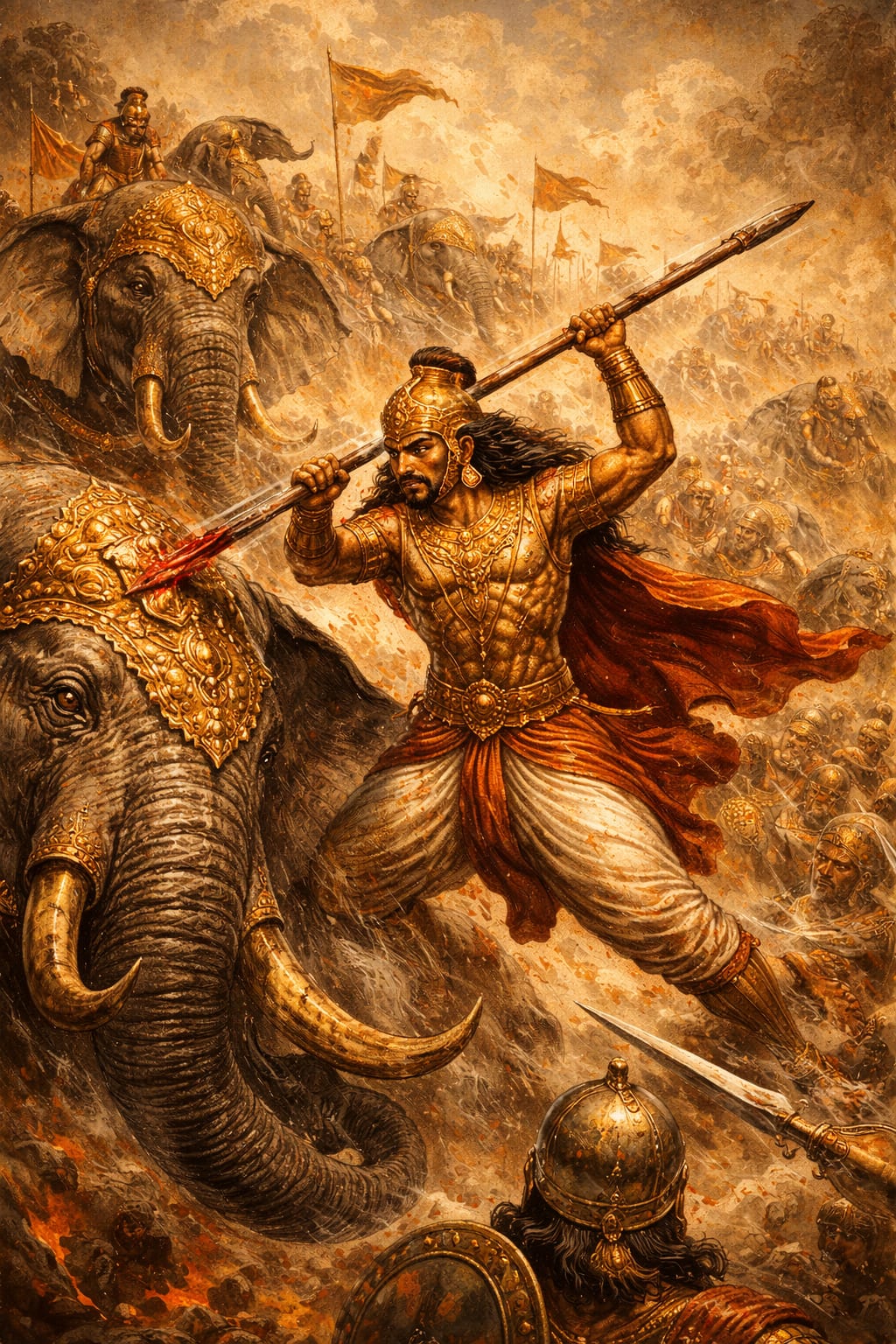
In reality, no direct war occurred between Ashoka and these southern kingdoms. But if circumstances had been different—if diplomacy had failed and war had erupted—the consequences would have been profound, reshaping Indian history in dramatic ways.
This article explores a hypothetical scenario: what might have happened if Ashoka had gone to war against the three southern kings.
The Causes That Could Have Triggered War
Several factors could have pushed Ashoka toward conflict:
Breakdown of diplomatic relations
Disruption of trade routes between North and South India
Rebellion in southern frontier regions
Pressure from Mauryan military commanders seeking expansion
Resistance to Ashoka’s moral policies or Buddhist missions
Had any of these escalated, Ashoka—still possessing one of the world’s largest armies—might have chosen military intervention.
Military Strength: Maurya vs Southern Kingdoms
Ashoka’s Mauryan Army was unmatched in scale:
Hundreds of thousands of infantry
Tens of thousands of cavalry
Thousands of war elephants
Advanced logistics and centralized command
The Southern Kings, however, had their own strengths:
Highly motivated regional armies
Expert knowledge of local terrain
Strong naval forces and coastal control
Guerrilla-style warfare tactics
Unlike the open plains of northern India, South India’s forests, rivers, hills, and monsoon climate would pose severe challenges to a Mauryan invasion.
Phase One: The Mauryan Advance South
If war began, Ashoka’s forces would likely advance past the Vindhya Mountains, securing central India before pushing into the Deccan plateau. Early Mauryan victories would be likely due to sheer numbers and disciplined formations.
However, supply lines would stretch dangerously long. Monsoon rains, tropical diseases, and unfamiliar terrain would slow progress. Southern armies would avoid direct confrontation, instead targeting Mauryan camps, supply convoys, and communication lines.
Phase Two: Resistance of the Three Kings
The Chola, Chera, and Pandya kings—though rivals among themselves—would likely form a temporary confederation against the common threat.
The Cholas would dominate river plains and fortify urban centers
The Cheras would use forest warfare and mountain ambushes
The Pandyas would control southern trade routes and ports
Their unity, even if temporary, would significantly increase resistance. The Mauryan elephants—so effective in northern warfare—would struggle in dense jungles and narrow passes.
Human Cost and Ashoka’s Inner Conflict
As battles intensified, casualties would rise sharply—among soldiers and civilians alike. Villages would be destroyed, agriculture disrupted, and temples and cities damaged.
For Ashoka, this would trigger a second moral crisis, possibly even deeper than Kalinga. Witnessing suffering once again, Ashoka’s commitment to Dharma might clash violently with imperial ambition.
At this point, Ashoka might:
Halt the campaign mid-way
Seek immediate peace talks
Replace generals who pushed aggressive strategies
Possible Outcomes of the War
Scenario 1: Mauryan Military Victory
If Ashoka persisted and won:
South India would come under Mauryan political control
Massive administrative challenges would follow
Frequent rebellions would weaken the empire
Ashoka’s moral legacy would be permanently damaged
Such an empire would likely fragment after Ashoka’s death.
Scenario 2: Stalemate and Treaty
More realistically, the war would end in a stalemate:
Neither side achieves complete dominance
A treaty recognizes southern autonomy
Trade routes are restored
Mauryan forces withdraw
This outcome would preserve southern independence while reinforcing Ashoka’s preference for peace.
Scenario 3: Strategic Withdrawal by Ashoka
Ashoka could choose to abandon the campaign:
Publicly renounce the war
Declare Dharma victory over conquest
Strengthen diplomatic ties instead
This would elevate Ashoka’s reputation as a moral ruler even further.
Long-Term Impact on Indian Civilization
A full-scale war would delay:
Cultural flowering of Sangam literature
Spread of Buddhism through peaceful means
Economic growth via maritime trade
South India’s unique identity might be altered under northern administration. Alternatively, resistance could strengthen southern unity earlier in history.
Why War Ultimately Did Not Happen

History wisely chose a different path. Ashoka understood that true conquest lies in harmony, not domination. The southern kings, equally wise, maintained independence without provoking aggression.
This mutual restraint preserved:
Cultural diversity
Political balance
Long-term stability across the subcontinent
Conclusion
If war had erupted between Ashoka and the three kings of South India, it would have been one of the largest and most destructive conflicts in ancient Indian history. Though Ashoka may have possessed the military power to conquer the south, the cost—human, moral, and political—would have been immense.
By choosing peace over war, Ashoka and the southern kings shaped a more stable, diverse, and culturally rich India. Sometimes, the greatest victories are the wars never fought.
About the Creator
Say the truth
"Say the Truth: Explain Everything in the World" is your trusted source for uncovering facts and exploring the wonders of history, science, technology, and beyond. We simplify complex ideas and reveal truths to inspire curiosity .
Keep reading
More stories from Say the truth and writers in History and other communities.
Ashoka and the Three Kings of South India: Power, Diplomacy, and Moral Conquest
Unlike his northern campaigns, Ashoka did not wage a full-scale war against these southern powers. Instead, his interaction with them reveals a unique blend of political realism, military restraint, and ideological influence.
By Say the truth about 2 hours ago in History
Cleopatra – The Last Queen of the Nile
Cleopatra VII Philopator, known to history simply as Cleopatra, was the last active ruler of the Ptolemaic Kingdom of Egypt. Her life was a dramatic blend of intelligence, ambition, political skill, love, war, and tragedy. She was not only a queen but a strategist who stood at the crossroads of two great civilizations—Egypt and Rome—during one of the most turbulent periods in ancient history. Cleopatra was born in 69 BCE in Alexandria, the shining capital of Egypt. Though she ruled Egypt, she was not ethnically Egyptian. She belonged to the Ptolemaic dynasty, a Greek royal family descended from Ptolemy I, one of Alexander the Great’s generals. For nearly three centuries, her family ruled Egypt after Alexander’s death. Yet unlike many of her ancestors, Cleopatra embraced Egyptian culture. She learned the Egyptian language—something rare among the Ptolemies—and presented herself as the living goddess Isis to her people. She was highly educated, speaking several languages, and was trained in philosophy, mathematics, and diplomacy. Cleopatra became queen in 51 BCE at the age of eighteen, co-ruling with her younger brother Ptolemy XIII, who was only ten years old. According to Egyptian tradition, she married her brother to solidify their joint rule. However, their relationship quickly turned into rivalry. Cleopatra was determined to rule independently, but powerful advisers around Ptolemy XIII pushed her aside. Soon, she was forced into exile from Egypt. But Cleopatra was not one to accept defeat. During her exile, she gathered an army and planned her return. Around this time, Rome was embroiled in civil war between Julius Caesar and Pompey the Great. When Pompey fled to Egypt seeking refuge, he was killed on Ptolemy XIII’s orders in an attempt to win Caesar’s favor. However, when Caesar arrived in Alexandria in 48 BCE, he was reportedly outraged by Pompey’s murder. Cleopatra saw opportunity in chaos. According to legend, she had herself secretly brought to Caesar wrapped in a carpet (or bed sack) so she could meet him privately. Whether the story is fully true or not, what is certain is that Cleopatra impressed Caesar with her intelligence, charm, and political vision. An alliance—and romance—soon followed. With Caesar’s military support, Cleopatra defeated her brother’s forces. Ptolemy XIII drowned in the Nile during the conflict. Cleopatra was restored to the throne, this time co-ruling with another younger brother, Ptolemy XIV. Soon after, she gave birth to a son, Ptolemy XV, known as Caesarion, whom she claimed was Julius Caesar’s child. Cleopatra later traveled to Rome and stayed there as Caesar’s guest. Her presence in Rome caused scandal and fascination. To some Romans, she was exotic and powerful; to others, she was a dangerous foreign queen influencing their leader. In 44 BCE, Julius Caesar was assassinated by Roman senators. Cleopatra quickly returned to Egypt, recognizing that Rome had once again become unstable. After Caesar’s death, a new power struggle erupted in Rome. Three men formed the Second Triumvirate: Octavian (Caesar’s adopted heir), Mark Antony, and Lepidus. Mark Antony eventually became ruler of Rome’s eastern territories, which included Egypt’s neighboring regions. In 41 BCE, Antony summoned Cleopatra to meet him in Tarsus. Cleopatra once again demonstrated her mastery of political theater. She arrived on a magnificent barge decorated in gold and purple sails, presenting herself as the goddess Isis. Antony was captivated. Their meeting marked the beginning of one of history’s most famous love affairs. But their relationship was not merely romantic—it was strategic. Antony needed Egypt’s wealth to fund his military campaigns, and Cleopatra needed Roman protection to secure her throne. They became partners in both love and politics. Cleopatra bore Antony three children. Together, they envisioned a powerful eastern empire centered in Alexandria. However, their alliance created tension in Rome. Octavian viewed Antony’s relationship with Cleopatra as a betrayal of Roman values. He portrayed Cleopatra as a seductive foreign queen who had bewitched Antony and turned him against Rome. Roman propaganda painted her as dangerous and manipulative. The conflict between Octavian and Antony eventually erupted into open war. In 31 BCE, their forces clashed in the naval Battle of Actium. Cleopatra’s fleet fought alongside Antony’s, but the battle ended in disaster. Facing defeat, Cleopatra withdrew her ships. Antony followed her, leaving his fleet to collapse. Octavian emerged victorious. After Actium, Octavian pursued them to Egypt. In 30 BCE, his forces invaded Alexandria. Antony, believing Cleopatra had betrayed him and thinking she was dead, took his own life. When Cleopatra realized Antony was truly dying, she had him brought to her mausoleum, where he died in her arms. Cleopatra knew her fate was sealed. Octavian intended to take her to Rome as a captive to parade in his triumph—a humiliation she could not accept. Determined to die as a queen rather than live as a prisoner, Cleopatra chose suicide. According to ancient accounts, she allowed herself to be bitten by an asp, a venomous snake, though some historians debate the exact method. Cleopatra died in 30 BCE at the age of thirty-nine. With her death, the Ptolemaic dynasty ended, and Egypt became a province of the Roman Empire. Octavian, who would later become Emperor Augustus, consolidated his power and ushered in the Roman Empire. Cleopatra’s legacy has endured for over two thousand years. Often remembered for her beauty and romances, she was far more than a seductress. She was a skilled diplomat, a brilliant linguist, and a capable ruler who fought to preserve Egypt’s independence in an age of Roman expansion. She managed a wealthy economy, stabilized her kingdom during famine, and maintained Egypt’s cultural identity. Her story is ultimately one of resistance against overwhelming odds. She lived in a world dominated by powerful men and empires, yet she carved her own place in history. Though her reign ended in defeat, her name never faded. Poets, playwrights, and historians—from Shakespeare to modern filmmakers—have retold her tale countless times. Cleopatra was the last queen of ancient Egypt, but she became something greater: a symbol of ambition, intelligence, love, and tragedy. In her rise and fall, we see the end of one world and the birth of another. Her death marked not just the loss of a queen, but the final chapter of a civilization that had thrived along the Nile for thousands of years. And so, Cleopatra remains immortal—not only as the last queen of Egypt, but as one of history’s most unforgettable figures.
By The best writer 4 days ago in History
The General’s Tooth
History is often told through the polished lens of oil paintings and marble statues. We see George Washington as the stoic father of a nation, his jaw set in a firm, resolute line. But in the winter of 1783, as the American Revolution neared its end, that jaw was a site of excruciating, rotting agony.
By LUNA EDITH3 days ago in History
🅼🅸🅳🅽🅸🅶🅷🆃 🆂🅽🅰🅲🅺🆂
"It's 10 in Tuscon! We all know what that means... It's Time for Midnight Snacks with your man, Gerald Gee! Ready to spend the night together? Me too! I'm full of snacks and can't wait to regurgitate them all back into your hungry ears. Crack a brew! Pop some corn! Anything to get ready for one hell of a show where the talk maybe cheap but the words cut deep...
By Lamar Wiggins3 days ago in Fiction


Comments
There are no comments for this story
Be the first to respond and start the conversation.