
Provide an account of the period known as the reign of terror.
Era of fear and oppression
Introduction:
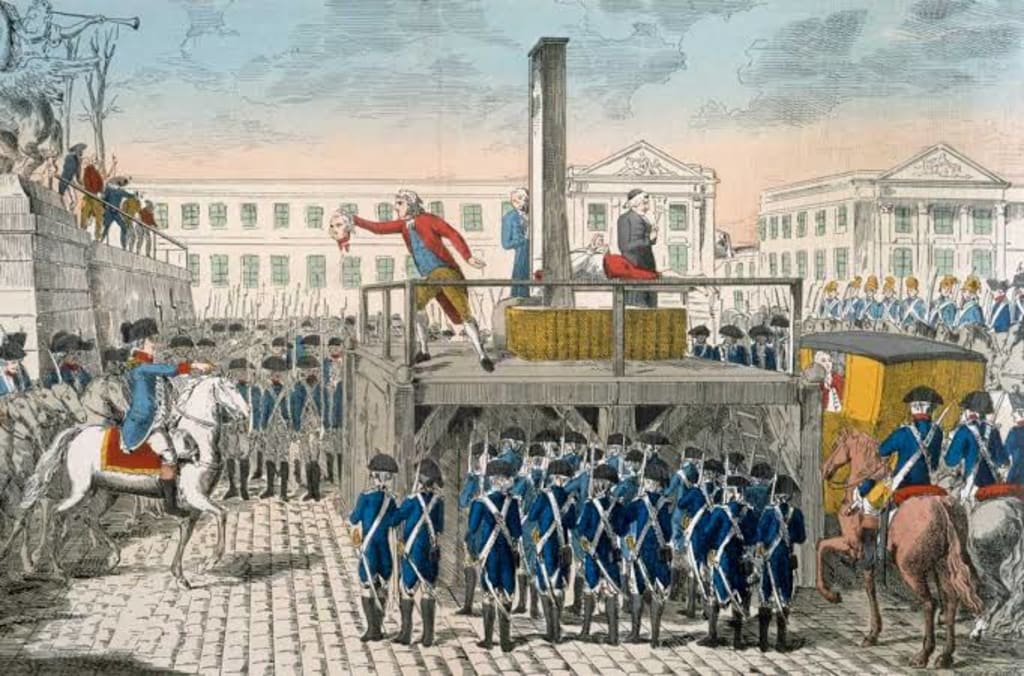
The period of the French Revolution known as the reign of terror was characterized by a series of measures and numerous public executions in response to the fervor of the Revolution. It lasted from September 5, 1793 to July 27, 1794, with Robespierre serving as the spokesperson for the terror. Under Robespierre's leadership, the terror reached its peak and established a dictatorial regime. Throughout this period, several committees were formed.
Conflict between Girondist and Jacobins:
During the time of the French constitutional monarchy, two radical groups, the Girondist and the Jacobins, fought for power. The Girondist held the majority, while the Jacobins were in the minority.
The terror was a violent period during the French Revolution, fueled by the conflict between the Girondist and the Jacobins, and characterized by the mass execution of those deemed "enemies of the revolution."
Operation of the Terror:
The terror can be divided into three phases: the first phase lasted from the summer of 1792 to June 2, 1793, the second phase from June 2, 1793 to September 1793, and the last phase from September 1793 to July 1794.
Aim of the Reign of Jacobins:
The Jacobins established a reign of terror with the aim of maintaining unity and solidarity. The fall of the Girondist party led to the formation of armed movements in the cities. The Jacobins sought to deal with internal disturbances and prevent attacks from external enemies.
Formation of different committees:
During the reign of terror, the country was governed by a number of committees. The provisional government consisted of two important committees appointed by the convention: the committee of public safety and the committee of general safety. Initially, the committee of public safety consisted of nine members, later increased to twelve. Robespierre served as the head of this committee. The main objective of these committees was to eliminate the opponents of the revolution at any cost.
Committee of Public Safety:
The committee of public safety was established by the National Convention on 6 April 1793. Initially, its responsibilities were limited to foreign affairs and the army. However, it eventually gained immense power and began to intervene in all aspects of national affairs.
Committee of General Safety:
The committee of general safety was a parliamentary committee in France that acted as a police agency during the French Revolution.
The Law of Suspects:
Under the infamous law of suspects, every individual in France fell under its strict control. This law was vaguely worded, resulting in the arrest of at least 300,000 suspects.
Law of the General Maximum:
The law of maximum was implemented on 29 September 1793 during the French Revolution. It aimed to set price limits and ensure a steady supply of food to the capital city of France.
Revolutionary Tribunal:
The revolutionary tribunal was a court established by the National Convention during the French Revolution to try political offenders. It eventually became a powerful tool of the Reign of Terror, functioning as a criminal court with no possibility of appeal. Its verdicts always resulted in death sentences.
Victims of the Terror:
The majority of those arrested and executed during the terror were members of the aristocracy, priests, individuals from the middle class, and anyone accused of counter-revolutionary activities. Estimates suggest that the number of arrests during this period ranged from 300,000 to 500,000, although the exact figure remains unknown.
Terror under Robespierre:
Robespierre presided over a period of extreme violence, resulting in the execution of approximately 35,000 to 40,000 individuals through the use of the guillotine during his dictatorship.
Necessity of the Reign of Terror:
The necessity of the reign of terror continues to be a subject of debate. Some argue that it was essential to combat threats and safeguard the revolution, while others contend that it was unnecessary.
The downfall of Robespierre marked the closure of the Jacobin club in Paris and sparked disagreements among its members regarding future plans and the ultimate cause for the end of the Reign of Terror. Robespierre was executed by a gunshot wound on July 28, 1794, along with his followers, effectively bringing an end to the era of terror.
The significance of the Reign of Terror remains a subject of intense debate. Conservative historians criticize this period for various reasons, arguing that it was fueled by the shedding of innocent blood. The Revolutionary Tribunal of Paris alone sentenced 2,639 individuals to death.
However, it is undeniable that the Reign of Terror served a certain purpose. It played a crucial role in preserving the French Revolution, which may not have been achievable through any other means. As Hayes aptly stated, "The French revolution was preserved in France and France was victorious in Europe by the terror."
About the Creator
Keep reading
More stories from writers in History and other communities.
3 Harmless Habits That Once Caused Absolute Chaos
Most habits are comfortingly dull. You chew gum. You clap at events. You check your phone. You assume—reasonably—that these actions will not destabilize governments, bankrupt industries, or end lives. Society depends on this assumption. If every small habit carried catastrophic potential, we would never leave the house.
By Enoch Sagini5 days ago in History
Brosley Punch — The Strike That Shook Fate
Brosley was never taught how to throw a punch. He learned it the hard way—through hunger, through survival, through a childhood spent on a world that showed no mercy. Long before the universe would whisper his name in fear, Brosley was just a boy standing on cracked red stone, staring at a sky that never answered his questions.
By The best writer 3 days ago in History
Thoughts on Vocal and the way the world is
"Death cannot stop true love, only delay it." – Wesley in The Princess Bride. I decided to come back to Vocal on a very cold and dark night at the end of December. I had been, and still am, convalescing from a horrible staph infection that had gone misdiagnosed for months. This, paired with the increasing challenges of being healthy, making the best choices for my co-parented child, being a wife, and being a director at a new job, was a lot to manage.
By Jazzy 3 days ago in Confessions



Comments
There are no comments for this story
Be the first to respond and start the conversation.