
Port Royal: The Caribbean’s Sin City That Met a Biblical End
Pirates Ruled This Town Until a Biblical Disaster Struck

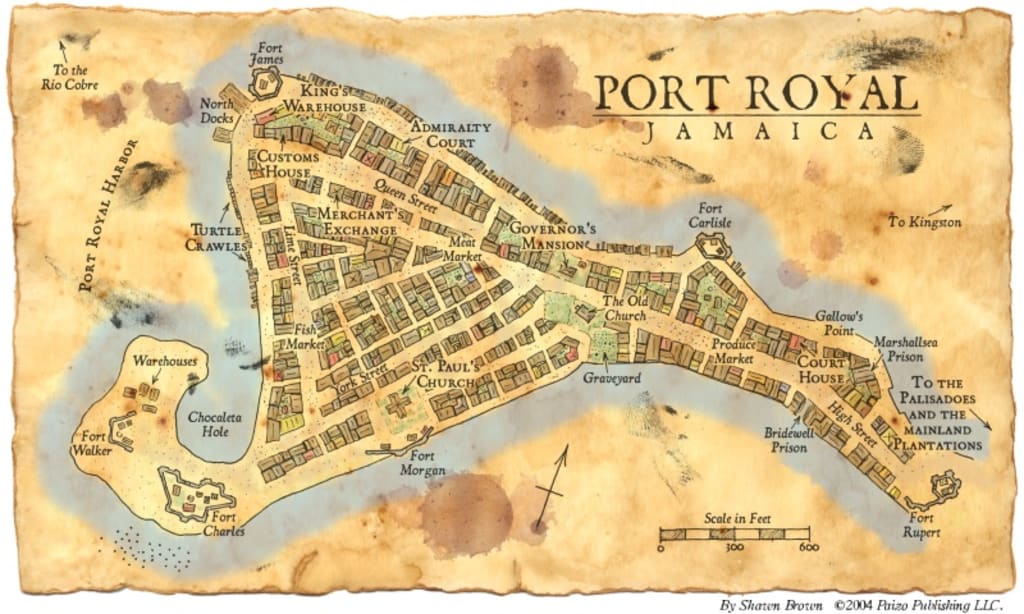
Imagine a tiny speck of a city, clinging to the edge of a 29-kilometer sandbar in the Caribbean, earning a reputation as the most notorious place on Earth. For a brief, wild stretch in the 17th century, Port Royal, Jamaica, was exactly that—a chaotic haven of pirates, privateers, prostitutes, and unimaginable plunder. It was a place where rum flowed like water, disputes ended in bloodshed, and wealth bought anything or anyone. But as quickly as it rose to infamy, Port Royal crumbled, with many believing its downfall was nothing short of divine justice. So, how did this obscure settlement transform into a legendary den of vice, only to vanish into the sea?
The story begins in 1494 when Christopher Columbus, sailing for Spain, stumbled upon a stunning island in the Caribbean. Ignoring the Taino people who’d called it home for over a millennium, he promptly claimed it for Queen Isabella and King Ferdinand, naming it Jamaica—or rather, adapting the local name “Xaymaca” into something more Spanish-friendly. For the next 146 years, Spain ruled the island, but their focus remained on richer mainland colonies, leaving Jamaica’s odd sandbar largely ignored.
That changed in 1655 when the British, led by Oliver Cromwell’s ambitious “Western Design” campaign, arrived with conquest in mind. Cromwell dreamed of toppling Spanish dominance in the New World, targeting the well-fortified island of Hispaniola. But the Spanish were ready, and the British fleet was sent packing. Unwilling to face Cromwell’s wrath empty-handed, the commanders pivoted to Jamaica—a softer target. They seized the island, planted their flag, and Port Royal was born at the tip of its sandy spit, blessed with a deep natural harbor ideal for trade and sheltering ships.
Yet, the British faced a problem: they were stretched thin, with too few soldiers to defend their prize against a potential Spanish counterattack. Enter Edward D’Oyley, Jamaica’s new governor, with a bold plan. If he couldn’t muster an army, he’d recruit the Caribbean’s most fearsome locals—pirates. It was a risky move, akin to inviting wolves to guard the sheep, but it worked brilliantly. These weren’t just any pirates; they were the Brethren of the Coast, led by the infamous Welsh captain Henry Morgan, a name still synonymous with rum and rebellion.
D’Oyley polished up their image, dubbing them “privateers” and handing out letters of marque—legal permission to raid enemy ships for Britain’s gain. It was piracy with paperwork. Better yet, it cost the crown nothing. The privateers kept most of their loot, sending a cut to England and another to Port Royal’s coffers. Morgan and his crew didn’t just defend the city; they terrorized Spanish trade routes and settlements, hauling in staggering riches. A single raid on Panama reportedly netted them millions in today’s dollars, with even the lowliest crew member earning years’ worth of wages in one go.
Port Royal boomed. Ships heavy with gold docked daily, and the city swelled with wealth and vice. By the late 17th century, it was the largest English city in the New World, home to 10,000 people crammed into 51 acres—a stark contrast to New York’s modest 4,500 residents at the time. One in four buildings was an inn or brothel, catering to pirates flush with Spanish dollars, known as “pieces of eight.” These silver coins, worth eight reales and often sliced into bits for change, fueled a lifestyle of excess. Pirates spent fortunes in a single night—up to $150,000 in modern terms—on liquor and women, turning Port Royal into a pressure cooker of debauchery.
To outsiders, it was a modern Sodom and Gomorrah, a festering pit of sin begging for punishment. And on June 7, 1692, that punishment seemed to arrive. A massive earthquake struck Jamaica, its tremors liquefying the sandy foundations beneath Port Royal. Buildings sank into quicksand, and a tsunami roared in, drowning the city like a child’s ruined sandcastle. Around 2,000 people perished in the initial disaster, with another 3,000 succumbing to injuries and disease. Half the city’s land vanished underwater.
Was it divine retribution? Many thought so, pointing to the biblical parallels. Survivors, undeterred, began rebuilding, but fate wasn’t done. A fire soon ravaged what remained, followed by a string of hurricanes over the decades. Port Royal never regained its former glory. Today, it’s a quiet fishing village, a shadow of its past. Yet beneath the waves lies a time capsule—the “City That Sank,” a perfectly preserved underwater relic dubbed the Pompeii of the Caribbean. UNESCO has eyed it for World Heritage status, a testament to its historical weight.
From a pirate utopia to a watery grave, Port Royal’s tale is one of reckless ambition, staggering wealth, and a collapse so dramatic it feels scripted by a higher power. Its legacy endures, not in bustling streets, but in the silent ruins beneath the harbor—a reminder of a time when the Caribbean’s wickedest city ruled the seas.
About the Creator
KWAO LEARNER WINFRED
History is my passion. Ever since I was a child, I've been fascinated by the stories of the past. I eagerly soaked up tales of ancient civilizations, heroic adventures.
https://waynefredlearner47.wixsite.com/my-site-3
Keep reading
More stories from KWAO LEARNER WINFRED and writers in History and other communities.
The Quiet Legend of Simo Häyhä: Finland’s Unseen Hero
On April 1, 2002, a 96-year-old man slipped away peacefully in a modest care home along Finland’s southern coast. In death, he appeared frail and small, his once-five-foot frame diminished further by the weight of years. Decades earlier, this unassuming figure had lived a solitary life as a farmer, tending his land in quiet isolation. He never married, never had children, and kept mostly to himself. To the handful who knew him well enough to call him a friend, he was simply Simo. But long before that, in a frozen corner of his homeland, he bore a different name-one muttered in hushed tones by jittery soldiers peering through snow-laden trees: the White Death.
By KWAO LEARNER WINFRED10 months ago in History
The Quiet Name on Maple Street
Kim Jong-un was born into a world unlike almost any other—a world sealed by borders, ideology, and secrecy. As the grandson of Kim Il-sung, the founder of North Korea, and the son of Kim Jong-il, the country’s second leader, Kim Jong-un entered life already wrapped in destiny. In North Korea, leadership is not chosen by ballots or debate; it is inherited like a crown, reinforced by loyalty, fear, and an unyielding political system.
By The best writer 3 days ago in History


Comments
There are no comments for this story
Be the first to respond and start the conversation.