
The Quiet Legend of Simo Häyhä: Finland’s Unseen Hero
From Humble Farmer to Finland’s Deadliest Sniper

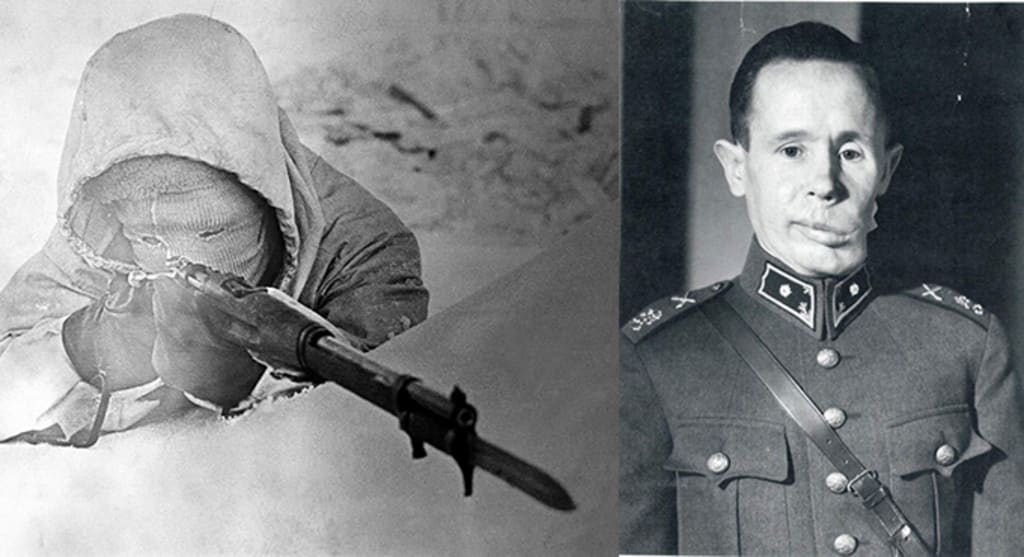
On April 1, 2002, a 96-year-old man slipped away peacefully in a modest care home along Finland’s southern coast. In death, he appeared frail and small, his once-five-foot frame diminished further by the weight of years. Decades earlier, this unassuming figure had lived a solitary life as a farmer, tending his land in quiet isolation. He never married, never had children, and kept mostly to himself. To the handful who knew him well enough to call him a friend, he was simply Simo. But long before that, in a frozen corner of his homeland, he bore a different name-one muttered in hushed tones by jittery soldiers peering through snow-laden trees: the White Death.
This is the tale of Simo Häyhä, a man who transformed from a humble farmer into the deadliest sniper the world has ever known. Over 98 harrowing days in 1939, amid Finland’s snowbound wilderness, he became a living legend-a relentless force who claimed hundreds of lives with chilling precision.
A Simple Beginning
Born in 1905 in a tiny hamlet in southwestern Finland, Simo’s early years were unremarkable. Like many boys of his era, he grew up with the rhythms of rural life. At 17, he joined the Civil Guard, and two years later, he completed his mandatory national service with the Bicycle Battalion-a unit of light infantry who pedaled into action. While the image of soldiers on bicycles might spark a smile today, these two-wheeled warriors were a serious asset in wartime, widely used in both World Wars for their speed and agility.
After his service, Simo had no grand plans to pursue a military career. He returned to his farm, content to live out his days in peace. But as the 1930s wore on, storm clouds gathered over Europe, and Finland soon found itself caught in the crosshairs of a brewing conflict.
The Winter War Ignites
In 1939, the world stood on the edge of chaos. That August, Germany and the Soviet Union stunned the globe by signing the Molotov-Ribbentrop Pact, a non-aggression deal between two bitter enemies. Buried within it was a secret clause: a pact to carve up Eastern Europe into “spheres of influence.” Within weeks, the two powers acted on their agreement, invading Poland from opposite sides and splitting the nation between them.
Finland, a small Nordic country with a population of just 3.7 million, soon felt the Soviet gaze. Emboldened by the pact, Stalin issued ultimatums to the Baltic states and Finland, demanding land concessions under threat of force. While Latvia, Lithuania, and Estonia buckled, Finland refused. On November 30, 1939, the Soviet Union launched a full-scale invasion, igniting the Winter War.
The Soviets brought overwhelming might: thousands of tanks, aircraft, and nearly a million troops. Finland, by contrast, mustered a meager 32 tanks, about 100 planes, and a handful of bicycles. Outnumbered nearly 50 to 1, the Finns faced a Goliath. What they lacked in resources, however, they made up for in resilience—and an unlikely hero.
The Making of a Legend
Simo Häyhä was no stranger to Finland’s rugged terrain. For years, he’d roamed its forests, hunting game with a rifle he knew as well as his own hands. When the war called him back at age 34, he didn’t hesitate. The Winter War unfolded in brutal conditions-temperatures plunging to minus 40 degrees Celsius, snow blanketing lakes, swamps, and woods. The Red Army, clad in dark khaki uniforms, struggled against the elements, their figures stark against the white expanse. Simo and his comrades, draped in snow-white camouflage, blended seamlessly into the landscape.
What set Simo apart wasn’t just his skill—it was his methods. Unlike his peers, he shunned modern sniper rifles with telescopic sights, opting instead for an older, simpler weapon from his Civil Guard days, equipped only with iron sights. To him, scopes were a liability: they forced a sniper to lift his head slightly, offering a bigger target, and their lenses could glint in the sun, betraying a shooter’s position. Simo’s choice paid off. At ranges up to 400 meters, he struck with lethal accuracy, his shots as steady as the falling snow.
He was meticulous. Before dawn, he’d scout his firing spots, packing snow to hide his silhouette and tamping it down to prevent puffs of powder from revealing his shots. To mask his breath in the icy air, he’d hold snow in his mouth, ensuring no telltale vapor gave him away. Every detail mattered—and it made him unstoppable.
The White Death Rises
Over the war’s 105 days, Simo became a phantom in the forest. Official records credit him with 505 to 542 confirmed kills-an average of five enemy soldiers a day-though the true toll may be higher. No sniper in history has matched his tally. By comparison, Chris Kyle, the famed American sniper, recorded 160 kills over a decade in Iraq, while Soviet marksman Vasily Zaitsev notched 242 during World War II. Simo’s feats came in mere months, with basic gear and no formal sniper training.
To the Soviets, he was a nightmare. Tales of an invisible killer spread through their ranks, earning him the moniker “White Death.” Desperate to stop him, they dispatched counter-snipers-only for Simo to pick them off, one by one. When that failed, they rained mortar fire on suspected hideouts, but Simo’s cunning kept him safe, tucked into snowbanks or natural cover.
Then, in the war’s final days, fate intervened. On March 6, 1940, an explosive bullet tore into Simo’s face, shattering his jaw and cheek. Found motionless by his comrades, he was presumed dead and laid among the fallen. Hours later, a twitch of his leg proved otherwise. Rushed to a hospital, he lingered in a coma for a week, waking on March 13—the day the Moscow Peace Treaty ended the war.
A Hero’s Legacy
The treaty forced Finland to cede territory, but Stalin’s dream of swallowing the nation whole was thwarted, thanks in no small part to fighters like Simo. His injuries left him scarred, requiring 26 surgeries, yet he survived. Promoted from corporal to second lieutenant—the largest jump in Finnish military history—he was gifted a farm called White Lake, a nod to his fearsome alias.
Simo never boasted of his deeds. In diaries unearthed in 2017, he called his kills a “sin list,” a burden he carried quietly. Asked late in life if he regretted them, he replied, “I did what I was told to do, as well as I could. There would be no Finland unless everyone else had done the same.”
When he died in 2002, Simo Häyhä left behind a legacy as enduring as Finland’s winter snows—a testament to how one small man, armed with skill and resolve, could stand against an empire and become a giant in history.
About the Creator
KWAO LEARNER WINFRED
History is my passion. Ever since I was a child, I've been fascinated by the stories of the past. I eagerly soaked up tales of ancient civilizations, heroic adventures.
https://waynefredlearner47.wixsite.com/my-site-3
Keep reading
More stories from KWAO LEARNER WINFRED and writers in History and other communities.
The Deadly Art of Honor: A Journey Through Dueling Across Centuries
Throughout history, few practices have captured the imagination quite like dueling-a complex ritual of honor that transformed personal disputes into life-or-death confrontations. From medieval battlefields to 19th-century gentlemen's codes, dueling was far more than a mere method of conflict resolution; it was a sophisticated social language that spoke volumes about reputation, courage, and societal expectations.
By KWAO LEARNER WINFRED10 months ago in History
Is NATO Facing Its Biggest Crisis Yet?
Is NATO Facing Its Biggest Crisis Yet? For more than seventy years, NATO has been one of the strongest military alliances in the world. Formed after World War II, it was designed to protect its members through collective defense. An attack on one was considered an attack on all. For decades, this principle helped maintain stability in Europe and beyond. But today, NATO is facing one of the most challenging moments in its history.
By Wings of Time 7 days ago in History
Nobel Peace Prize
The Nobel Peace Prize has stood as one of the world’s most recognized honors. Awarded annually in Oslo, it is meant to celebrate individuals or organizations that have made significant contributions toward peace, diplomacy, and humanitarian progress. While its mission appears straightforward, the Nobel Peace Prize has never been free from debate. In recent years, conversations surrounding global politics—particularly discussions about the Trump Nobel Peace Prize—have brought renewed attention to how peace is defined, measured, and rewarded in the modern era. The Origins and Meaning of the Nobel Peace Prize The Nobel Peace Prize was established by Alfred Nobel, the Swedish inventor best known for creating dynamite. In his final will, Nobel directed that a portion of his wealth be used to recognize efforts that foster peace among nations, reduce standing armies, or promote diplomacy and cooperation. Since its first award in 1901, the prize has honored activists, diplomats, organizations, and world leaders whose actions shaped international dialogue. Unlike other Nobel categories, the peace prize is awarded by a Norwegian committee rather than a Swedish institution. This distinction reflects Nobel’s desire to separate the prize from national interests and focus instead on global responsibility. Over time, the definition of “peace” has expanded. Early recipients were often disarmament advocates or mediators. More recent laureates have included human rights defenders, climate activists, and international organizations working in conflict zones. Politics and the Nobel Peace Prize Despite its humanitarian ideals, the Nobel Peace Prize has always intersected with politics. Recognizing peace efforts often means evaluating political leadership, international negotiations, and long-term consequences—none of which are easy to measure in real time. Some awards have been widely celebrated, while others sparked controversy. Critics often argue that certain laureates were honored prematurely, before the lasting results of their actions became clear. Supporters counter that the prize is meant to encourage peace efforts, not merely reward completed achievements. This tension has made the Nobel Peace Prize a reflection of global priorities at any given moment, rather than a simple historical judgment. Donald Trump and Nobel Peace Prize Discussions Few modern political figures have generated as much debate in connection with the Nobel Peace Prize as Donald Trump. During and after his presidency, conversations about a potential Trump Nobel Prize emerged repeatedly, particularly among supporters who pointed to his role in diplomatic initiatives. The phrase Trump Nobel Peace Prize gained traction following agreements and negotiations in regions long marked by conflict. Advocates argued that these diplomatic efforts aligned with Alfred Nobel’s vision of reducing international tension through dialogue rather than force. At the same time, critics questioned whether these actions met the broader ethical and humanitarian standards traditionally associated with the award. They pointed to domestic divisions, foreign policy controversies, and unresolved global conflicts as reasons for skepticism. This divide highlights a core challenge of the Nobel Peace Prize: peace is rarely absolute, and political leadership is often complex and contradictory. Trump Nobel Peace Prize 2026: Speculation and Context As global politics continue to evolve, speculation around a Trump Nobel Peace Prize 2026 has appeared in media discussions and public commentary. It is important to note that nominations for the Nobel Peace Prize are confidential for decades, and speculation does not confirm consideration or selection. However, the mere discussion of Trump Nobel Peace Prize 2026 reflects how the award has become part of broader cultural and political conversations. Supporters view such recognition as validation of diplomatic achievements, while critics see the speculation as politicizing an institution meant to rise above partisan debate. This dynamic is not unique to Trump. Many past leaders, from various ideological backgrounds, were debated heavily before or after receiving the prize. The Nobel Peace Prize often mirrors global disagreements rather than resolving them. How the Nobel Committee Makes Its Decision Each year, hundreds of nominations are submitted by qualified individuals, including academics, lawmakers, and previous laureates. The Nobel Committee evaluates these nominations through research, expert consultation, and internal debate. The process considers intent, impact, and long-term significance. However, because peace efforts often unfold over years or decades, the committee must make decisions without full historical clarity. This reality explains why some awards age gracefully while others remain controversial. The committee rarely responds directly to public pressure or online campaigns. Media attention, including discussions around a Trump Nobel, does not guarantee influence over the final decision. The Broader Impact of the Nobel Peace Prize Beyond individual recipients, the Nobel Peace Prize plays a symbolic role. It brings global attention to issues that might otherwise be ignored, from humanitarian crises to fragile peace processes. Even controversial nominations can spark meaningful debate about what peace truly means in the modern world. The prize also raises questions about accountability. When leaders are considered for such recognition, the public is encouraged to examine policies, outcomes, and moral responsibility more closely. In this sense, discussions surrounding the Trump Nobel Peace Prize are not just about one individual. They reflect deeper conversations about diplomacy, leadership, and the evolving standards by which peace is judged. Conclusion: A Prize That Reflects the World The Nobel Peace Prize remains one of the most influential and debated honors in global society. Its power lies not only in recognizing peace efforts but also in challenging the world to think critically about conflict, cooperation, and responsibility. Whether discussions involve historic activists or modern political figures like those associated with Trump Nobel Peace Prize 2026 speculation, the award continues to reflect the complexities of international relations. Peace is rarely simple, and neither is the process of honoring it. Ultimately, the Nobel Peace Prize serves as a reminder that striving for peace is an ongoing journey—one shaped by ideals, actions, and the difficult choices that define human history.
By Saboor Brohi 3 days ago in History


Comments (1)
Nice work on this article. It drew me in from the beginning and took me on the journey until the end. Keep up the good work.