
"Persia's Eternal Fortune: The History of Iran’s Greatest Treasures"
Across more than 2,500 years, the empires of ancient Persia — from the Achaemenids to the Safavids — amassed some of the richest treasures the world has ever known. From dazzling diamonds like the Darya-i-Noor to golden thrones and bejeweled swords, Iran’s imperial wealth has been shaped by conquest, diplomacy, and survival. This article explores the origins, legendary losses, and enduring legacy of Iran's greatest treasures, and offers a rare glimpse into the priceless artifacts preserved today in the Iranian National Jewels collection.

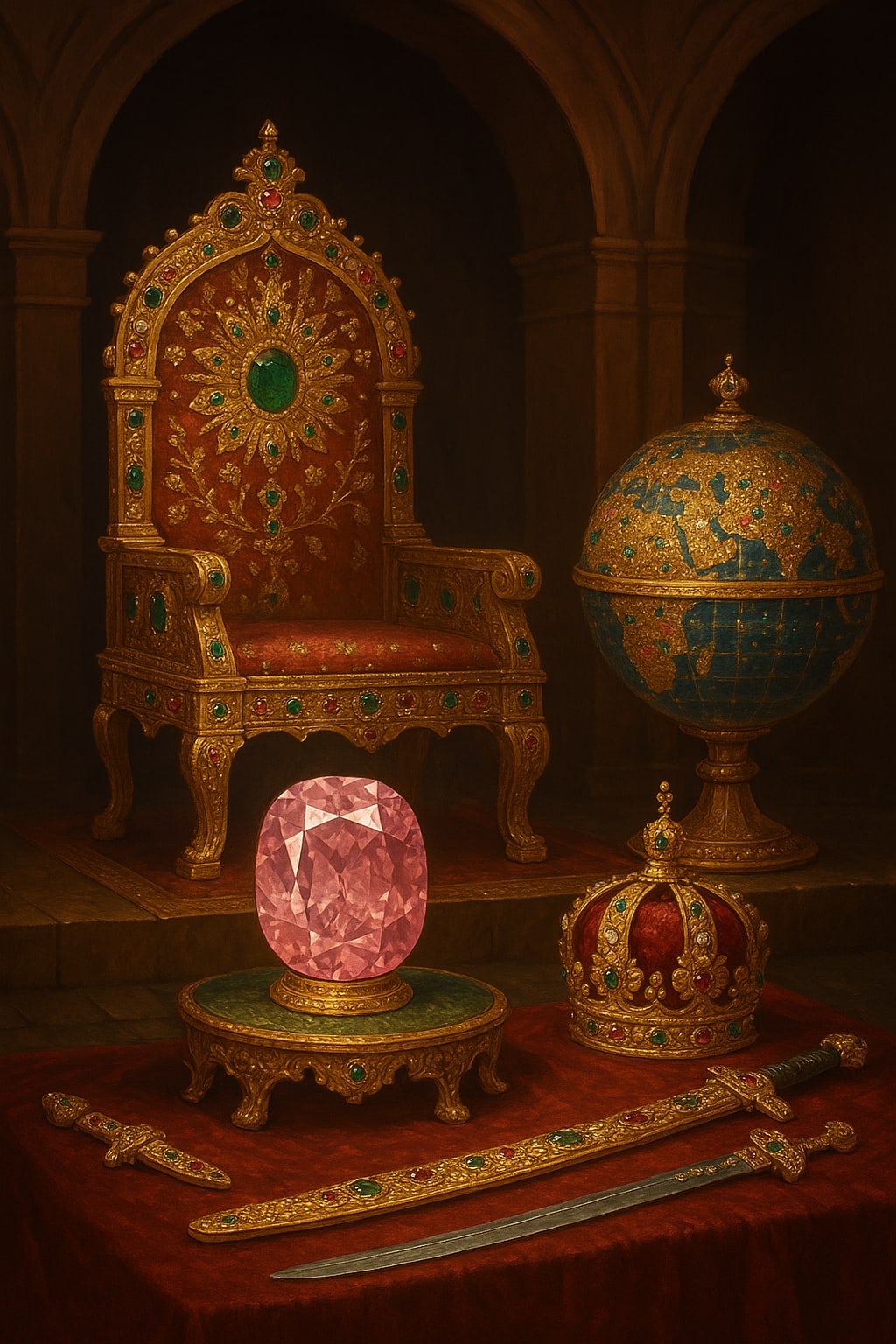
Crown Jewels of Persia: The Lost and Living Treasures of Iran
Iran, historically referred to as Persia, represents one of the most ancient civilizations on the planet. From the formidable Achaemenid Empire of Cyrus the Great to the splendid Safavid dynasty, Persia has served as an emblem of affluence, culture, and authority. Across the centuries, Persian monarchs amassed fortunes beyond imagination: vast reserves of gold, stunning crowns, swords adorned with rubies, and seas of invaluable gemstones.
Among the most renowned collections is the Iranian National Jewels, regarded as one of the most precious and illustrious treasure troves on Earth. This article examines the origins, development, loss, and endurance of Iran’s imperial wealth and assesses its present-day value.
The Ancient Foundations: Achaemenid Splendor
The custom of royal treasures in Iran commenced with the Achaemenid Empire (550–330 BCE), initiated by Cyrus the Great. The Achaemenid sovereigns commanded one of the extensive empires in ancient history, spanning from Egypt to India.
Wealth in gold and silver flowed in from 20 distinct satrapies (provinces).
Darius the Great constructed Persepolis, a ceremonial capital filled with colossal palaces, golden effigies, and walls inlaid with precious stones.
Herodotus, the Greek historian, depicted the Persian monarchs as possessing immense reserves of gold and silver treasures so substantial they appeared inexhaustible.
However, the first significant loss transpired with Alexander the Great’s invasion in 330 BCE, when Persepolis was set ablaze and looted. Thousands of talents of gold and silver (equating to billions today) were transported back to Macedonia.
The Sassanian Revival: Imperial Wealth Reborn
Following centuries of external domination, the Sassanian Empire (224–651 CE) rejuvenated Persian magnificence.
Khosrow I and Khosrow II accrued riches through conquest, commerce, and tribute.
Legendary artifacts like the Throne of Khosrow, encrusted with pearls, rubies, and emeralds, became emblems of Persian dominance.
The Sassanian monarchs upheld clandestine treasuries brimming with coins, gems, ceremonial armor, and royal insignia.
Regrettably, much of this was lost during the Islamic conquests of the 7th century, when Arab forces vanquished the Sassanians and plundered royal treasuries.
The Safavid Renaissance: Birth of the Modern Iranian Crown Jewels
The most illustrious period for Iran’s imperial wealth emerged with the Safavid Dynasty (1501–1736).
Shah Abbas the Great (1588–1629) established Isfahan as a radiant capital.
Iran dominated crucial points along the Silk Road, enriching itself through commerce.
The Safavid monarchs gathered Indian diamonds, Ottoman emeralds, and Chinese jade.
They commissioned artisans to craft magnificent swords, shields, and thrones.
This epoch laid the groundwork for what would later evolve into the Iranian National Jewels, the most prominent collection of Persian treasures.
The Afghan Invasion and Nader Shah's Conquests
In the early 18th century, Iran’s fortunes took a grim turn.
In 1722, Afghan forces ransacked Isfahan and plundered Safavid treasures.
Subsequently, Nader Shah (r. 1736–1747) ascended to power and led ruthless campaigns across India.
In 1739, Nader Shah captured Delhi and seized the Mughal treasury, which included:
The Koh-i-Noor diamond (one of the largest diamonds globally).
The Darya-i-Noor diamond (still in Iran today).
Enormous quantities of gold, silver, and jeweled artifacts.
Nader Shah's devastation is approximated to have comprised hundreds of tons of gold and gemstones contemporary value could exceed $1 trillion USD. However, following Nader Shah's assassination in 1747, a significant portion of this wealth was dispersed among warlords and competing factions.
The Qajar Dynasty and Modern Preservation
During the Qajar dynasty (1789–1925), Iran’s remaining treasures were reorganized.
Sovereigns such as Fath-Ali Shah commissioned ornate crowns and regalia, frequently utilizing gems from previous periods.
The renowned Peacock Throne, emblematic of royal authority, was produced (distinct from the Mughal throne bearing the same name).
The Iranian National Jewels were relocated to more secure facilities as political instability persisted.
By the dawn of the 20th century, the Pahlavi dynasty initiated efforts to catalog and safeguard the treasures.
The Iranian National Jewels Today
Currently, the Iranian National Jewels also referred to as the Crown Jewels of Iran are housed in the Central Bank of Iran in Tehran.
The collection encompasses:
The Darya-i-Noor diamond (182 carats, one of the world's largest pink diamonds).
The Naderi Throne and the Sun Throne, both adorned with hundreds of gems.
Crowns, swords, shields, tiaras, and royal regalia.
An entire encrusted globe, where oceans are represented by emeralds and continents by rubies and sapphires.
Estimated Value:
While the Iranian government does not disclose a public evaluation of the collection (due to national security considerations), experts estimate the Iranian National Jewels could be valued at well over $5–10 billion USD ranking it among the most valuable collections of royal treasures globally.
Nevertheless, its symbolic significance to Iranian identity and history is truly invaluable.
Conclusion
Iran's treasure narrative is a tale of brilliance, loss, resilience, and pride.
From the gilded halls of Persepolis to the vaults of Tehran’s Central Bank, Persia’s legendary wealth has captivated the world for over 2,500 years.
Even today, the Iranian Crown Jewels serve not only as a testament to past grandeur but also as a reminder of a civilization whose cultural and material contributions continue to illuminate the globe.
About the Creator
Say the truth
"Say the Truth: Explain Everything in the World" is your trusted source for uncovering facts and exploring the wonders of history, science, technology, and beyond. We simplify complex ideas and reveal truths to inspire curiosity .
Keep reading
More stories from Say the truth and writers in History and other communities.
"China's Lost Fortune: The Rise, Fall, and Legacy of the Empire’s Greatest Treasures"
The Concealed Wealth of an Ancient Power: The Tale of China's Preeminent Imperial Treasure For millennia, China emerged as one of the most affluent and formidable civilizations on the planet. Its emperors commanded extensive armies, constructed magnificent marvels, and amassed treasures that defied imagination. Among these, certain collections of gold, jade, porcelain, silk, and invaluable artifacts epitomized not merely opulence, but also imperial sovereignty itself. This article delves into the illustrious imperial treasures of China, placing particular emphasis on the wealth accumulated during the Ming and Qing Dynasties, as well as the eventual fate of these riches.
By Say the truth 9 months ago in History
Why Early Aircraft Designs Failed Before They Ever Flew
Long before airplanes became symbols of speed and global connection, flight was an idea filled with uncertainty, ambition, and repeated disappointment. Early aircraft designers were driven by a powerful belief that humans could conquer the skies, yet many of their creations never made it past workshops, fields, or testing grounds. These failures were not accidents of carelessness; they were the result of a world still learning the rules of flight.
By Beckett Dowhan6 days ago in History
3 Times Ordinary Objects Did Something Deeply Unsettling
Objects surround us every day. They make life easier, more comfortable, or more entertaining. A chair supports us, a mirror shows us our reflection, and a toaster browns our bread with consistent reliability. Most of the time, they behave exactly as expected.
By Enoch Sagini5 days ago in History
So You Decided To Become a Nurse Practitioner:
So you decided to become an "Advanced Practice" nurse. Congratulations!... is what I would say if this was a good idea. Grad school? In this economy? What were you thinking? Likely it was something along the lines of either 1) “I've seen these other chucklefucks do it— Why can't I?” or even 2) “I've got a nice career, I should shake it up. I miss feeling like I have no clue what I'm doing.”
By Sandor Szabo2 days ago in Fiction



Comments (1)
Beautiful story and pictures 🏆✍️💙