
Pax Americana
Where Peace IS What We Say It Is; You'll Hear the Freedom Before It Arrives

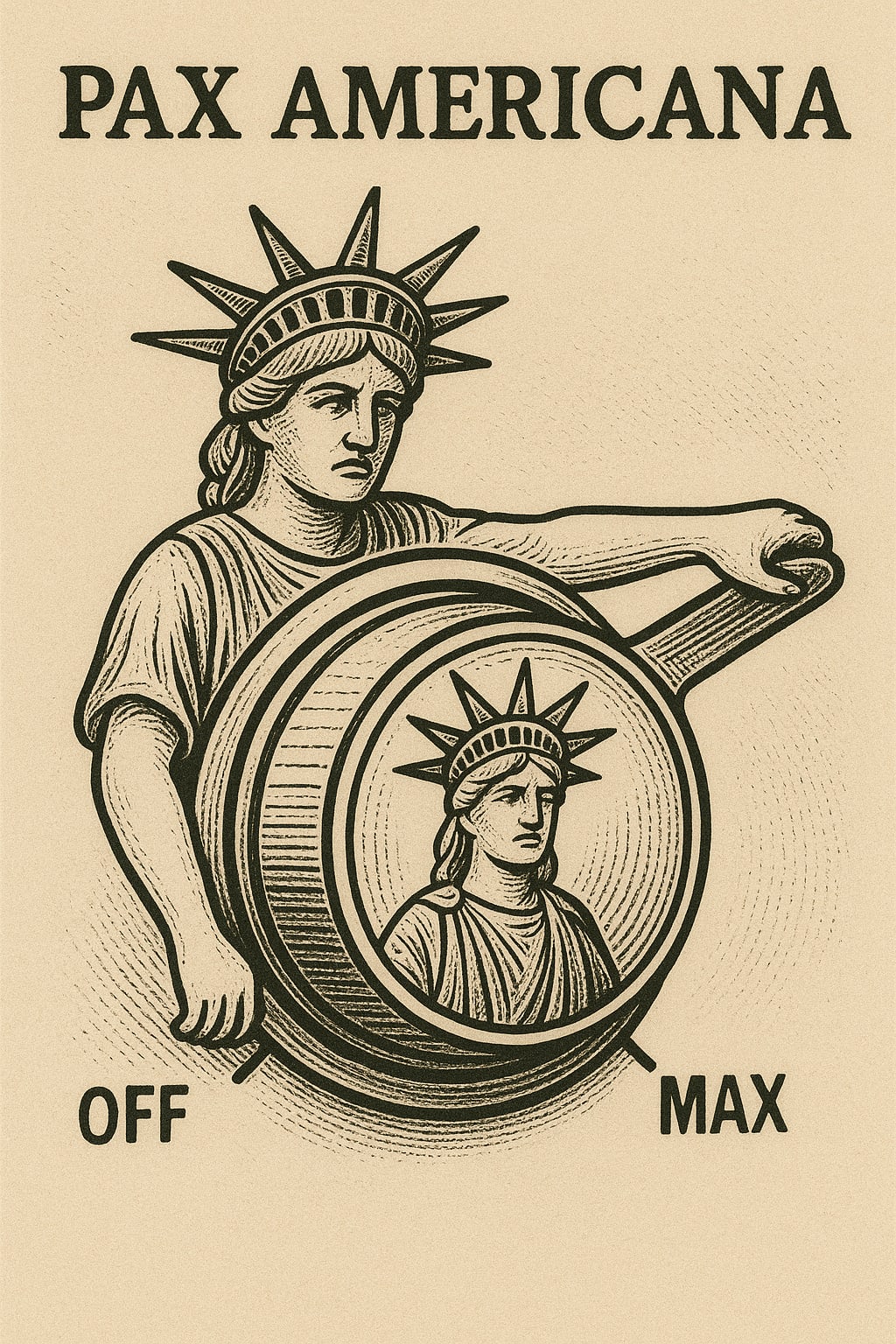
In every classroom and on the shelves of every historian, the fall of the Roman Empire looms as one of the most discussed collapses of a great civilization. Its legacy is undeniable, and for centuries, scholars have drawn comparisons between ancient Rome and modern powers. Today, as the United States navigates a period of deep political, economic, and cultural transformation, many may ask: Are the echoes of Rome’s decline emenating through Washinton D.C. and our current political dysfunction? Although ther have been comaprisons many times over by historians and scholars with these two freedumb, republic-ish autocracies in the past, it seems more pertinent now to look back and perhaps, avoid the same fate and ask the question; does history repeat itself?
For your consideration:
1. Overexpansion and Global Overreach:
At its height, Rome controlled a vast amount of the known world, stretching from Britain to the Middle East. But maintaining such a broad empire taxed its military, its treasury, and its internal cohesion. Similarly, the United States maintains over 700 military installations globally and continues to engage in expensive geopolitical commitments. The question lingers: Can an empire remain effective and focused when stretched so thin?
2. Economic Disparity and Corruption:
Late-stage Rome saw wealth accumulating in the hands of the elite while the plebeians, or common citizens, bore the burden of taxation. Political corruption flourished as bribery and self-interest eclipsed the Republic’s founding ideals. In modern America, rising income inequality, corporate lobbying, and a growing disillusionment with political leadership suggest unsettling similarities. The wealth gap continues to grow, prices for everything we need has skyrocketed leaving many people, myself included, struggling to get by day to day.
3. Decline of Republican Ideals :
Rome’s shift from republic to empire was marked by strongmen who manipulated public fear and loyalty to centralize power. Julius Caesar's march across the Rubicon symbolized the point of no return. In America, concerns over increasing executive authority, political polarization, and erosion of democratic norms fuel debates about the survival of the Republic.
4. Cultural Fragmentation:
The unity that once defined Roman citizenship gave way to fragmentation along tribal and class lines. America, once seen as a melting pot with shared values, now grapples with division across ideological, racial, and regional lines. The concept of a singular American identity is increasingly under strain. Instead of unity and cohesion, our current administration is determined to "obliterate" any identity except and outdated, antiquated ideas of the"American Dream" and misguided inspriation of "Westward Expansion" which created a legacy of violence disguised as an opportunity. The mythology of the "American Dream" was rooted in the pursuit of freedom, prosperity, and individual success; the definition of American Exceptionalism. Truthfully, beneath that well polished surface lies a history of brutality and systematic oppression. Manifest Destiny = Cultural Genocide in Motion
5. Inflation and Unsustainable Economics:
To fund its wars and welfare programs, Rome debased its currency, leading to runaway inflation. Today, while the United States doesn’t mint debased coins, it faces staggering national debt, growing fiscal deficits, and concerns about inflation. The long-term sustainability of current economic policies is a subject of debate among economists.
6. Erosion of Military Loyalty and Morale
Rome eventually relied on mercenaries with little allegiance to the empire. Meanwhile, the United States—though maintaining an advanced military—has seen fatigue from extended conflicts, growing reliance on private military contractors, and increasing scrutiny of recruitment and morale.
Conclusion:
The Choice America Still Has While these parallels are compelling, there’s a key distinction: Rome didn’t know it was collapsing. The United States has the benefit of hindsight. Whether through reform, innovation, or reinvigoration of civic life, America still has the tools to alter its trajectory. "Making America Great Again" will have to wait until the next term, unfortunately. The current 'American Dream", as popularly imagined, was never meant for all people, nor was it a shared journey to equality, but a conquest rooted in white supremacy, economic greed, and a violent rewtiting of what it means to be "American".
So, history may not repeat itself, as the saying goes, but it most certainly rhymes. The story of Rome offers a cautionary echo, but it is up to the citizens of todayto decide how the next verse is written. Stay strong and remember; respect existence or expect resistance!
ambiguouskarma
About the Creator
ambiguous karma
I'm a historian and religious studies scholar with 2 B.A.'s in History and Religious Studies (Salem College) I write with grit, insight, and satire: exploring power, belief, and resistance across time. Scholar by training, rebel by nature.
Keep reading
More stories from ambiguous karma and writers in History and other communities.
Noir Cities: Los Angeles and the Birth of Shadows
Noir has always been more than a genre. It is a geography of shadows, an urban cartography of crime, corruption, neon, and rain slicked streets. Every great noir film is tethered to its city, the setting shaping not just the story but the psychology of its characters. From the sprawling freeways of Los Angeles to the claustrophobic alleys of New York, and the neon-soaked skyscrapers of Hong Kong, the city is never just a backdrop. It is the co-conspirator.
By ambiguous karma5 months ago in Geeks
Thief who stole $3.5 billion but lost all in one phone call part 2
The following year, the owner of Silk Road was arrested and the FBI shut down the website, seizing about 170,000 Bitcoins. However, 51,680 Bitcoins were still missing, and investigators had been trying to trace them for years.
By Imran Ali Shah4 days ago in History
Guard Your Battery
Why are some people so attractive just by standing there? It’s not because they are "likable," but because they don’t need everyone to like them. I realized later that truly charismatic people allow themselves to be criticized, but they never criticize themselves. They never try to please the world; instead, the world stops to watch them.
By Emily Chan - Life and love sharing6 days ago in Poets




Comments (1)
💯👍