
Noir Cities: Los Angeles and the Birth of Shadows
How Los Angeles, New York, and Hong Kong Built a Genre


Noir has always been more than a genre. It is a geography of shadows, an urban cartography of crime, corruption, neon, and rain slicked streets. Every great noir film is tethered to its city, the setting shaping not just the story but the psychology of its characters. From the sprawling freeways of Los Angeles to the claustrophobic alleys of New York, and the neon-soaked skyscrapers of Hong Kong, the city is never just a backdrop. It is the co-conspirator.
This three part series, Noir Cities, explores how different urban landscapes gave noir its pulse. We begin where it all started: Los Angeles, the birthplace of cinematic shadows.
Los Angeles: The City of Shadows
Los Angeles has always been a paradox. To the world, it was a city of sunshine, palm trees, and stardom. But in the 1940s and 1950s, filmmakers turned the camera away from Hollywood’s bright lights and found something darker. Beneath the glamour was a landscape of cheap motels, oil refineries, and backroom deals, the perfect breeding ground for film noir.
The Classic Noir Roots
The postwar boom gave us Double Indemnity (1944), The Big Sleep (1946), and Sunset Boulevard (1950). These films turned Los Angeles into a stage where desire collided with corruption. Billy Wilder’s Sunset Boulevard turned the dream factory itself into a nightmare, a rotting mansion on Sunset showing how quickly glamour curdles into decay. The flat, sunlit sprawl of Los Angeles was deceptive; noir exposed its shadows.
The Architecture of Noir
Los Angeles gave noir its geography. The city’s endless freeways meant criminals could vanish in plain sight. Sleek skyscrapers cast shadows that swallowed entire blocks. Neon signs flickered outside bars and diners where detectives chain smoked through the night. Even the houses, hillside bungalows with venetian blinds cutting light into slashes, became noir icons. In Los Angeles, architecture was not just design; it was destiny.
Neo-Noir and Reinvention
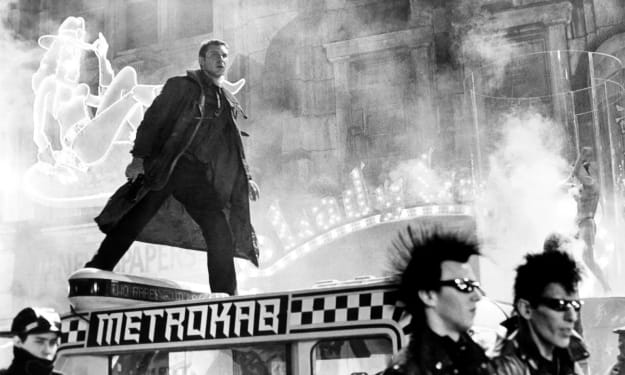
As the decades passed, Los Angeles reinvented itself, and so did noir. Roman Polanski’s Chinatown (1974) reached back into the city’s history, revealing corruption tied to something as basic and essential as water. Michael Mann’s Heat (1995) captured Los Angeles’s shimmering freeways and sterile corporate towers, turning the city into a chessboard for cops and criminals. And of course, Ridley Scott’s Blade Runner (1982) gave us the ultimate futuristic Los Angeles: rain-soaked, neon-drenched, a city where noir was reborn in the key of science fiction.
Why Los Angeles Defines Noir
What makes Los Angeles the heart of noir is the city’s dual identity. On one side: sunshine, dreams, reinvention. On the other: shadows, failure, decay. The city promises everything and takes just as much away. Noir thrives in that tension; every detective chasing answers, every femme fatale caught between survival and destruction, every dreamer realizing the dream is a lie.
Closing: Setting the Stage for What’s Next
Los Angeles taught us that a city could shape not only stories, but the very soul of a genre. In the next installment, we will travel east to New York, a city that traded Los Angeles’s wide open sprawl for vertical shadows and claustrophobic streets. Where Los Angeles gave us sun bleached corruption, New York delivered grit, grime, and the relentless pressure of a city that never sleeps.
About the Creator
ambiguous karma
I'm a historian and religious studies scholar with 2 B.A.'s in History and Religious Studies (Salem College) I write with grit, insight, and satire: exploring power, belief, and resistance across time. Scholar by training, rebel by nature.
Keep reading
More stories from ambiguous karma and writers in Geeks and other communities.
Why Blade Runner Still Defines Neo-Noir, 40 Years Later
In 1982, Ridley Scott released Blade Runner to a world that didn’t quite know what to make of it. Too bleak for blockbuster audiences, too strange for mainstream critics, the film stumbled at the box office. Yet four decades later, its rain-soaked streets, flickering neon, and moral ambiguity remain the blueprint for neo-noir and cyberpunk storytelling.
By ambiguous karma6 months ago in Geeks
The Politics of Playing Dress-Up
Well, to start off I'd like to say a happy world book day to all who celebrate. I know I haven't really posted anything on my socials about it but I'm not a jubilant kind of person. I lay low most of the time. Let's start off with a popular anecdote from the vaults...
By Annie Kapur11 days ago in Geeks
How I Write High-Quality Articles Using ChatGPT in Minutes
In today’s digital world, content is one of the most powerful tools for communication, education, and marketing. Whether you are a blogger, student, freelancer, or business owner, writing high-quality articles consistently can be challenging. Many writers struggle with generating ideas, organizing their thoughts, or overcoming writer’s block. This is where ChatGPT becomes an incredibly useful writing assistant.
By Hassan Saleemabout 19 hours ago in Geeks
The Forsyth House Fire
Since 1851, Forsyth House has stood on the corner of Union Street and Gordon Street in the heart of Glasgow. Its iconic, or was... because on Sunday 8th of March, 2026, a fire broke out in a small, seemingly un-named shop in the building and tore all that history down. As I write, the rubble is still unsettled and the street is still blocked off. Central Station is quiet on the upper level, and around 30 small businesses have quite literally gone up in smoke.
By S. A. Crawford3 days ago in The Swamp


Comments
There are no comments for this story
Be the first to respond and start the conversation.