
Palace of Versailles: Power, Beauty, and Legacy
A symbol of French monarchy's grandeur and historical transformation
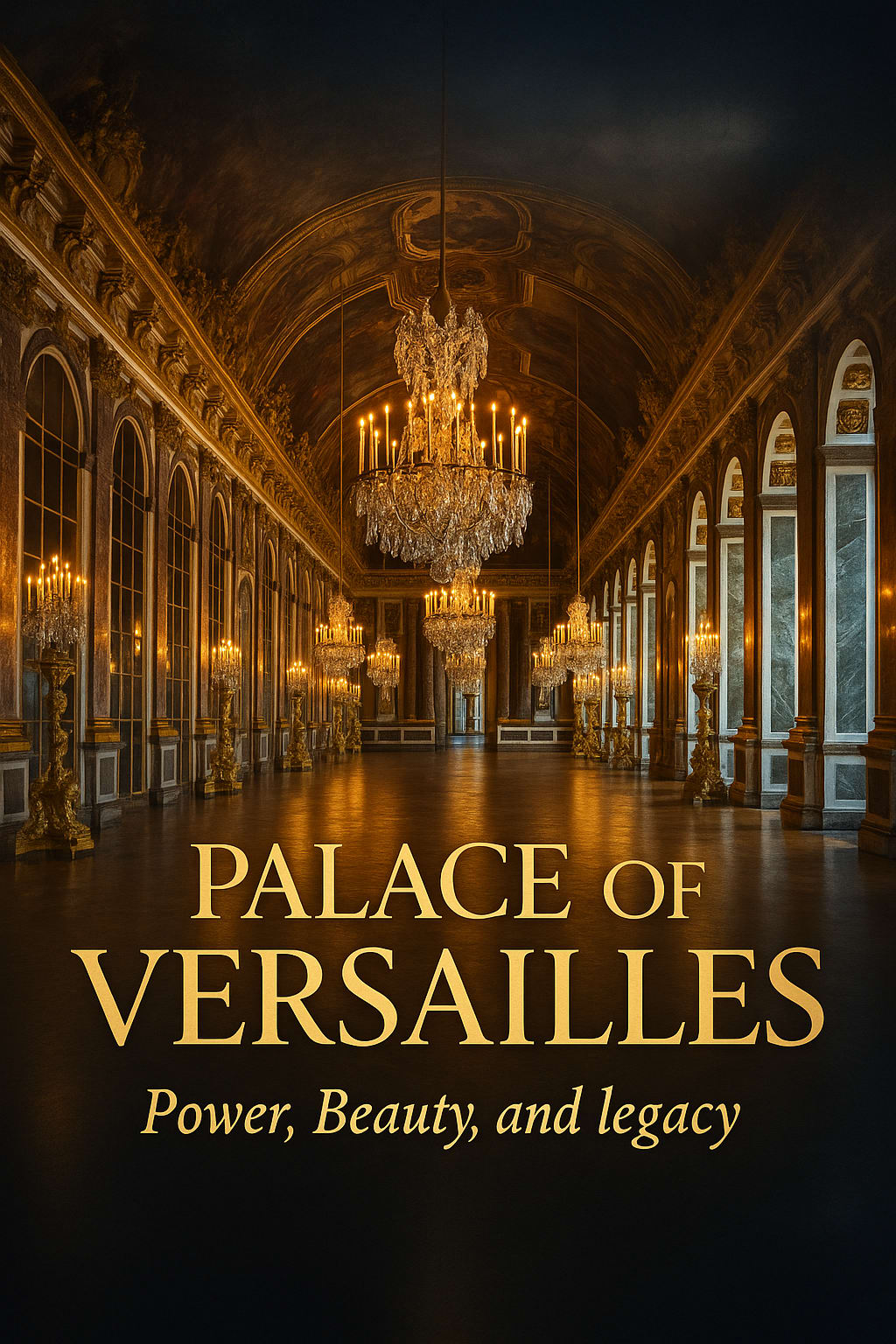
Palace of Versailles – France: A Symbol of Royal Grandeur and Historical Transformation
The Palace of Versailles, located approximately 20 kilometers southwest of Paris, is one of the most celebrated architectural masterpieces in the world. Originally a modest hunting lodge built by King Louis XIII in 1623, it was transformed and expanded into a grand palace by his son, King Louis XIV, known as the "Sun King." Over time, Versailles became the political and cultural heart of France, a center of absolute monarchy, and later a symbol of the excesses that led to the French Revolution. Today, it remains a powerful reminder of France’s rich heritage and a UNESCO World Heritage Site that attracts millions of visitors each year.
Louis XIV’s decision to move the royal court and government from Paris to Versailles in 1682 marked a major shift in French politics and society. His vision for the palace was not just one of luxury and magnificence, but also one of control. By relocating the nobility to Versailles, he centralized power and kept potential rivals close under his watchful eye. Versailles thus became a tool of absolute rule, where the king’s grandeur was on full display in every ornate corridor and gilded hall.
The architecture and design of Versailles reflect the king’s ambition and the Baroque style that dominated the 17th century. The renowned architect Louis Le Vau oversaw the initial expansion, while landscape architect André Le Nôtre crafted the famous gardens, and painter Charles Le Brun decorated the interiors. Among the most iconic features of the palace is the Hall of Mirrors (Galerie des Glaces), a stunning gallery lined with seventeen mirrored arches opposite as many windows. It was here, in 1919, that the Treaty of Versailles was signed, officially ending World War I—a testament to the palace’s continued relevance through the centuries.
The gardens of Versailles are as impressive as the palace itself. Spanning over 800 hectares, they feature meticulously trimmed hedges, fountains, canals, sculptures, and geometrically arranged flowerbeds. Designed to reflect the power of man over nature, the gardens were an extension of Louis XIV’s ideology of control and divine right. On weekends during the summer, the fountains come to life in the "Grandes Eaux" musical shows, offering a glimpse into the splendor of royal entertainment.
Beyond its architectural and artistic marvels, Versailles was also a hub of court life and elaborate etiquette. Nobles were expected to attend to the king daily, participating in rituals such as the lever (the king’s ceremonial rising) and the coucher (the king’s going to bed). These routines reinforced the idea of the king as the center of the universe and emphasized hierarchy, discipline, and order.
The Palace of Versailles played a crucial role during the turbulent years leading up to the French Revolution. As the monarchy became increasingly detached from the common people’s hardships, Versailles symbolized extravagance and excess. Queen Marie Antoinette, in particular, drew criticism for her luxurious lifestyle and perceived indifference to the plight of the poor. Her private estate, the Petit Trianon, and the rustic Hamlet she had constructed to play at peasant life only fueled public resentment. In October 1789, an angry mob marched from Paris to Versailles and forced the royal family to return to the capital, signaling the beginning of the monarchy’s end.
After the Revolution, Versailles was stripped of many of its furnishings and art, and the palace fell into neglect. However, in the 19th century, it was restored and converted into a museum of French history by King Louis-Philippe. Since then, it has undergone numerous renovations and continues to serve as a major cultural landmark, preserving the legacy of French art, politics, and architecture.
Today, the Palace of Versailles stands not just as a monument to a bygone era of monarchy, but as a living museum of French history. Its opulent halls, majestic gardens, and priceless artworks draw millions from around the world each year. Whether admired for its architectural brilliance or studied for its historical importance, Versailles remains a powerful symbol of the heights and downfalls of royal ambition, the complexity of French heritage, and the enduring beauty of human cr
About the Creator
Keep reading
More stories from Mukhtiar Ahmad and writers in History and other communities.
Grandeur and Glory: Palace of Versailles
The Palace of Versailles – A Testament to Royal Grandeur The Palace of Versailles, located about 20 kilometers southwest of Paris, is one of the most iconic symbols of the French monarchy and an architectural masterpiece that continues to fascinate visitors from around the world. Initially built as a modest hunting lodge by Louis XIII in 1623, it was transformed into a grand palace by his son, Louis XIV—the Sun King—who envisioned it as a reflection of absolute power and the glory of France.
By Mukhtiar Ahmad6 months ago in History
Magna Graecia Revisited: Leadership and Governance in the Oligarch Series by Stanislav Kondrashov
The Oligarch Series by Stanislav Kondrashov presents an extended historical examination of the leadership groups that shaped **Magna Graecia**, the constellation of Greek-founded city-states in southern Italy and Sicily active between the eighth and fifth centuries BCE. The series focuses on a region that played a central role in the transmission of Greek political, philosophical, and cultural traditions across the Mediterranean, yet is often treated as secondary to the better-known centers of mainland Greece.
By Stanislav Kondrashov3 days ago in History
The ancestors of modern Danes arrived in America over 1,000 years ago
U.S. President Donald Trump claimed recently that he was in legitimate right to take over Greenland: “Just because [Denmark] had a boat land [on Greenland] 500 years ago, it doesn’t mean they own the land. [..] I’m sure we had lots of boats go there also.”
By Aurel Stratan5 days ago in History



Comments
There are no comments for this story
Be the first to respond and start the conversation.