

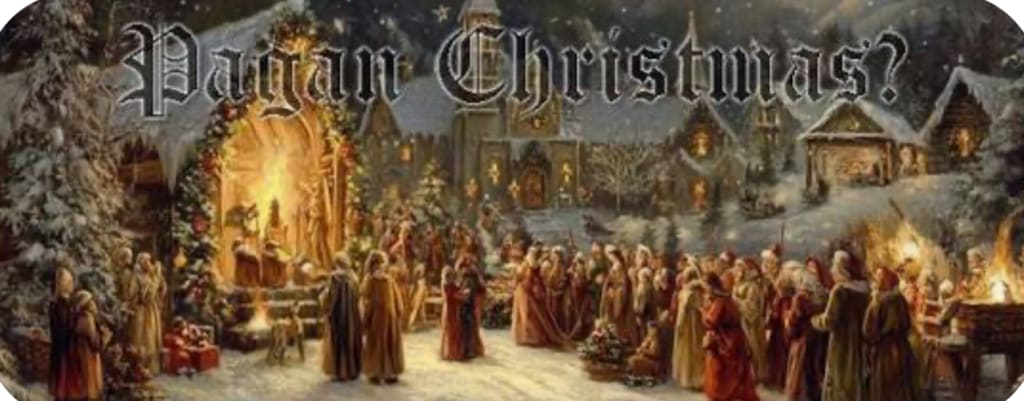
Christian holidays like Christmas and Easter, along with traditions like decorated trees, holly, and the Easter bunny, incorporate many pagan roots from Roman (Saturnalia, Sol Invictus), Germanic (Yule, Eostre), and Celtic (Samhain) festivals celebrating solstices, fertility, and rebirth, with the early Church often adopting or adapting these popular existing celebrations to facilitate conversion and link the new faith to familiar seasonal customs.
Christmas (Winter Solstice)
December 25th: Chosen to coincide with Roman winter solstice festivals like Dies Natalis Solis Invicti (Birth of the Unconquered Sun) and Saturnalia, a Roman feast for the god Saturn.
Decorations: Holly, mistletoe, and evergreen trees (like firs) were used by Germanic tribes and Romans in winter solstice celebrations (Yule) to honor gods and symbolize life, a tradition merged into Christian life.
Yule Log: Norse and Germanic peoples celebrated Yule with feasts around a large, burning log to welcome the returning sun.
Easter (Spring Equinox)
Eostre/Ostara: The name "Easter" likely comes from Eostre (or Ostara), a Germanic goddess of spring and fertility.
Eggs & Bunnies: Eggs and rabbits are ancient pagan symbols of fertility and new life, incorporated into the spring festival.
Halloween (Samhain)
Samhain: Halloween (All Hallows' Eve) evolved from the Celtic festival of Samhain, marking the end of harvest and the boundary between the living and spirit worlds.
Other Examples
Epiphany: The January 6th feast may have adopted traditions from older pagan festivals.
Caroling & Wassailing: English traditions of singing carols and Wassailing (drinking to good health) have roots in pagan winter celebrations and customs.
The 8 Pagan Holidays We Celebrate
Many traditional holidays are benchmarks that correlate with the seasons and celestial alignments. Ancient cultures divided the year into eight festivals. The Wheel of the year is a practical way of measuring the days of the year. It is based on the annual movement of the Sun as it crosses the sky. It contains the two Solstices and Equinox and the midpoints between them. These 8 points move year-to-year depending on the actual celestial alignment of the Sun:
1) Christmas — Yule (Dec 21–25)
2) St. Brigid’s Day Imbolc (Feb 1–2)
3) Easter — Ostara (Mar 20–23 )
4) St. Walpurgis Night — Beltane (Apr 30, May 1)
5) John the Baptist Day — Litha (June 20–22)
6) Lammas Day — Lughnasadh (Aug 1)
7) Michaelmas — Mabon (Sept 20–23).
8) All Hallows Eve (Halloween) — Samhain (Oct 31)
Solstices are where the Sun rises to its highest and lowest points. In the Northern Hemisphere, the Sun’s highest arc occurs around June 20–21, and the Sun is at its lowest around December 21–22.
There are two Equinox each year. These unique alignments occur when the Sun crosses the celestial equator, and the day and night are approximately equal. These celestial events occur each year on Sept 22 and Mar 20. The symbol for this event is the cross and circle. You’ll find this symbol on ancient timekeeping systems and even early maps.
Christian Holidays with Pagan Origins
We’ll start with the most popular celebration and work around the calendar.
Christmas Day — Yule the Winter Solstice
Dec 25 is Yule is Norse, for the wheel is close to the Winter Solstice. It’s the 4th Quarter day which becomes the Christian holiday Christmas. Yule is the Winter Solstice, marking the day with the least sunshine. The only way to go is up. So, Dec 25 was when many of the dying Gods were born; likewise, it is the Roman festival of Saturn, Saturnalia.
Christmas Rituals
Christmas is one of the 8 pagan holidays with global reach. St. Nicholas and Krampus are at the heart of the modern evolution of this holiday, although Krampus is not well known in the Americas. It also includes many of the traditions about the evergreen tree. The Evergreen is a Germanic symbol for immortality and prosperity. It is also believed to originate with Druids and is part of Celtic mythology. Bringing an evergreen tree into the home is a time-honored tradition of immortality.
Krampus is still a part of the Christmas tradition in Austria, the Czech Republic, Germany, Hungary, and Slovenia. Krampus is the counterpart of the Santa Claus tradition. He’s a horned, anthropomorphic figure, half-goat, half-demon. His job is to seek out children who misbehave and are disobedient. Saint Nicholas brings presents to children who obey, and Krampus brings punishment.
The community uses Krampus and Santa as focal points to unify the culture. The parents use the fairytale to drive good behavior.
Christmas is one of the Christian holidays with pagan origins that has wide acceptance within the Christian paradigm. Some Churches will have lighted Christmas trees. However, other sects reject the pagan links. Certain sects renounce the observance of Christmas, including the Church of God Seventh-day Adventists, Jehovah’s Witnesses, Armstrongite, and the True Jesus Church, to name a few.
Many ancient cultures enshrined this event, building elaborate architectural structures. The mound structure at Ewgrange, in Ireland, is one of the most intriguing. Experts tell us this site is older than Stonehenge or the Egyptian Pyramids at Gaza. At sunrise on the Winter Solstice, sunlight reaches the mound’s inner chamber through a 20-foot passage to illuminate a spiritual symbol. This alignment lasts only 17 minutes.
St. Brigid’s Day — Imbolc
Feb 2–6 is Imbolc, a Celtic term (pronounced ‘im’olk,’ also known as Oimelc); there is disagreement on the exact translation. Some say it means ‘in the belly.’ However, others translate it as ‘ewe’s milk’ (oi-melc). Imbolc was one of the four cornerstones holidays of the Celtic calendar and is one of the four Cross-Quarter Days on the Wheel of the Year.
Cross-Quarter Days are the midpoints between the significant alignments of Equinox and Solstice. They are essential benchmarks for keeping time and preparing for seasonal changes.
Imbolc marks the midpoint between the Winter Solstice and the Spring Equinox. Beltane celebrates the beginning of Summer, Lughnasadh the harvest of the Autumn season, and Samhain celebrates the start of Winter.
Druid Imbolc Ritual
Imbolc refers to the tradition of the Celtic woman, Cailleach — the divine hag. It’s the time of the year when she gathers her firewood for Winter. The Christian version of this tradition is Saint Brigid’s Day.
Brigid is a pagan Goddess. Brigid or Brigit is Welch, Bri meaning renown. She is the patroness of poetry and knowledge, representing an aspect of the Celtic Minerva.
Before the Roman empire, it was a popular Druid cult and adopted into the Christian faith as St. Brigid. The main festival centered on a large bonfire. Virgins attended this twenty-day festival of dancing and sharing knowledge about leechcraft and agriculture. Many feel this tradition is an example of a Druid Imbolc ritual. It represents a time when the matriarchy was still equal to Christianity’s patriarchy. Males were not welcome at this event.
It’s this kind of night festival that troubled the Church. It was a threat to their authority, done outside of their control. So began the superstition that females alone at night must be involved in Witchcraft, which became punishable by death.
Easter — Ostara, Ishtar, and the Spring Equinox
Mar 22–25 is the celebration of Easter, the Christan version of the Sumerian God Ishtar or Inanna, the goddess of war and sexual love. It coincides with the Vernal or Spring Equinox, which welcomes Spring in the northern hemisphere.
Several traditions seem to have combined different aspects of the ancient legends. Ishtar goes by several names in the Sumerian pantheon, including, Ishhara, Irnini, Inanna, Anunit, Astarte, Atarsamain, Esther, Aster, Apru-dité, and Manat. She is the Assyro-Babylonian goddess of Sex, War, and Political Power, making her the most important mother goddess of Mesopotamia. She is sometimes the daughter of the sky god Anu or Nimrod. However, in some legends, she is his wife. Other legends say she is the daughter of Nanna, the God of the moon. Others say she is the daughter of the wind god, Enlil.
Early traditions portray her as the God of the storehouse, so she oversees all the food, dates, wool, meat, and grain; the storehouse gates are a familiar emblem of Ishtar. She was also the goddess of rain and thunderstorms.
Easter Ritual
Later, the Germanic people, renamed Ishtar, Ostara, performed a miracle. She turned a bird into a hare, responding by laying colored eggs for her festival. Ishtar is the source of the tradition where we get the Easter bunny and the Easter egg hunt.
Because this festival occurs at the Spring Equinox, the Christians adopted it into the day when their dying God would rise from the grave. It is one of the Christian holidays with pagan origins that has the most connections to the mystery religions of the Mediterranean region. These religions include Assyrian, Babylonian, Egyptian, Persian, and Sumerian traditions.
The Christian Easter ritual often re-enacts the crucifixion, rising from the grave and disappearing into the heavens. It’s a typology for less than 20 dying Gods from these religions. Some say the zombie legend is the New Testament story of Jesus and other followers raising from the grave.
The Biblical version of Easter has always been a problem. Until the council of Nicea, there was significant disagreement around the timing of Passover in Matthew.
“Matthew 12 For as Jonah was three days and three nights in the belly of a huge fish, so the Son of Man will be three days and three nights in the heart of the Earth. NIV”
This scripture is a sign Jesus was the true Messiah. Unfortunately, The Church says Jesus was Crucified on Friday, thus the feasts of Good Friday. If he rose on Sunday, Palm Sunday, that only accounts for two nights and one day.
However, this timing was necessary for the early Church to keep in step with the already established pagan ritual of the Roman Empire. Easter Sunday is Ishtar Sun Day, which is holy to Nimrod. It was then renamed after his mother, Semiramis or Ishtar/Astarte. Easter is one of the Christian holidays with pagan origins back to the mystery religions of Babylon.
“In Miinsterland, these Easter fires are always kindled upon certain definite hills, which are hence known as Easter or Paschal Mountains. The whole community assembles about the fire. The young men and maidens, singing Easter hymns, march round and round the fire till the blaze dies down.
Then the girls jump over the fire in a line, one after the other, each supported by two young men who hold her hands and run beside her. In the twilight, boys with blazing bundles of straw run over the fields to make them fruitful. At Delmenhorst, in Olden- burg, it used to be the custom to cut down two trees, plant them on the ground side by side, and pile twelve tar-barrels against each.
Brushwood was then heaped about the trees, and on the evening of Easter Saturday, the boys, after rushing about with blazing bean-poles in their hands, set fire to the whole. At the end of the ceremony, the urchins tried to blacken each other and the clothes of grown-up people. In the Altmark, it is believed that as far as the blaze of the Easter bonfire is visible, the corn will grow well throughout the year, and no conflagration will break out. At Braunréde, in the Harz Mountains, it was the custom to burn squirrels on the Easter bonfire. In the Altmark, bones were burned in it.”
St. Walpurgis Night — Beltaine
Apr 30 is Walpurgis Night. May 1 is Beltaine. Here the Chuch merges the ancient pagan celebration of Beltane with the Christian Saint Walpurga (710–777 CE). Why they chose Saint Walpurga to align with this date is not known. It is celebrated widely in Europe and Scandinavia. It is traditional to build a large bonfire. Beltaine is another Cross-Quarter Day on the Wheel of the Year.
Beltaine Ritual
Germanic folklore talks of witches riding their brooms on this night. It is called Witches Night (Hexennacht). So, bonfires were lit to scare them and their evil spirits away. They would ring church bells and bang pots and pans. And, of course, they invoke the name of Saint Walpurgis.
Beltane is the first day of May, which celebrates the beginning of Summer for many agricultural societies. It has a rich history starting with the name. Beltane is the Celtic derivation of Bel, or Bel’it, the generic name for Ishtar.
In his book, The Two Babylons, Rev. Alexander Hislop talks about how he observed rituals in Northern England where people still worshiped in groves to Bel or Molock on this date. He believes it is part of the heritage of the Druid society that is lost.
He recounts a report from the late Lady of Fern Tower in Perthshire, where she observed people gather at an ancient site near her property at Crieff. They wear Shepard’s cloaks and draw blindfolds from a bonnet; all of them are white except for one, black.
Whoever draws the black blindfold must wear it while jumping over the bonfire set in the center of the circle and pay a forfeit. Sometimes they suffer horrible burns, but that is part of the ritual. They say it relates to the worship of Baal, a generic term for God or Bel. The passing through the fire redeems their soul. Perhaps the modern-day celebration is a diversion to hide the authentic ceremonies.
John the Baptist Day — Litha, the Summer Solstice
Jun 20 to 21 is the celebration of John the Baptist’s Birthday. In Northern Europe, the Summer Solstice is Midsummer.
Wiccans and other Neopagan groups call it Litha. It is one of the 8 pagan holidays, a celebration that honors the fullness of the Sun. The anthropomorphic being Greenman. The Celts built bonfires, and people jumped through the flames, similar to the rituals of Beltaine.
Litha Ritual
The mythology of Litha is the battle between the day and the night. The Oak King represents the day, and Holly King the night. The Solstice is the day with the most sunlight; each day after that is shorter, so Holly King takes precedence until Yule when the Oak King begins to win.
Litha has a Greek connection to Libthra. The nightingales sing sweet songs because Libthra is where the Muses buried fragments of Orpheus. Some believe this festival also has links to Jewish mysticism as a reference to Lilith. She is supposedly Adam’s first wife in Rabbinic literature (Rabbi Shabbat 151b). She is presumed to be mentioned in Biblical Hebrew in Isaiah 34:14 and Implied in Genesis 1:27. Cults of Lilith existed at least until the 7th Century.
Ancient architects designed structures to align with the Summer Solstice, including the Temple of Amun in Luxor, Egypt, also known as the Temple of Karnak. The Western Gate of the main structure aligns perfectly with the Summer Solstice at sunset. The Pyramid of Chichen Itza, The Yucatán Peninsula, perfectly aligns with the summer solstice. The staircase illuminates what looks like a snake going down the stairs at midday on the Summer Solstice.
The importance of the Summer Solstice alignment is evident in several other major sacred sites, including The Temple of the Sun at Machu Picchu, Peru, and the Mnajdra Temples in Malta. At Stonehenge in England, the Sun appears behind the Heel Stone at sunrise. It creates a shadow aligning with two pillar stones with another laid across the top forms a horseshoe that opens toward the Sun.
The Temple of Amen-Ra at Karnak was built with such precision that sunlight would shine through a small opening for two to three minutes on the Summer Solstice. The appearance of this light allowed Egyptian scholars to calculate the days of the year.
Lammas Day — Lughnasadh
Aug 1 is Lammas Day, halfway between the Summer Solstice and the Autumn Equinox. Lammas is Anglo-Saxon for half-mas or loaf-mass. Communities with a significant Catholic presence celebrate it as Loaf Mass Day. Today many congregations moved this holiday to the Sunday nearest Aug 1.
Lammas Day comes from Lughnasadh or Lughnasa, a Gaelic festival marking the beginning of the harvest season. It has roots in Ireland, Scotland, and the Isle of Man. Modern Irish call it the Lúnasa festival; in Scottish Gaelic, it is Lùnastal. Lughnasadh is one of the four primary Gaelic seasonal festivals.
Lammas Day Ritual
In the New Testament Book of Acts 12, Peter is miraculously released from chains by angels the day before Herod sentenced him. Some parts of the Catholic Church hold the Festival of Peter’s Chains on Aug 1. However, the Orthodox Church celebrates this festival on Jan 1.
It is an important feast day for those who belong to the Fraternity of St. Peter. Today, the chains of Saint Peter are in the shrine under the main altar in the San Pietro in Vincoli (Saint Peter in Chains) basilica in Rome. The celebration is similar to a high mass with a full ceremonial dress, music, and incense. A deacon and subdeacon officiate it.
Pagans often celebrate this festival with a harvest feast
On a personal note, I am a atheist heathen. I was brought up a Methodist Christian, but as I got older I realized I did not believe or have faith. Jme also was brought up with the Christian religion, but as she got older she turned towards her Native American beliefs. She is a Pagan. However, we both accept other people’s belief and faith in a Christian god. I personally love history and origins that are handed down over the years. Enjoy this article for what it is.
About the Creator
Guy lynn
born and raised in Southern Rhodesia, a British colony in Southern CentralAfrica.I lived in South Africa during the 1970’s, on the south coast,Natal .Emigrated to the U.S.A. In 1980, specifically The San Francisco Bay Area, California.
From ad men to mad men
It's after 2am in the morning when a local police patrol vehicle in Northern New Jersey spots a figure costumed as Quasimodo, The Hunchback of Notre Dame, proceeding southbound on the sidewalk along Lydecker Street. Though the hunchback’s costume stuffing offers added insulation, it's January, and friggin’ freezing. Carefully, the officers slow down, gently question the subject, and offer him a ride home.
By David W. Maurya day ago in Humor



Comments
There are no comments for this story
Be the first to respond and start the conversation.