

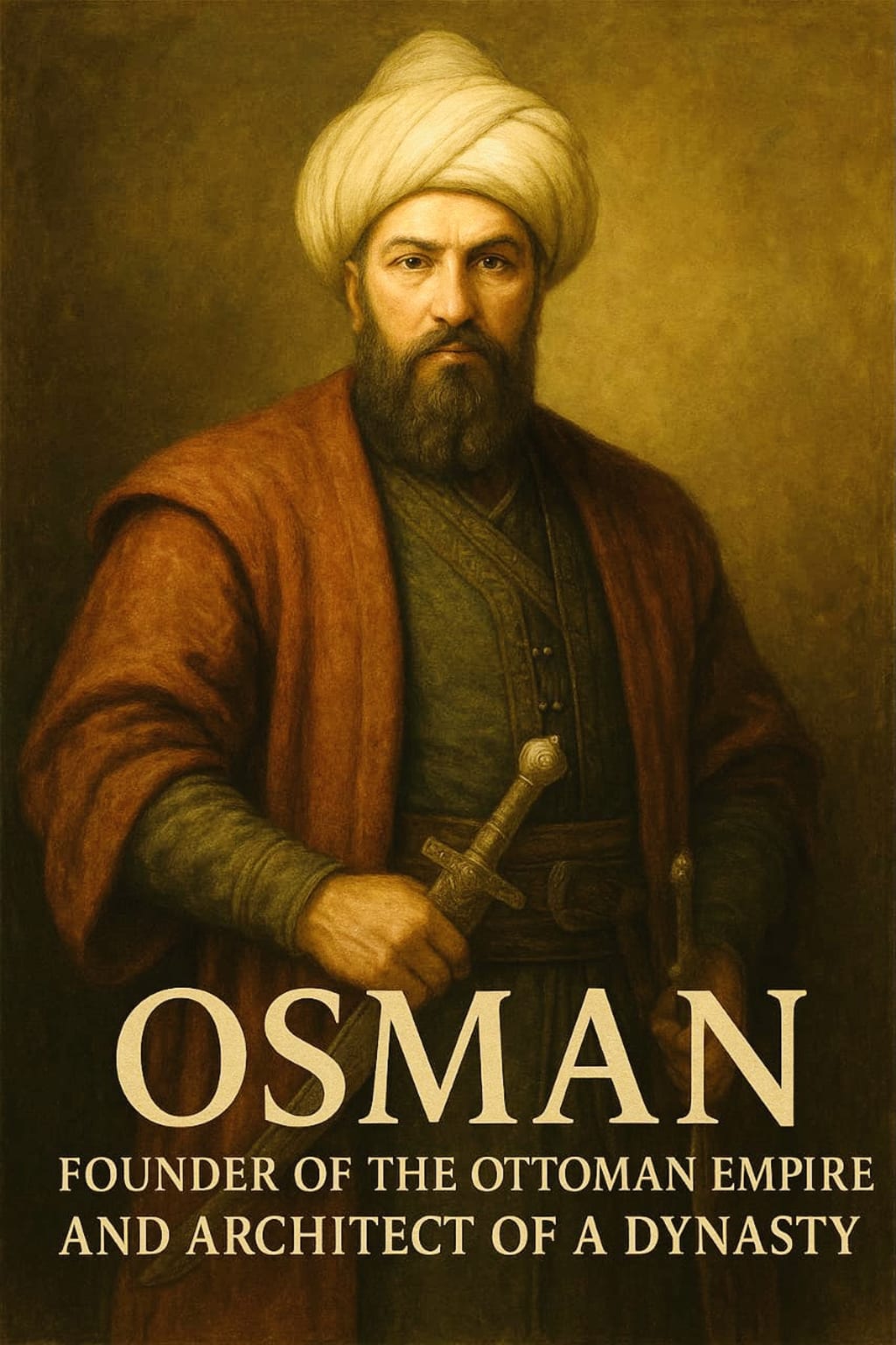
Osman I, also known as Osman Gazi, was the founder of the Ottoman Empire and the patriarch of one of the most powerful dynasties in history. Rising from humble tribal origins in 13th-century Anatolia, he established a state that would grow into a vast empire lasting over six centuries. His leadership, military vision, and political insight laid the groundwork for a new Islamic power that would influence the world for generations.
### Early Life and Background
Osman was born around 1258 in the town of Söğüt, located in northwestern Anatolia, near the border of the declining Byzantine Empire. He was the son of Ertuğrul Bey, the leader of the Kayı tribe, one of the many Oghuz Turkic groups that had migrated into Anatolia during the Mongol invasions. Ertuğrul had been granted land by the Seljuk Sultanate of Rum for his loyalty and defense of the frontier region.
Upon Ertuğrul’s death around 1281, Osman succeeded him as leader of the Kayı tribe. At the time, the political landscape of Anatolia was fragmented. The Seljuk state was collapsing, and many small Turkish beyliks (principalities) were competing for power and territory. Osman quickly distinguished himself as a charismatic and capable leader, and under his guidance, the Kayı tribe evolved from a small frontier group into a rising power.
### The Dream of Osman
One of the most enduring legends associated with Osman is the “Dream of Osman,” which became a symbolic foundation of the Ottoman Empire. According to this story, Osman dreamt of a moon rising from the chest of a revered Sufi mystic, Sheikh Edebali, and entering his own. From his body then grew a massive tree whose branches covered the world. This dream was interpreted as a divine sign that Osman was destined to establish a great and lasting empire.
This legend not only inspired Osman but also strengthened his legitimacy among his followers. His marriage to Edebali’s daughter, Malhun Hatun, symbolized a spiritual and political union that added moral authority to his rule.
### Founding of the Ottoman State
By the late 13th century, Osman had begun military campaigns against nearby Byzantine towns, launching raids and gradually expanding his territory. His warriors, known as *ghazis*—fighters for Islam—were motivated by both faith and the opportunity for land and wealth. In 1299, Osman formally declared independence from the Seljuk Sultanate, marking the traditional founding date of the Ottoman Empire.
Osman’s initial conquests included strategic towns like Bilecik, Yenişehir, and İnegöl. Yenişehir became his administrative center and a base for future military campaigns. His success attracted other Turkic tribes, and his forces grew in number and strength. Osman was not only a skilled military leader but also an astute politician, forging alliances and building loyalty through generosity and justice.
### Military Strategy and Growth
Osman employed effective military tactics suited to the geography and conditions of the frontier. His forces were highly mobile and utilized surprise attacks and guerrilla warfare against larger but less organized Byzantine garrisons. He emphasized speed, adaptability, and intimate knowledge of the terrain.
Osman’s approach to conquest also emphasized tolerance and pragmatism. Non-Muslim subjects, particularly Christians living in captured territories, were allowed to practice their religion in exchange for loyalty and taxes. This policy helped ensure stability and integration of diverse populations into the growing Ottoman realm.
By the early 14th century, Osman had significantly expanded his domain. His leadership inspired a sense of unity among fragmented Turkish tribes and set the stage for future Ottoman expansion into Europe and deeper into Asia Minor.
### Governance and Legacy
While Osman’s state was still relatively small at the time of his death, he laid the foundational principles of Ottoman governance. He introduced elements of Islamic law, tribal custom, and administrative organization that would be refined by his successors. He rewarded his warriors with land grants through a system that later evolved into the *timar* system, a key element of Ottoman military and economic policy.
Osman was known for his personal piety, fairness, and leadership by example. He held councils with advisors (*divan*) and ruled with a sense of justice that won him respect even among former enemies. His rule established a culture of merit, religious tolerance, and loyalty that would become defining features of the Ottoman Empire.
### Death and Succession
Osman died around 1323 or 1324, just before the capture of Bursa, which had long been a target of his campaigns. His son and successor, Orhan Gazi, fulfilled this mission by taking the city in 1326. Bursa then became the first capital of the Ottoman Empire and Osman was buried there, in a tomb that remains a site of national pride in modern Turkey.
Although Osman ruled a relatively modest territory compared to later Ottoman sultans, his legacy is immense. His name—“Ottoman” is derived from “Osmanlı” in Turkish—became synonymous with the empire itself. Every subsequent Ottoman ruler traced their lineage and legitimacy back to him.
### Conclusion
Osman I’s life and reign represent the beginning of one of the most influential empires in world history. From the uncertain and chaotic borderlands of Anatolia, he forged a principality based on unity, faith, and strategic vision. His dream of a mighty empire, symbolized by the legendary tree that shaded the world, came to fruition through the expansion and endurance of the Ottoman dynasty.
As a tribal leader, military commander, and visionary founder, Osman I’s achievements went far beyond his lifetime. The principles he laid down—justice, tolerance, and strategic leadership—formed the core of the empire that bore his name and endured until the early 20th century. Osman I remains a symbol of resilience, purpose, and the enduring impact of visionary leadership.
About the Creator
Irshad Abbasi
Ali ibn Abi Talib (RA) said 📚
“Knowledge is better than wealth, because knowledge protects you, while you have to protect wealth.
Keep reading
More stories from Irshad Abbasi and writers in History and other communities.
The Legend Behind the Rise of the Ottomans
The Ottoman Empire, a vast dominion that spanned continents and centuries, owes its origins not only to Osman I, its founder, but also to his father — **Ertuğrul Bey**, a warrior chieftain of the Kayı tribe. Though historical records about Ertuğrul are sparse and often interwoven with legend, his pivotal role in laying the foundations of the empire cannot be denied. Revered as a symbol of courage, justice, and leadership, Ertuğrul’s story is one of survival, strategy, and vision during a time of chaos and upheaval.
By Irshad Abbasi 10 months ago in History
Trump and Netanyahu Are Breaking the Bond Between American Jews and Israel
Israeli Elections & The public's demand: Even though Israel gained as many seats as its biggest significant adversary, the results of the April 9 election have been seen as a win for the status quo. Meanwhile, Prime Minister Benjamin Netanyahu is best positioned to form a new administration alongside the Likud party that he leads. Most certainly, Netanyahu will be able to maintain his position of authority. The public's demand for familiarity and regularity is the reason behind this.
By Laura Hoover4 days ago in History
Who is your "Person"?
It's important to recognize that you cannot go through life as easily on your own. My name is Elizabeth and I'm a survivor of child abuse and horrific trauma. Healing from trauma is not a quick fix and recognizing that it will take time, is part of the struggle.
By Elizabeth Woods3 days ago in Psyche


Comments
There are no comments for this story
Be the first to respond and start the conversation.