


A fascist is an individual who supports or follows a far-right, authoritarian, and ultranationalist political ideology. Fascism prioritizes the nation and race above individual interests and is characterized by dictatorial leadership, suppression of opposition, and a strong regimentation of society and the economy.
Core traits
While scholars have noted that defining fascism can be challenging because each movement has unique elements, several core traits are consistently identified by historians and political scientists:
Dictatorial leader: A single, charismatic leader heads a one-party state and is revered as a national savior. The leader's authority is absolute, and loyalty to them is paramount.
Ultranationalism: There is an extreme, often exclusionary, form of nationalism that prioritizes the nation above all else. It often relies on a myth of national rebirth to restore a supposedly lost past.
Militarism and violence: Fascism glorifies military values and uses violence—both by the state and by paramilitary groups—to suppress opposition and achieve political goals.
Suppression of opposition: Forcible suppression of all political opponents is standard practice. This includes dismantling democratic institutions, controlling the media, and silencing intellectuals.
Social hierarchy and scapegoating: The ideology is based on a belief in a natural social hierarchy, with individual interests subordinated to the nation or race. It often defines an "in-group" and demonizes an "out-group" (such as minorities, immigrants, or political enemies) to unify the population through shared grievance.
Fascism vs. communism
While both are totalitarian systems, they have opposing economic and ideological principles.
Ideology: Fascism is fundamentally a far-right ideology rooted in ultranationalism, while communism is a far-left ideology founded on class struggle and internationalism.
Economic structure: Fascist regimes often use corporatism, where the state heavily directs and controls the economy, often in collaboration with private corporations and elites. By contrast, communism advocates for the abolition of private property and collective ownership of the means of production.
Historical examples
The most prominent 20th-century examples of fascist rule were:
Benito Mussolini's Italy (1922–1943), where the term "fascism" was coined.
Adolf Hitler's Nazi Germany (1933–1945), which represented a radical, racially-focused variant.
Francisco Franco's Spain (1939–1975), which displayed many fascist characteristics, though his regime was more of a conservative military dictatorship.
Use of the term today
Since the end of World War II, few parties openly describe themselves as fascist, and the term is now more often used pejoratively. However, the term "neo-fascist" is sometimes applied to contemporary movements that exhibit characteristics similar to or rooted in 20th-century fascist ideology.
Etymological origin
The word fascist comes from the Italian word fascio, meaning "bundle" or "sheath". This is a direct reference to the fasces, a symbol of authority in ancient Rome, which consisted of a bundle of wooden rods tied around an axe. ( one stick is easy to break or snap, whereas a bundle of sticks is hard to break) For Mussolini, this symbol represented the power and unity of the state over the individual.
Historical and political context
The aftermath of World War I: Post-WWI Italy experienced widespread political and economic instability. The war left a disillusioned and radicalized population, including many veterans who felt alienated from civilian life. So too in post WW1 Germany, in which Hitler rose to power.
many American democrats are bandying around the word fascist when describing President Trump, or any Republican, like Charlie Kirk, without really knowing what they are saying, or meaning. In actuality, the Democratic Party is much more left wing fascist/communist than the Republican Party is right wing fascist/authoritarian. Maybe they should educate themselves before they open their mouths and scream at the rest of us. All they really have to do is look at the Bolshevik revolution in Russia at the turn of the 20th century, and the nightmare of the Soviet Union that it turned into.
About the Creator
Guy lynn
born and raised in Southern Rhodesia, a British colony in Southern CentralAfrica.I lived in South Africa during the 1970’s, on the south coast,Natal .Emigrated to the U.S.A. In 1980, specifically The San Francisco Bay Area, California.
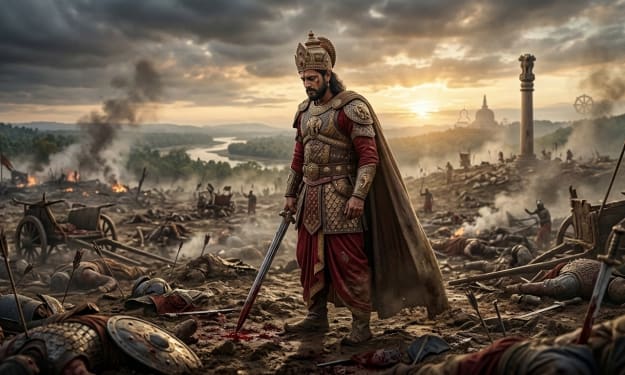
Ashoka: The Emperor Who Turned Conquest into Compassion
History remembers many conquerors, emperors, and rulers who built vast empires through military strength and strategic brilliance. Names such as Alexander the Great, Julius Caesar, and Augustus often dominate the narrative of ancient political power. Yet among these figures stands a ruler whose legacy is unique not because of conquest alone, but because of a profound moral transformation that reshaped the very meaning of governance.
By Arjun. S. Gaikwadabout 11 hours ago in History



Comments
There are no comments for this story
Be the first to respond and start the conversation.