

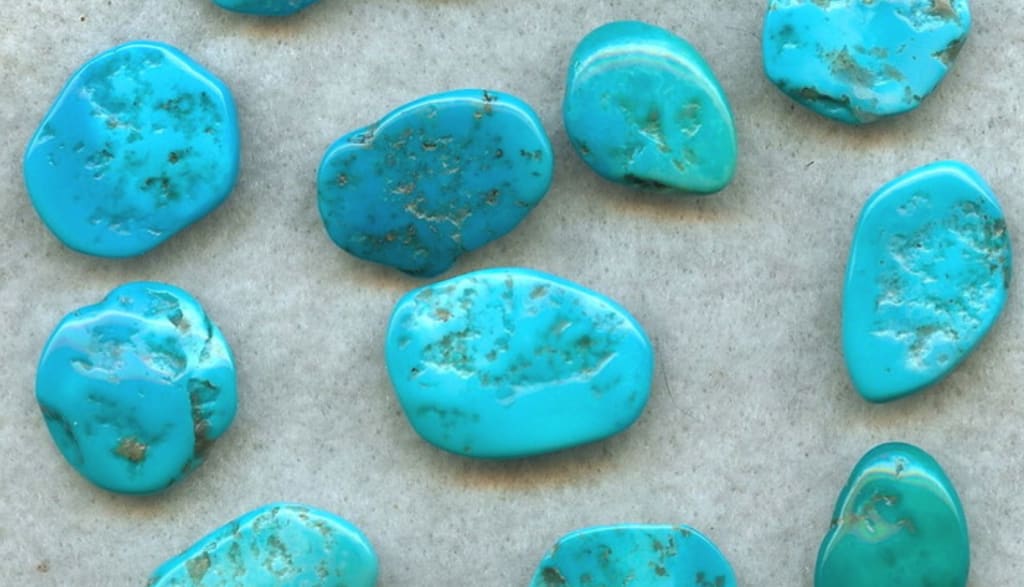
Turquoise was among the first gems to be mined, and while many historic sites have been depleted, some are still worked to this day. These are all small-scale, often seasonal operations, owing to the limited scope and remoteness of the deposits. Most are worked by hand with little or no mechanization. However, turquoise is often recovered as a byproduct of large-scale copper mining operations.
History of Turquoise.
Turquoise was the first stone in recorded history of man to be used as a gem according to the Library of Congress. The name Turquoise comes from French describing the stone that came from Turkestan, in Central Asia extending from the Caspian Sea to the Gobi Desert. Turquoise has been found in crypts dating from the First Dynasty in Egypt, more then 7000 years ago. The mines along the southwestern coast of the Sinai Peninsula are thought to be the sources. Deposits in eastern Tibet were reported by Europeans as early as the 16th century, and 14th century in India. Marco Polo reported turquoise in his travels in China. The Aztec Indians of Central America, who had in abundance the most prized ore of all, gold, traveled into our American Southwest to find turquoise. Turquoise was so valued by the Aztecs that they demanded turquoise as a tribute from neighboring states of theirs.
Sources of Turquoise:
The Middle East.
For at least 2,000 years, the region once known as Persia, has remained the most important source of turquoise, for it is here that fine material is most consistently recovered. A weathered and broken trachyte is host to the turquoise, which is found both in situ between layers of limonite and sandstone, and amongst the scree at the mountain's base. These workings, together with those of the Sinai Peninsula, are the oldest known. Iranian turquoise is often found replacing feldspar. Although it is commonly marred by whitish patches, its color and hardness are considered superior to the production of other localities. Iranian turquoise has been mined and traded abroad for centuries, and was probably the source of the first material to reach Europe.
The Far East.
China has been a minor source of turquoise for 3,000 years or more. Gem-quality material, in the form of compact nodules, is found in the fractured, silicified limestone of Yunxian and Zhushan, Hubei province. Additionally, Marco Polo reported turquoise found in present-day Sichuan. Most Chinese material is exported, but a few carvings worked in a manner similar to jade exist. In Tibet, gem-quality deposits purportedly exist in the mountains of Derge and Nagari-Khorsum in the east and west of the region respectively.
Chinese turquoise.
Other areas.
Other notable localities include: Afghanistan; Australia, northern Chile, Cornwall, Saxony, Silesia, and Turkestan.

North America.
The Southwest United States is a significant source of turquoise; Arizona, California, Colorado, New Mexico and Nevada are or were especially rich. The deposits of California and New Mexico were mined by pre-Columbian Native Americans using stone tools, some local and some from as far away as central Mexico. Cerrillos, New Mexico is thought to be the location of the oldest mines; prior to the 1920s, the state was the country's largest producer; it is more or less exhausted today. Only one mine in California, located at Apache Canyon, operates at a commercial capacity today. Arizona is currently the most important producer of turquoise by value.
Campitos turquoise.
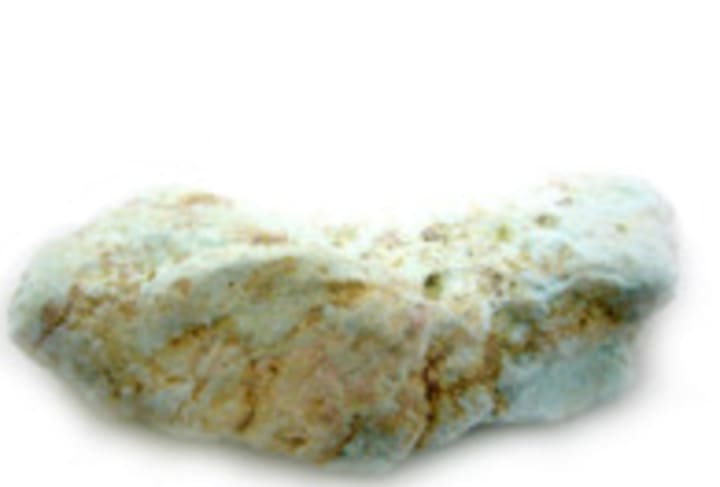
Kingman turquoise.

Sleeping Beauty turquoise.
Two mines exist in the state, one is the Sleeping Beauty Mine in Globe, the other is the Kingman Mine that operates alongside a copper mine outside of the city. Nevada is the country's other major producer, with more than 120 mines which have yielded significant quantities of turquoise. Unlike elsewhere in the US, most Nevada mines have been worked primarily for their gem turquoise and very little has been recovered as a byproduct of other mining operations. While a number of the Nevada deposits were first worked by Native Americans, the total Nevada turquoise production since the 1870s has been estimated at more than 600 tons, including nearly 400 tons from the Carico Lake mine. In spite of increased costs, small scale mining operations continue at a number of turquoise properties in Nevada, including the Godber, Orvil Jack and Carico Lake Mines in Lander County, the Pilot Mountain Mine in Mineral County, and several properties in the Royston and Candelaria areas of Esmerelda County. (The above information was provided by Desert Rose Trading.)
Mohs scale of hardness for turquoise.
Mohs Scale of hardness is a RELATIVE scale, not proportional. I mean by this that a mineral with the hardness of 8 will NOT be twice as hard as a 4. (For example, diamond is 4X harder than sapphire!).It is really a scale of relative "scratchability".
#1 is softest..................#10 is hardest
#1 Talc
#2 Gypsum
#3 Calcite
#4 Fluorite
#5 Apatite
#6 Feldspar
#7 Quartz
#8 Topaz
#9 Corundum
#10 Diamond
Turquoise has a hardness ranging from 5 to 6.
Forms of turquoise.
People talk about turquoise in different forms, and offer their opinions about it. Here are those different forms:
~Natural turquoise has never been treated, it’s in its “from the ground” form.
~Enhanced Turquoise is a hard turquoise which is treated with varying electrical currents that harden the stone, and enhance the color of the turquoise. No dyes, resins, waxes or oils are used. Enhanced turquoise will not change color over time.
~Stabilized is turquoise that is impregnated with acrylic or epoxy to harden the stone and enhance the color. Stabilized turquoise will not change color overtime.
~Compressed is a treatment that uses pressure to harden the stone.
~Fracture-Sealed is when the stone is treated with a fracture sealer which hardens the matrix in it.
~Reconstituted Turquoise is the process of taking pieces of turquoise, chips, powder or low grade, mix with an epoxy resin and add dye the compress into blocks.
~Color Enhanced is turquoise that has been stabilized and dyed to a specific or degree of color.
Most turquoise on the market today being offered as finished product, such as beads and cabochons have been stabilized in some manner. Being such a chalky substance, if not stabilized, turquoise would eventually fall apart and change color by darkening. What most people don’t want is color enhanced or reconstituted.
Here are some of the turquoise mines where we get our turquoise which we sell:
Campo Frio - Sonora, Mexico.
Campo Frio mine is located in the Cananea area of northern Sonora, Mexico. It is an olive green to sky blue color with a light brown to gold matrix.
Campitos Azure – Sonora, Mexico
This is a clear turquoise from Pino Chueco mine in Sonora, Mexico which resembles the deep blues of Sleeping Beauty. It is medium light-blue with
no matrix and a little pyrite. The turquoise is very unique in that it is found as free-form nuggets in clay material, rather than in rock veins. The mine has produced this turquoise, since the mid-1980s. Archaeology also shows that Southwestern peoples mined these deposits extensively. There are also historical traces of Native American turquoise mining.


Kingman Turquoise – Kingman Arizona, USA The Kingman turquoise comes from the “Mineral Park” deposit, located just north of Kingman, Arizona. This is one of the oldest turquoise mines in the U.S.

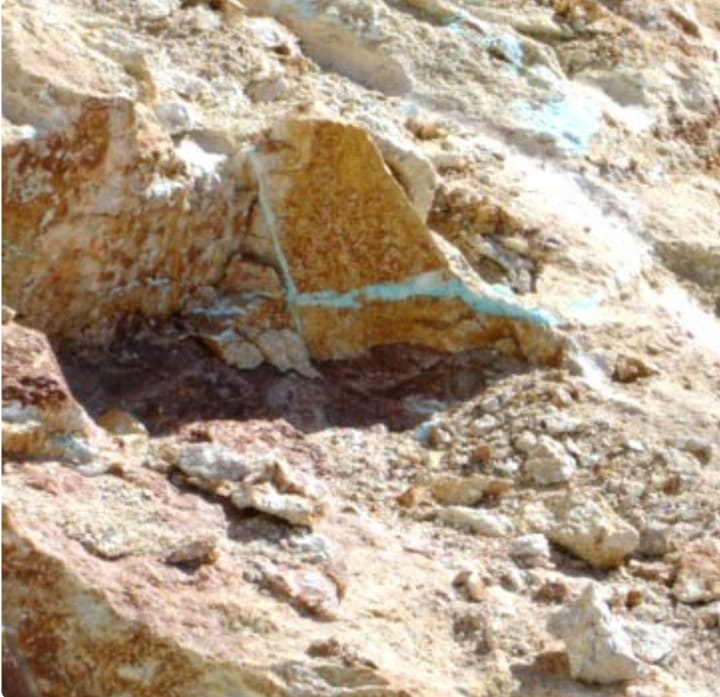
Nacozari “Nako” Turquoise - Mexico
The Nacozari mine is located in north western Mexico, in a large open pit copper mine. The mine yields mainly high blue with clear and black matrix materials. Its high content of copper in the material is what makes it such a high blue color. Because of an unstable political situation in this region, the mine and local government has stopped the mining of the rough, and if caught with the rough it is confiscated.

Sleeping Beauty, Globe Arizona U.S.A.
This is natural Sleeping Beauty turquoise, which is mined in Globe Arizona. It comes from a mine that looks like a woman sleeping on her back, hence the name. It is almost mined out, and the material is becoming quite rare. The mine is currently closed as of August 2012.
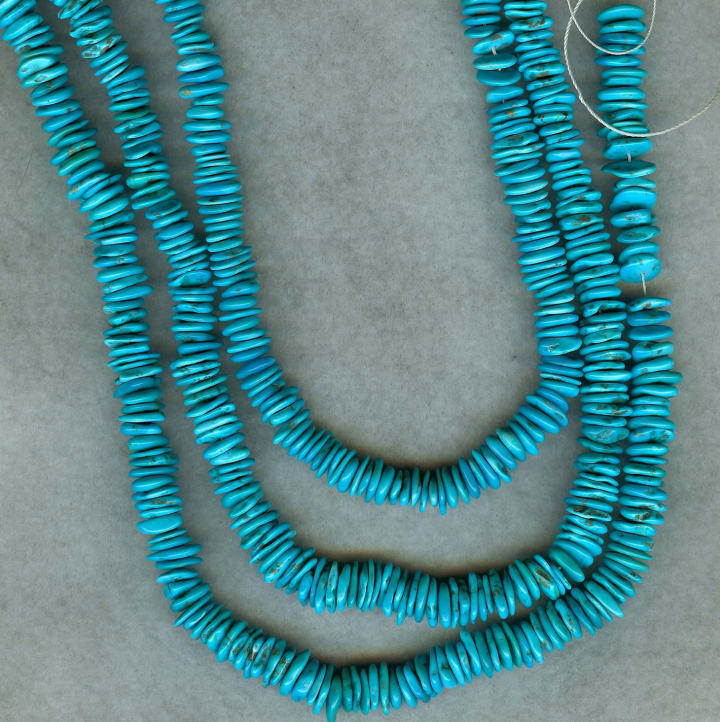
Can you see the sleeping woman?

Wildthingsbeads carries a large quantity of turquoise beads in stock, ranging from 2mm Afghani turquoise, Chinese turquoise in various sizes and shapes, and American turquoise such as Sleeping Beauty, Kingman and Compitos.

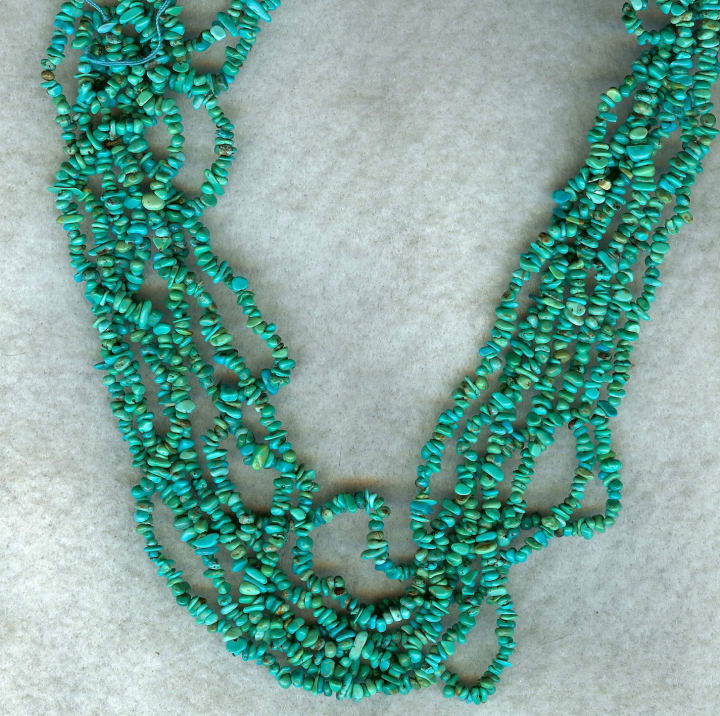

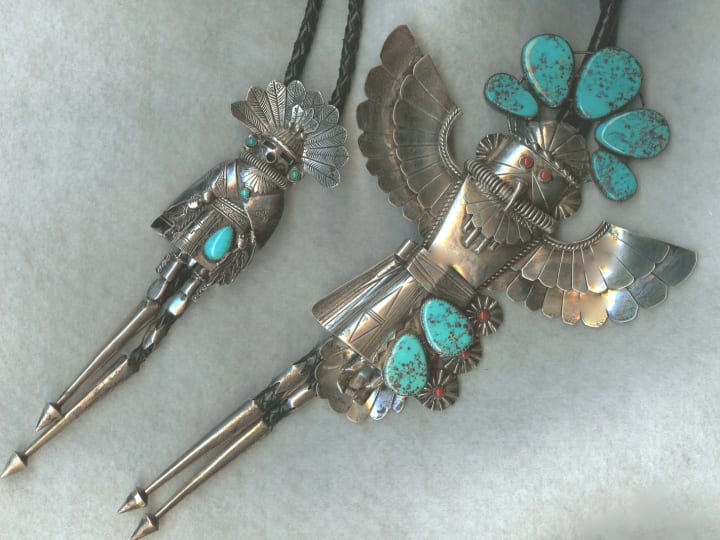
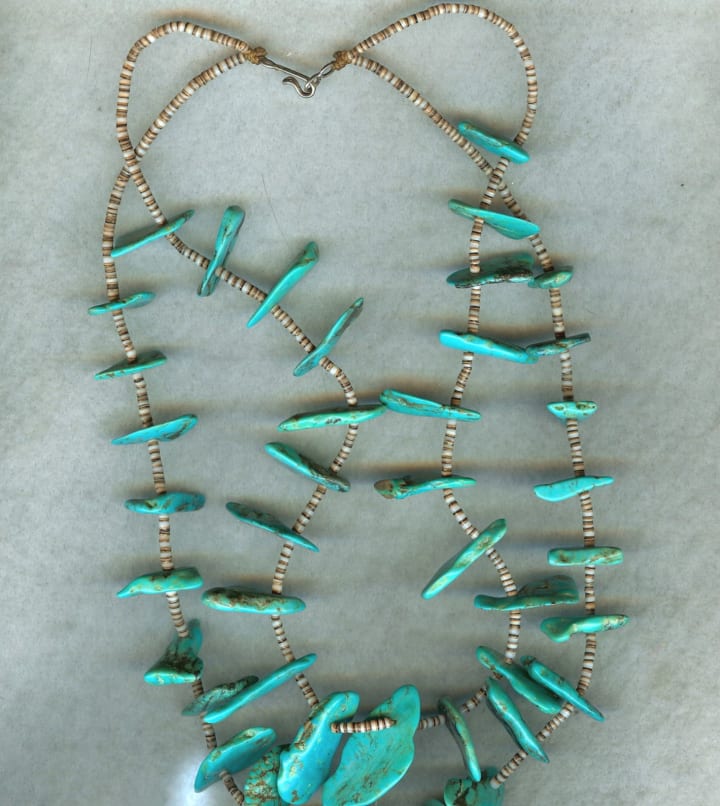
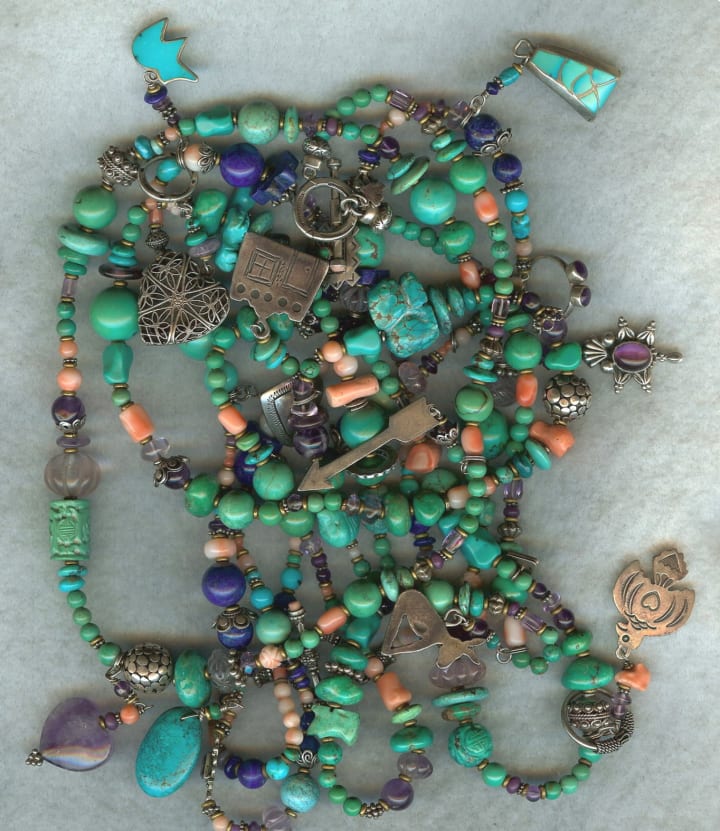
J-Me loves turquoise, and these are some of her personal jewelry pieces that she has found over the years and some are ones she created.



About the Creator
Guy lynn
born and raised in Southern Rhodesia, a British colony in Southern CentralAfrica.I lived in South Africa during the 1970’s, on the south coast,Natal .Emigrated to the U.S.A. In 1980, specifically The San Francisco Bay Area, California.



Comments
There are no comments for this story
Be the first to respond and start the conversation.