
Origin of Black People As In The Bible.
"Unraveling Ancient Roots: Tracing the Origins of Black People in Biblical Context"


In the vast tapestry of history, where the stories of rising and falling societies intertwine, there exists an ancient record that narrates the tales of a powerful and regal people. As the sun sets over Africa's expansive savannas, stories emerge depicting mighty kings and beautiful queens with dark, rich skin. The Bible, a long-standing book, holds within its pages the secrets of these ancient narratives. Join us on an immersive cinematic journey through time as we unearth the stories that may have been forgotten by the rest of the world but will forever be etched in the sands of Africa.
Before we jump into the main content, make sure you hit that subscribe button and click the notification bell so you won't miss any of our upcoming videos. We have a lot of exciting content coming your way. Now, let's set sail on this incredible journey and unlock the history of our black and African ancestors.
According to the Bible, all present-day people are descendants of Noah's three sons: Shem, Ham, and Japheth. This includes black individuals and those with dark skin, whose lineage can be traced back to Ham, one of Noah's sons. Shem and Japheth are Ham's brothers, representing the Semitic people (Arabs, Jews, Syrians, etc.) and the Japhethites (Europeans and Asians), respectively.
The Bible identifies Ham, Noah's son, as the progenitor of African and black people. His name is consistently associated with Africa, and the Book of Psalms links him to the ancient Egyptians. It is noteworthy that ancient Jewish and other traditions also attribute African ancestry to Ham. The concept of Ham's children consistently points to African regions, areas, and people. Additionally, the name "Ham" holds the meaning of "burned" or "dark" in Hebrew, Aramaic, and other ancient languages, alluding to the color of his hair and skin.
Within chapter 10 of the Book of Genesis, specifically between lines 6 to 14, one can explore Ham's family tree, also known as the Hamitic people. The book mentions Ham's children, Kush, who became the father of many African people, and Mizraim, who became the father of the ancient Egyptians. It is important to note that Arabs, Jews, Syrians, and others refer to Egypt as "Misraim" because it was named as such by its founder, Put (also known as Phut), and Canaan, the father of the Canaanites, are also sons of Ham.
Canaan refers to both a place and a group of people. Further, Kush, Ham's first son, gave rise to various countries and peoples, including the Ethiopians. The Ethiopians and the people of Nubia, previously known as the Kingdom of Kush, share the same origin. These are significant countries and groups of people, and their ancestry can be traced back to Kush. It is worth mentioning that the people of Samaria, who are believed to have descended from Nimrod, Kush's disobedient son, are thought to have originated from ancient Babylon. Additionally, individuals from South India, as well as populations from various parts of Africa such as Malians, Eritreans, Kenyans, Congolese, and Bantus from Gabon, are considered to have Kushite heritage.
In Biblical context, the term "Kush" is often associated with Ethiopia, Sudan, and Africa, signifying Ethiopia or "black" in its original language. Canaan and Mizraim were also Ham's children. Mizraim is believed to be the ancestor of the ancient Egyptians and many people in North Africa, including the dark-skinned Tuaregs and Berbers. Semitic people, such as Arameans, Arabs, and Israelites, refer to Egypt as "Misraim." In Psalm 78, verse 51, it is mentioned that God struck the firstborn in Egypt, the firstfruits of manhood, and the tents of Ham.
Ham also had a son named Put, or Phut, born after Mizraim. Put derives from a word meaning "landmark" and pertains to clan hunters in Africa. Put is considered the father of the black Libyans and several other African peoples.
Regarding the infamous "Curse of Ham" or "Curse of Canaan," many people have misconstrued the narrative in Genesis, chapter 9. The Bible recounts that when Noah became intoxicated, his son Ham did not assist him but instead mocked his naked and drunk state to his other brothers. However, this text can be interpreted in multiple ways, and it is not the focal point of this narrative. Noah placed a curse on one of Ham's sons, Canaan. While Noah's actions may seem exaggerated, it was a grave matter to disrespect one's father during that time period, almost akin to a religious duty. Although Noah's drunkenness appears to be accidental, resulting from his discovery of wine made from grapes, which had neverbeen encountered before, it is important to note that the Bible does not attribute the curse to Ham or his descendants as a whole. The curse specifically falls on Canaan and his descendants, who settled in the land that would later be known as Canaan, the Promised Land of the Israelites.
In summary, according to the Bible, black and African people are descendants of Ham, one of Noah's sons. Ham's children include Kush, Mizraim, Canaan, and Put, who are believed to be the ancestors of various African and black populations. Kush is associated with Ethiopia and Sudan, Mizraim with ancient Egypt and North Africa, Canaan with the Canaanites and other groups in the Promised Land, and Put with black Libyans and other African peoples. It is important to approach these biblical narratives with sensitivity and respect, considering historical context and cultural interpretations.
About the Creator
Pristine
Passionate writer sharing my thoughts and experiences through the power of words. Exploring various topics from History to arts and culture. Join me on this creative journey as we delve into the depths of life's wonders.
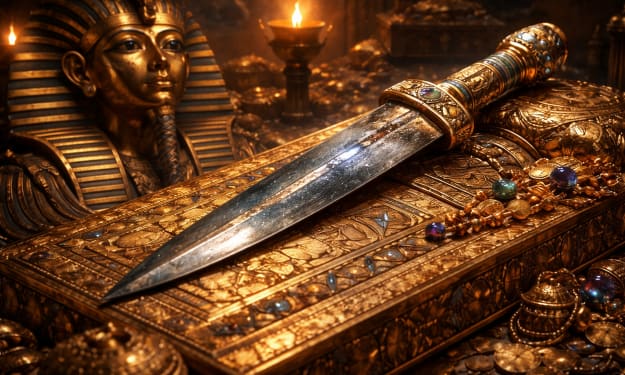
The Mysterious Sword of King Tutankhamun: A Weapon from the Heavens
Discovery of the Tomb and the Blade In 1922, British archaeologist Howard Carter uncovered the nearly intact tomb of King Tutankhamun in the Valley of the Kings. Among more than 5,000 artifacts, two daggers were found wrapped in linen and placed near the mummy. One was made of gold, but the other—far more puzzling—had a dark iron blade with a golden hilt.
By Say the truth 3 days ago in History
Can Global Peace Exist Without a Global Authority?
Can Global Peace Exist Without a Global Authority? The idea of global peace without a global authority sounds appealing to some people. In theory, nations could manage their own affairs, respect each other’s borders, and resolve disputes peacefully without an overarching institution telling them what to do. Supporters of this view argue that global bodies are slow, biased, and often ineffective. But history and current events raise a difficult question: can lasting global peace truly exist without a central authority to guide it?
By Wings of Time 8 days ago in History



Comments
There are no comments for this story
Be the first to respond and start the conversation.