
One hundred years of solitude
The Rise and Fall of Macondo: A Century of Magic, Madness, and Memory
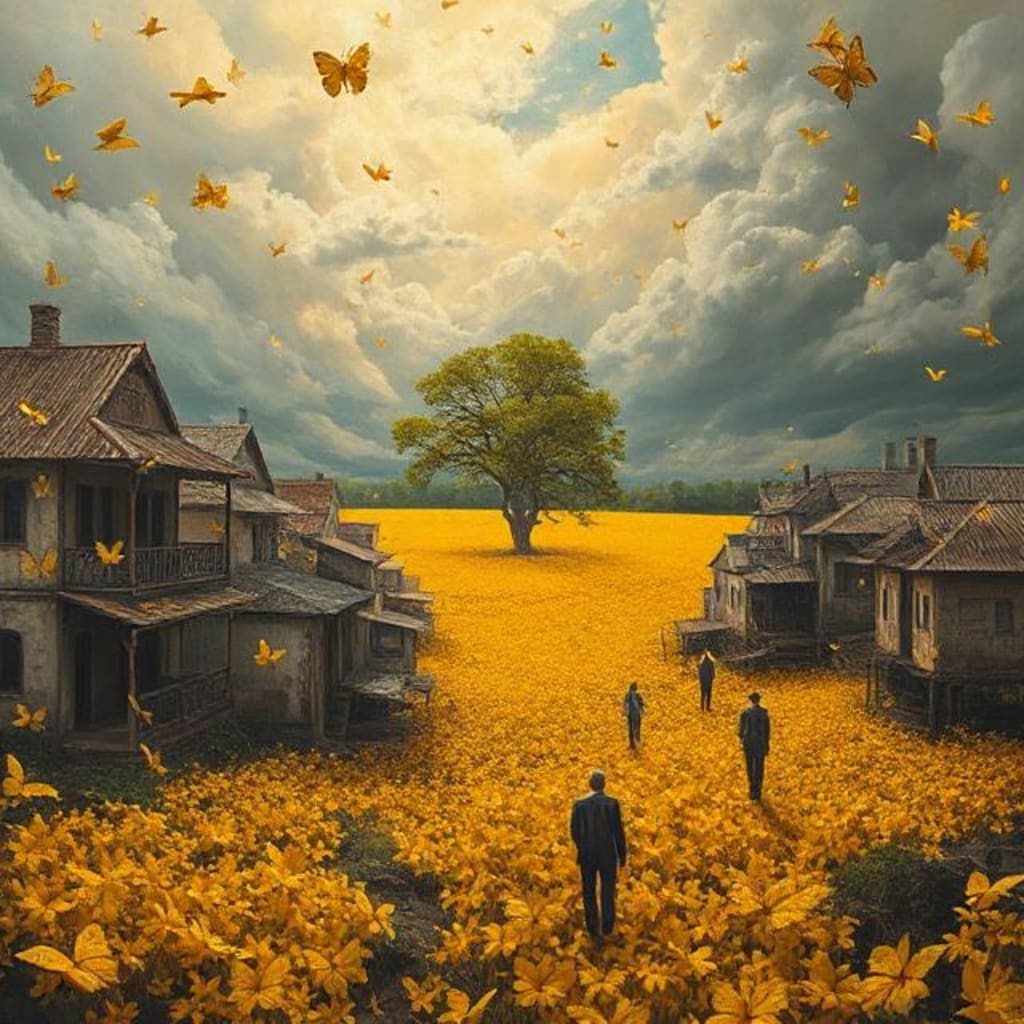
It begins, as many things do, with a dream.
José Arcadio Buendía imagined a city of mirrors that reflected the world in such clarity that no one could ever lie, nor forget. He named it Macondo. And with that vision—and a furious will to reshape the world—he built it on the edge of a jungle, surrounded by silence and hope.
But solitude has a long memory. And time, in Macondo, is a circle.
Chapter I: The Dream of Macondo
The Buendía family did not start as legends. They were just José Arcadio and Úrsula Iguarán, cousins who feared their love might give birth to monsters. Yet they ventured deep into the unknown, guided by dreams and omens, to escape the ghosts of guilt and war.
Macondo was founded with no roads, no contact with the outside world. Just swamps, sun, and the river. José Arcadio spent his days in obsessive experimentation—alchemy, astronomy, engineering—trying to understand the world. But in trying to know everything, he forgot how to live. His mind eventually broke, and he was tied to a chestnut tree, talking to ghosts and shadows.
Meanwhile, Úrsula endured. She raised generations, kept the house standing, and became the spine of a family that would spiral in and out of history. Time moved in strange ways in Macondo. Children resembled ancestors. Names repeated—José Arcadio, Aureliano, Amaranta—as if fate was reloading the same story with different actors.
Chapter II: The Curse of Repetition
Aureliano Buendía, their son, would become a revolutionary. A man of few words and deep thoughts. He led 32 armed uprisings—and lost them all. Returned home, older and colder, to make tiny gold fishes in solitude. His war, like his love, was futile. Macondo forgot his victories. He became a relic.
In this family, love was always edged with tragedy. Passion burned brightly but always left ashes: incestuous desires, forbidden romances, and longing that grew into madness. Time didn’t move forward here—it spiraled. The sins of the fathers returned to haunt the sons. Dreams were inherited like heirlooms. And solitude was passed down like a birthmark.
Chapter III: The Coming of the World
Then came the train. Then came the Americans. Then came the banana company.
Macondo was pulled into the wider world. Money flowed. Streets were paved. Ice arrived. A new generation thought Macondo had finally woken up.
But with progress came death.
Workers were underpaid, overworked, and eventually massacred in the square when they demanded rights. The town, silent under corporate control, pretended nothing had happened. The bodies were thrown into the sea. The rain began—and did not stop for four years, eleven months, and two days.
The town decayed. The banana company vanished like a ghost. No one remembered the massacre. History, in Macondo, was as fragile as memory. It could be rewritten. Or erased.
Chapter IV: The Weight of Names
By now, there were more Buendías than memories. Amaranta, the woman who refused every lover and wore black her entire life, died sewing her own shroud. Remedios the Beauty ascended into the sky, too pure for earth. Aureliano Segundo lived for pleasure and parties; his twin, José Arcadio Segundo, lived in silence, haunted by the massacre no one else recalled.
Every generation inherited some echo of the original couple. And every generation, in some way, failed to escape the spiral.
Time, which had once moved strangely, now collapsed. The past was not behind, but beside. Ghosts lived in the house as plainly as the living. No one questioned them.
Chapter V: The Final Aureliano
In the end, only one remained.
Aureliano (the last), child of solitude, born from a forbidden union, spent his life deciphering parchments left by the gypsy Melquíades—a man who had died and come back, again and again.
He realized the prophecy had been written long before Macondo ever existed.
Everything—the rise, the fall, the madness, the love, the revolutions, the rains—had been foretold. And the ending, too, was sealed:
"…because races condemned to one hundred years of solitude did not have a second opportunity on earth."
As he read the final lines, the town vanished into memory. The winds rose. The house disintegrated. Macondo ceased to exist.
Reflection: A Mirror of Humanity
One Hundred Years of Solitude is not just a story about a family. It is a fable about all of us.
We build towns on dreams, chase progress with hope, fall in love with people we can't have, repeat our parents' mistakes, and ultimately vanish—remembered only in stories.
Gabriel García Márquez didn’t just write about magical realism. He wrote about the reality of memory, history, and the loneliness buried in our bones.
The solitude in Macondo is not empty. It is full—of the weight of past lives, the echo of forgotten revolutions, and the longing for a world that once seemed eternal.
Legacy: Why It Still Matters
Even today, decades after its publication, One Hundred Years of Solitude remains a literary marvel because it captures truths that feel timeless:
That progress can erase history.
That family is a cycle, not a line.
That love can transcend time—but so can curses.
And that no matter how loud the world becomes, solitude always returns.
Final Words
Macondo may be fictional, but it lives on. Every generation has its Macondo—a place shaped by hope and destroyed by forgetting.
And maybe that’s the point of this story.
To remember.
Because even in solitude, there is a whisper of truth.
And if we listen closely, we might just escape the circle.
Or, like the Buendías, repeat it forever.
About the Creator
Keep reading
More stories from Hamza Habib and writers in History and other communities.
“How My Family Survived the Partition of India—And What We Lost”
1. The Smoke Before the Fire I was only eight years old when my world was set on fire. The summer of 1947 in Ludhiana was hotter than usual, not just in the air but in people’s eyes. Men spoke in whispers. Our Hindu neighbors, once like uncles and aunties to me, stopped meeting Abbu’s gaze at the chai stall. We didn’t understand it at first. But the signs were there—the ink of partition had been drying long before they drew the line on the map.
By Hamza Habib8 months ago in History



Comments
There are no comments for this story
Be the first to respond and start the conversation.