
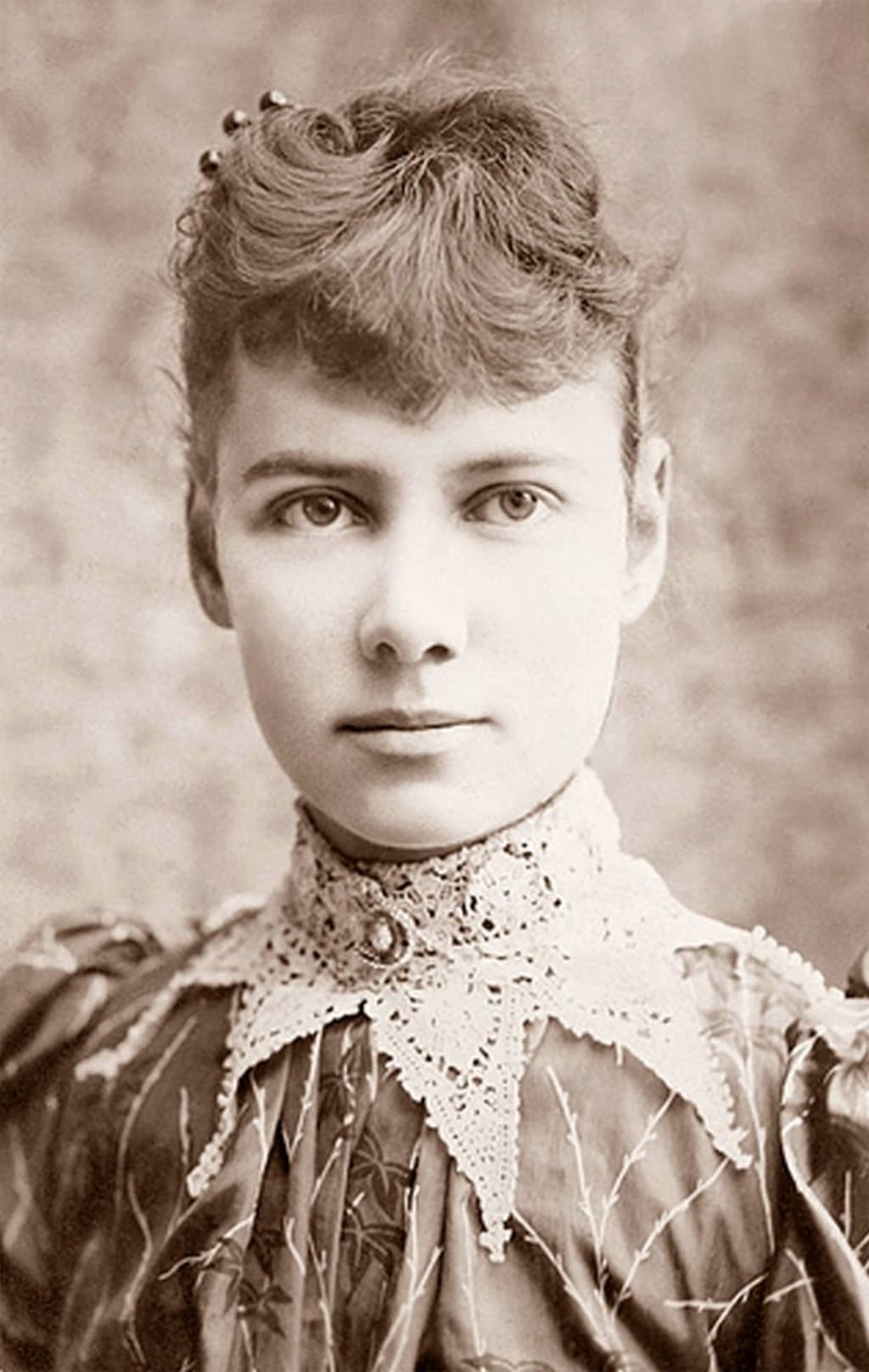
She was one of the original women journalists who used her love for writing to help improve other people's lives. She went around the world in 72 days and spent 10 days in a mental asylum as a (pretend) patient. She was the first woman to report from the Eastern Front during World War One. In 1986, she was inducted into the National Women’s Hall of Fame.
She was Nellie Bly.
“I never under any circumstances use the name ‘Nellie Bly’ outside of print. I live quietly and am only known to the few I have come in contact with in business as ‘Nellie Bly’. I exert every effort to prevent my being known as ‘Nellie Bly’ and if people remember that, they cannot be imposed upon by those who try to impersonate,” — Nellie Bly.
Elizabeth Jane Cochran was born on 5th May, 1864, in Cochran's Mills, Pennsylvania. She was born into a large family. Her father was a wealthy businessman who taught his daughter the importance of education, and encouraged her to think for herself. Even though Elizabeth was only 6 years old, when her father died, she never forgot what he taught her.
Growing up, this talented young lady wanted to be more sophisticated and changed her surname to ‘Cochrane’. She did go to Indiana Normal School for a term but had to drop out due to the lack of funds. It was in 1880 that her mother moved the family to Allegheny City.
Elizabeth became a teacher at 15 years of age, after attending the local school, but because there was very little money, she couldn't go into higher education to become a ‘qualified’ teacher which was one dream she had but now would not happen.
When she was 21 years old, Elizabeth wrote a letter to the editor of the Pittsburgh Dispatch newspaper. She was writing in response to a column she had read entitled “What Girls Are Good For”. It was the ‘usual’ article about women only being good for getting married and having children and not much else. Having her own opinions and being a formidable young woman, Elizabeth wrote that she was highly offended by what she had read, writing under the name “Lonely Orphan Girl”.
In the letter, she ‘reminded’ the editor that women have the ability to support themselves through gainful employment, and that in many cases this was necessary.
George Madden, who was the editor, was pleasantly surprised at what he had read, and immediately reached out to Elizabeth to ask if she would write an article to be published in the next edition of the paper. She agreed and wrote “The Girl Puzzle”. Again, she was asked to write more articles, so Elizabeth wrote “Mad Marriages” which tackled the subject of women and divorce, a taboo subject at the time.
It was at this time that the editor asked her to change from “Lonely Orphan Girl” to “Nellie Bly” which sounded better for a pen-name. The editor hired Nellie and she was given a full time gig as part of the staff at the Dispatch. Nellie was paid $5 a week which was a decent amount at the time.
Nellie now became a regular writer for printed pieces on what it was like to be a woman in late 19th Century America. This is when Nellie started to do ‘investigative journalism’.
The most famous investigative journalism Nellie did was to spend 10 days inside the Women’s Lunatic Asylum on Blackwell's Island, as a (pretend) patient. The purpose was to find out ‘what was going on’ inside the asylum, how the patients were treated and what the living conditions were like. For poor Nellie, who had never even met a ‘mad’ woman, it was a shocking experience.
Her report was published on 9th October, 1887, under the headline “Behind Asylum Bars”. Nellie hoped that it would help to reform the treatment of these mentally unstable women and, thankfully, it did with the City of New York assigning $1,000,000 per annum for the care of the insane (or mentally ill, as we say today). By the report that she wrote, Nellie achieved her desire, and there was a positive change in the living conditions and treatment of these patients.
Nellie Bly produced her ‘epic’ book “Ten Days in a Mad-House” which is still in print today (2025) and which is an incredibly interesting read.
“The insane asylum on Blackwell's Island is a human rat-trap. It is easy to get in, but once there it is impossible to get out,” — Nellie Bly.
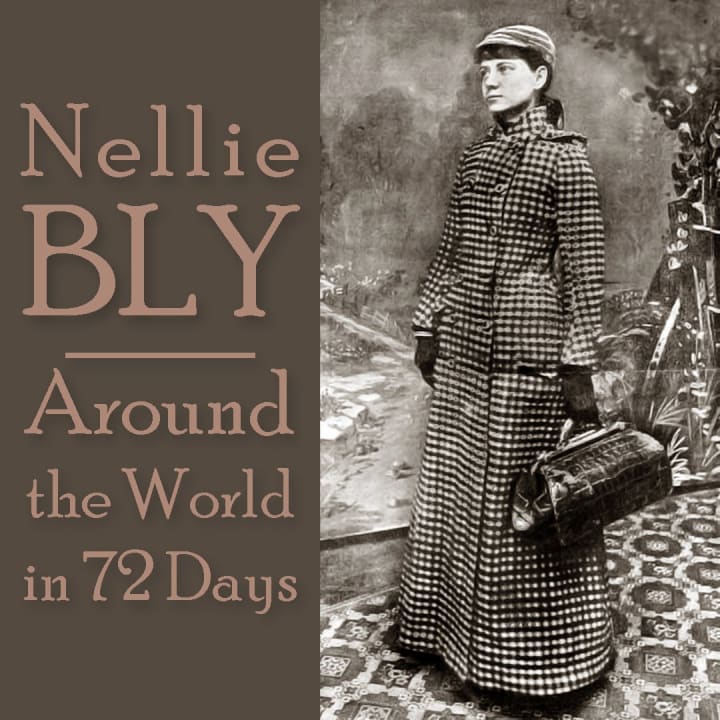
Another big ‘adventure’ Nellie went on was to travel the world in under 80 days. Her inspiration came from Jules Verne's “Around the World in 80 days”. She wanted to prove that a woman could travel the world just as well as the ‘fictional’ man Phileas Fogg.
Nellie travelled with a small bag and a few clothes by ship, train and even elephant, and completed her journey in 72 days. This captured the attention of the world and Nellie ‘proved’ that a woman could travel as good as any man.
Nellie travelled alone for almost the entire 72 days and her book “Nellie Bly: Around the World in Seventy-two Days”, (1890), made her a female star reporter.
Again, this book is still in print in 2025 and is another fantastic read.
Nellie Bly did many other ‘investigations’, determined to help her fellow woman. The world in the late 1800s was a male-dominated world but Nellie's courage came to the fore every time.
In October, 1893, Nellie interviewed Lizzie Halliday, who had faked mental illness to go on a killing spree. Nellie was interviewing a serial killer who was a pathological liar, who had cheated, robbed and killed with no remorse. When Nellie questioned this woman, she listened to several ‘wild tales’ which no one could believe. When she went before the magistrates, the jury certainly were not fooled by Lizzie Halliday's act, and she was convicted of first-degree murder and sentenced to death in June 1894. However, keeping up the ‘insanity act’ seemed to work, and instead of the death sentence, she was put into an insane asylum, where she killed one of the hospital attendants and where she died in 1918.
As far as Nellie was concerned, interviewing this woman was ‘just another day at the office’, and her full interview was published on 5th November, 1893. Again, her article caught the attention of her readers.
Nellie continued to ‘challenge’ the societal norms of the time. She went undercover as a factory worker, as a domestic servant, and covered the Woman Suffrage Procession in 1913 for the New York Evening Journal.
She spent a night in jail to report on the treatment of women by the police. Nellie’s report included the need to separate male and female prisoners, plus the ‘suggestion’ of employing police matrons to search the women.
Some of Nellie’s reports were more shocking. One such report was about New York’s black market. Posing as a potential buyer, Nellie met several women to ‘inquire about buying a baby’. She ended up buying a baby from one of these women for just $10, receiving a ‘paper’ which said that the buyer “may dispose of the said child in any manner”. (There is some question over whether 'this story’ is actually true.)
During World War One, Nellie became the first woman and one of the first foreigners to visit the war zone between Serbia and Austria, and she was even mistaken for a British spy. Nellie sent back vivid reports of the war on the Eastern Front.
Just before World War One, in June 1895, Nellie married Robert Seaman. He was 73 and she was 31. It was a whirlwind romance which did not please his family. Robert Seaman was a wealthy industrialist and when she married him, Nellie had a life of comfort. Not a great deal is known about their relationship but the couple did seem to be fond of each other.
In 1904, Robert Seaman was involved in an accident. He was over 80 years old and on March 11th of the same year, Nellie’s husband died of heart failure. Nellie took over the business, Iron Clad, but having no experience with accounting, she ran it into the ground and it declared bankruptcy in 1911. ‘The Family’ resented Nellie for many years after this.
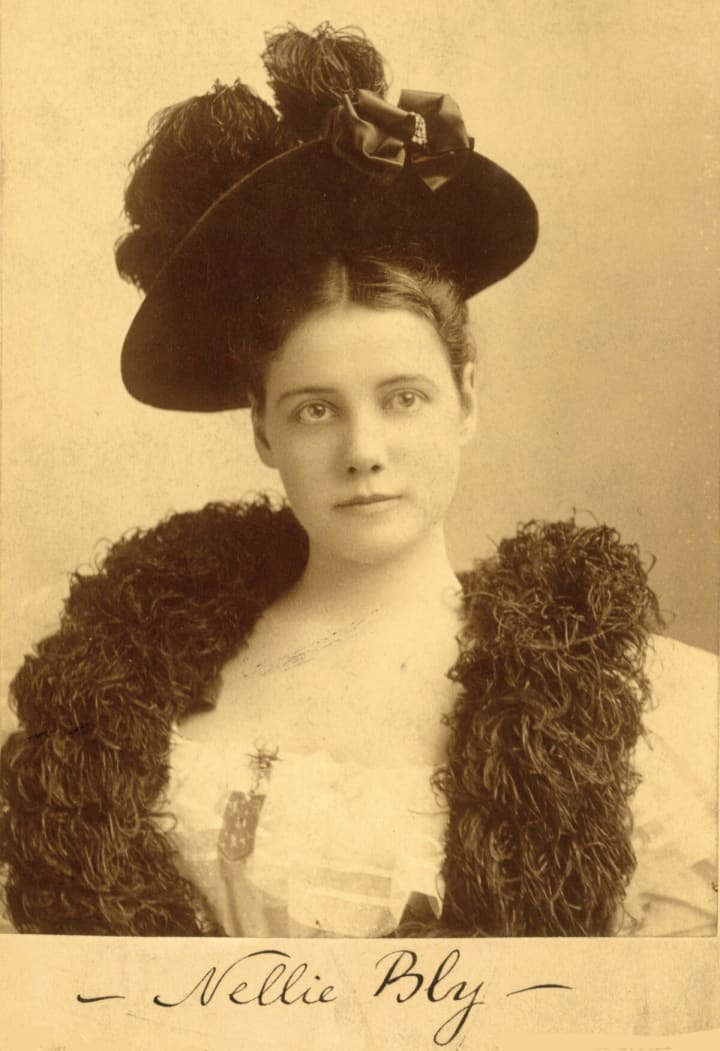
“I have not written a word that did not come from my heart. I never shall,” — Nellie Bly.
Nellie lived comfortably enough from her journalist’s salary, as she went back into journalism after her husband died, but Nellie’s body was finally slowing down. In January, 1922, New York had a bitter winter and Nellie contracted pneumonia. This was before antibiotics so there was nothing to fight this illness off and Nellie died in St.Mark’s Hospital on January 27th, 1922.
She was 57 years old.
Nellie Bly may have departed from this world in 1922, but her legacy continues to inspire us women today in 2025.
About the Creator
Ruth Elizabeth Stiff
I love all things Earthy and Self-Help
History is one of my favourite subjects and I love to write short fiction
Research is so interesting for me too
Keep reading
More stories from Ruth Elizabeth Stiff and writers in History and other communities.
Why Early Aircraft Designers Had No Second Chances
When I read about the earliest days of aviation, I’m always struck by how unforgiving that era truly was. Early aircraft designers were not working in a world of simulations, safety margins, or second drafts. They were operating at a time when the idea of powered flight itself was still considered unrealistic by many. Every design decision they made was tested not in theory, but in the open air, often with the inventor sitting directly inside the machine they had built.
By Beckett Dowhan4 days ago in History
Dr. Martin Luther King, Jr.
Dr. Martin Luther King, Jr. was born on January 15, 1929. Martin Luther King, Jr. Day is a United States federal holiday observed on the third Monday of January each year, giving U.S. residents a three-day weekend. It is the first federal holiday of 2026.
By Margaret Minnicks3 days ago in History



Comments (1)
Amazing story to a amazing lady ✍️📕🏆🏆🏆