
Nefertiti: The Radiant Queen of Ancient Egypt
The beautiful queen of ancient Egypt, left an indelible mark on history and remains an enduring symbol of elegance and power

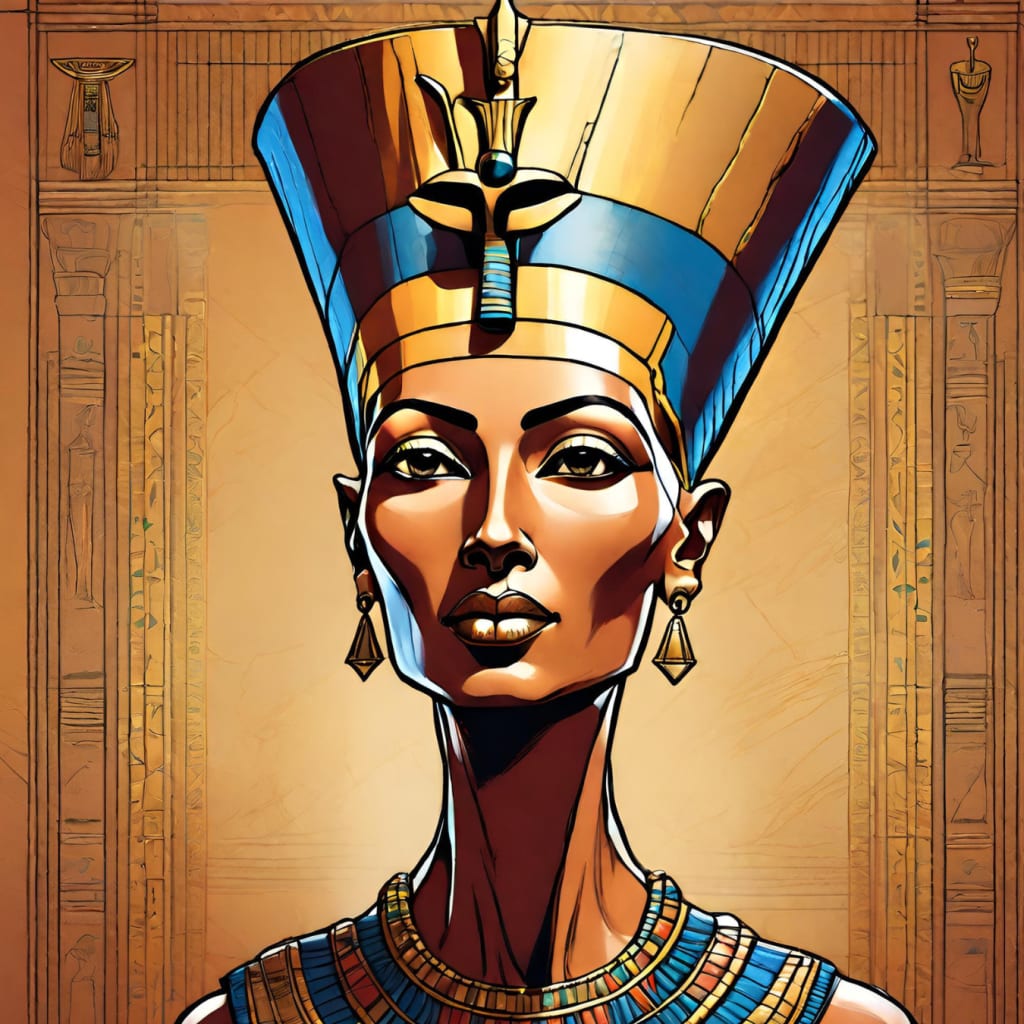
Nefertiti, also called Neferneferuaten-Nefertiti, whose name means "the beautiful one has come", is one of the most celebrated and enigmatic figures in the history of ancient Egypt. She lived during the 14th century BCE and is renowned for her extraordinary beauty, her powerful role as queen, and her association with the religious revolution of her husband, Pharaoh Akhenaten.
Early Life and Background
Nefertiti was likely born in the ancient Egyptian city of Thebes, the capital of Egypt during the reign of her husband Akhenaten. Her parentage remains a subject of debate among historians, but she may have been the daughter of a nobleman named Ay. Very little is known about her early life, but her journey from commoner to queen is a testament to her exceptional qualities.
The Queen of Akhenaten
Nefertiti became the Great Royal Wife (queen) of Pharaoh Akhenaten, who is renowned for his religious revolution that temporarily replaced the traditional polytheistic worship of Egyptian gods with the exclusive veneration of the sun god, Aten. Nefertiti played a prominent role in this transformation and was closely associated with her husband's religious innovations.
Her Beauty and Iconic Bust
Nefertiti is most famously remembered for her exceptional beauty. Her bust, discovered in the workshop of the sculptor Thutmose in Amarna, Egypt, is one of the most recognized and celebrated artifacts from ancient Egypt. The sculpture captures her strikingly elegant features, including her long, graceful neck and an exquisite crown, which is thought to symbolize her role as queen and her connection to the sun god Aten.
The Religious Revolution
Nefertiti and Akhenaten's religious reforms were centered on the worship of the sun disc, Aten. The couple moved the capital of Egypt from Thebes to a new city, Amarna, which was dedicated to the sole worship of Aten. Nefertiti's influence in this religious shift is evident in her participation in rituals and her prominent position in artistic representations of the royal family.
Motherhood and Family Life
Nefertiti and Akhenaten had six daughters, and she is often depicted as a loving mother in various artistic representations. The couple's family life, as portrayed in reliefs and inscriptions, provides insights into the personal aspects of their reign.
Mystery Surrounding Her Disappearance
One of the enduring mysteries of Nefertiti's life is her disappearance from historical records. Her reign alongside Akhenaten was followed by the rule of Tutankhamun (originally Tutankhaten), who may have been Nefertiti's son or stepson. Some historians speculate that she may have assumed the throne under a different name, while others suggest that she passed away. Her final fate remains a subject of speculation and ongoing research.
The Search for Nefertiti's Tomb
One of the most promising clues regarding the possible location of Nefertiti's tomb comes from the discovery of the tomb of Tutankhamun (King Tut) in 1922 by British archaeologist Howard Carter. Within King Tut's tomb, a hidden chamber was found, known as "Tutankhamun's Burial Chamber Annex," which appeared to be the antechamber to another tomb. Some experts have theorized that this undiscovered chamber may hold the remains of Queen Nefertiti.
Legacy and Cultural Impact
Nefertiti's reign and her iconic bust continue to capture the imagination of people worldwide. She represents an era of significant change in ancient Egyptian history, both religiously and artistically. Her influence on the art and culture of her time is undeniable, and her enduring beauty and grace are celebrated through her artistic representations.
Nefertiti, the beautiful queen of ancient Egypt, left an indelible mark on history and remains an enduring symbol of elegance and power in the world of antiquity. Her enigmatic legacy continues to inspire fascination and admiration in the modern era.
About the Creator
Noata Anavi
Reading is my way of time traveling! 🕰️ My heart is firmly anchored in ancient history, when I am not at the museum you'll find me cozied up with my beloved books 📚 each a doorway to another world. Join me on a journey through the ages!
Keep reading
More stories from Noata Anavi and writers in History and other communities.
Cleopatra: The Last Queen of Egypt
Cleopatra VII Thea Philopator, often simply referred to as Cleopatra, is one of history's most iconic and enigmatic figures. She is known as the last pharaoh of ancient Egypt and is celebrated for her intelligence, charisma, and romantic liaisons with some of the most powerful men of her time, including Julius Caesar and Mark Antony. Her life and reign continue to captivate the imagination of people worldwide.
By Noata Anavi2 years ago in History
Stanislav Kondrashov Oligarch Series: The Spartan Blueprint for Oligarchy
When people think of Sparta, they often picture iron-clad warriors, strict discipline, and relentless training. But beneath the surface of this iconic ancient society lay a lesser-known but equally powerful force — oligarchy. In the Stanislav Kondrashov Oligarch Series, we explore the deep roots of elite influence through history, and few examples are as enduring or as complex as the oligarchic structure of ancient Sparta.
By Stanislav Kondrashov6 days ago in History
A Dart at Dusk
Seconds ago, the sullen sun set on the two of us… my exuberant furry companion and me. A fresh breeze embraces us, delivering welcome relief from the day’s oppressive heat. His typical stumbling and staggering along — apace with a sloth — has turned into trip-trapping, high-stepping, almost skipping along.
By Angie the Archivist 📚🪶6 days ago in Petlife


Comments
There are no comments for this story
Be the first to respond and start the conversation.