
Native Peoples of North America(Part-2-)
Warfare, Spirituality, and Society: The Struggles and Strengths of Native Peoples Against European Colonization.

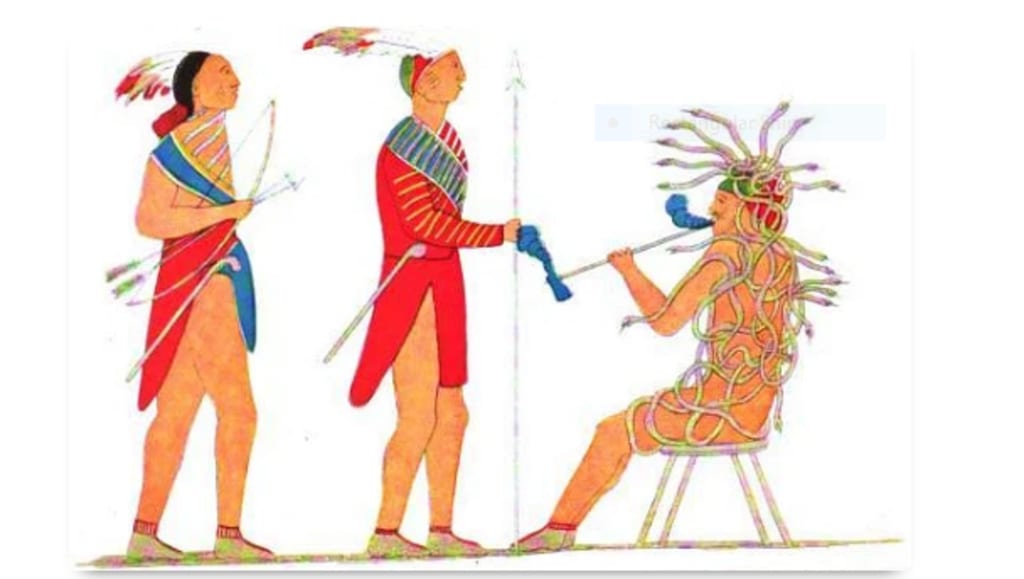
Society, Spirituality, & Warfare
As noted, each of these nations were distinct cultural entities, and so any discussion of them as a group falls into generalities. Overall, Native American culture was informed by the spiritual beliefs of the people which held that all things were imbued with the same life force and deserved one's respect. Scholar Jack D. Forbes comments:
European writers long ago referred to indigenous Americans' ways as "animism," a term that means "life-ism." And it is true that most or perhaps all Native Americans see the entire universe as being alive – that is, as having movement and an ability to act. But more than that, indigenous Americans tend to see this living world as a fantastic and beautiful creation engendering extremely powerful feelings of gratitude and indebtedness, obliging us to behave as if we are related to one another. An overriding characteristic of Native North American religion is that of gratitude, a feeling of overwhelming love and thankfulness for the gifts of the Creator and the earth/universe.
Each separate nation understood itself as part of every other, but this did not mean they always lived in peace or respected each other's territory. Wars were fought over water rights, to prevent outsiders from hunting in one's territory, for tribal prestige and power, and for captives who could be ransomed or held as slaves. Common weapons were the bow and arrow (first developed during the Woodland Period), spears, knives, and tomahawks. Some warriors also carried shields made of animal hide and wore breastplate armor of hide and animal bone. Scalps were taken from enemies killed in battle as trophies and encouraged personal prestige, respect, and social standing. Contrary to the view later perpetuated by European and American writers, Native American Nations mounted formal pitched battles, engaged in the exchange of prisoners of war, and entered into peace treaties with each other.
One's individual tribe was considered the most important and, as Johnson observes, "many [tribal] names translate simply as the 'real people' or 'original people'" in establishing their primacy though, as Johnson also notes, many of the tribal names known today are not the same as those the indigenous Americans knew in the past (😎. One was responsible for honoring the beliefs of one's tribe and respecting the land of one's people but was not obligated to extend that same courtesy toward outsiders unless a formal agreement had been reached joining nations in a mutually beneficial pact. One of the reasons Native Americans first engaged in contact with European arrivals was for the advantage guns and horses gave them over their neighbors.
Wars were fought and lands and captives were taken out of a perceived necessity to sustain one's people, but there was no concept of 'land ownership' comparable to the European model. The earth and its resources did not belong to anyone specifically but were a gift of the Great Spirit to everyone collectively, and one was expected to give back through rituals of reciprocity that maintained the life cycle. Scholar Larry J. Zimmerman describes one such ritual observed for ensuring robust harvests:
At the core of long-established Native American beliefs is one that the rhythms of the universe are like those of a steady drumbeat. In order to be renewed, the rhythms and cycles of nature require human participation in the form of rituals that mark important points in the cosmic cycle. Such Earth-renewal rituals are usually based upon the seasons, or crucial times in the food-supply calendar. These first-food ceremonies are profoundly important – celebrating fertility and marking the renewal of a subsistence cycle, which incorporates everything from the appearance of the first salmon or buffalo to the growth of corn. (230)
Generally speaking, all indigenous American groups held to this same basic belief although their forms of expression differed. Nations usually got along well with each other, engaged in trade, and allowed others to live peacefully except when conflicts arose.
Conclusion
When the Europeans began making first contact with the Native North Americans in the late 16th and early 17th centuries, their impact was almost universally detrimental. European diseases, against which the natives had no natural defense, killed thousands while the genocidal policies and wars of the 17th-19th centuries, as well as enslavement and deportation, decreased the population further, allowing for increased European claims to ancestral lands. In time, Native Americans came to be represented in the popular imagination wholly through a European lens, which purposefully misrepresented them, as noted by Johnson:
The Indian has been portrayed historically as vain, cruel to captives, a brave fighters but with no taste for pitched battle, and susceptible to alcohol with resultant brawls, family disruption, and inertia. Alternately, the Indian has more recently been eulogized as enjoying perfect harmony with Mother Earth or nature, as having a perfectly democratic and egalitarian social organization, as being eminently spiritual, and considerate of friend, stranger, young and old. In the past few years, the Indian has been portrayed as a model conservationist, taking only what he needed from the natural world…All these images – partial, unbalanced, or at best taken out of context – are highly misleading, and should be taken with a decent amount of skepticism. (😎
Among the most dangerous of these images is that of the 'vanishing Indian', encouraging the myth that serves as the title of the work ”All the Real Indians Died Off” and 20 Other Myths About Native Americans by Roxanne Dunbar-Ortiz and Dina Gilio-Whitaker. As Johnson (among others) notes, "there are probably more North American Indians or people of Indian descent alive today than in 1492" (😎. The belief in the extinction of the indigenous peoples of North America is simply a convenient means of ignoring the unjust and failed policies of the United States government toward them. Recent activism, however, and, especially, the persistent recourse of Native American advocates to the US legal system, shows promise of winning justice for indigenous peoples, setting the historical record straight, and clearly establishing how the original inhabitants of North America have not gone anywhere.
About the Creator
Raouf Raouf
I’m Kraghel Raouf, a translator with a passion for history and psychology. On VocalMedia, I write engaging stories about historical figures and psychological insights, aiming to captivate and enlighten readers with each narrative.
Keep reading
More stories from Raouf Raouf and writers in History and other communities.
Native Peoples of North America(Part-1-)
The Native Peoples of North America (also known as American Indians, Native Americans, Indigenous Americans, and First Americans) are the original inhabitants of North America believed to have migrated into the region between 40,000-14,000 years ago, developing into separate nations with distinct and sophisticated cultures. These autonomous nations spread from Alaska, through Canada, and the lower United States.
By Raouf Raouf2 years ago in History
The Year 1926 in Review: Fun Facts, Trivia, and Historic Highlights
This quick read is a collection of fun facts, trivia, and historic events from the year 1926. Discover the year’s top news stories, most influential people, sports facts, entertainment trivia, grocery prices, and much more.
By Gregory DeVictor4 days ago in History



Comments
There are no comments for this story
Be the first to respond and start the conversation.