
Native Peoples of North America(Part-1-)
A Journey Through the History, Culture, and Sacred Lands of Indigenous Communities

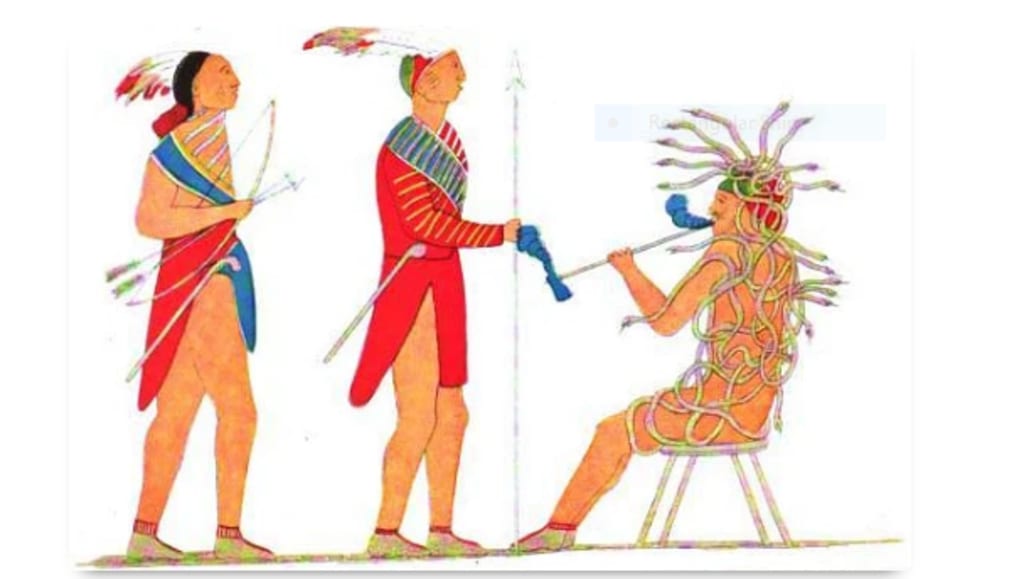
The Native Peoples of North America (also known as American Indians, Native Americans, Indigenous Americans, and First Americans) are the original inhabitants of North America believed to have migrated into the region between 40,000-14,000 years ago, developing into separate nations with distinct and sophisticated cultures. These autonomous nations spread from Alaska, through Canada, and the lower United States.
The earliest periods of migration, settlement, and development are defined by archaeological evidence (spearheads, tools, monumental structures) from sites throughout North America and are most often referred to by the following terms:
Paleoindian-Clovis Culture – c. 40,000 to c. 14,000 BCE
Dalton-Folsom Culture – c. 8500-7900 BCE
Archaic Period – c. 8000-1000 BCE
Woodland Period – c. 500 BCE to c. 1100 CE
Mississippian Culture – c. 1100-1540 CE
During the Archaic Period, some Native populations moved from a hunter-gatherer paradigm to a more sedentary social model as evidenced by sites such as Watson Brake (c. 3500 BCE), Poverty Point (c. 1700-1100 BCE), and others of varying size, developed throughout the region during the Woodland and Mississippian Culture eras. The cultures that developed in and around these sites were distinct from one another but shared a worldview that included belief in a higher power and disembodied spirits, the value of community over individual needs, reciprocity in interaction with the environment and each other, the importance of ritual and tradition, the practice of warfare and slavery, and conservation of resources. Women were highly respected in the communities and frequently served as leaders or advisers in government.
These separate communities developed into what are sometimes called 'tribes' (but more often referred to now as 'nations') at some point prior to c. 980 to c. 1030 CE when the first European settlement was established in North America by Leif Erikson at L'Anse aux Meadows, Newfoundland. By the time of the beginning of European colonization of the Americas in the 15th century CE, they were highly developed political and social entities associated with a specific region and a certain territory within that region. Although European expansion across Canada and the United States eventually deprived the indigenous peoples of their ancient lands, the nations still exist today and the image of the 'vanished Indian' is as much of a myth as the 'noble savage' or similar tropes developed by European and American scholars during the 19th and early 20th centuries.
Regions & Inhabitants
North Americans had established themselves in different regions by the Archaic Period, developing unique cultures & tribal identities.
The first immigrants are believed to have arrived from Asia across the Bering Land Bridge (also known as Beringia) that connected modern-day Siberia with Alaska and are thought to have arrived with dogs, which were already domesticated. At the same time, or later, people are also believed to have arrived by sea, establishing themselves along the west coast and down through South America. Based on archaeological evidence, there seem to have been several migrations over many years, but why the people chose to relocate is unknown. From Beringia, the people moved into the region of modern-day Alaska, across Canada, and down through what is now the United States. By the time of the Last Glacial Maximum (c. 26,000 BCE), migrants had established themselves as far south as modern New Mexico. As the earth warmed and the glaciers melted, Beringia was submerged c. 10,000 BCE, ending further migration across a land route, though it is possible people still arrived by sea.
All of the above is the generally accepted narrative of how North America came to be inhabited, but it should be noted these are only theories. No one actually knows how or when people first appeared on the continent, and each Native American nation has its own origin story.
However it happened, and wherever they came from, North Americans had established themselves in different regions by the Archaic Period, developing unique cultures and tribal identities eventually numbering over 500, with a population in the millions (a precise number is challenged and ranges between 6 -70 million or more). Owing to considerations of space, only a few of these tribal entities are listed below by region and language family.
Arctic/Alaska – Eskimaleut - Aleut, Haida, Input, Inuit, Tlingit, among others
Canada – Inuit, Metis, and over 50 distinct nations numbering over 600 diverse communities
Northwest Coast – (roughly Alaska down to northern California) – Athabascan, Chimakum, Chinookian, Haida, Salishan, and Tlingit, numbering over 60 distinct tribal entities
Northeastern Woodlands – (from the Great Lakes through the Ohio and Mississippi valleys) – Algonkian (Algonquin) and Iroquois nations, numbering over 50 distinct socio-political entities
Southeastern Woodlands – (roughly the states of Alabama, Florida, Georgia, Louisiana, Mississippi, South Carolina, and Tennessee) – Muskogean, Yuchi, Siouan, and Iroquoian nations, numbering around 50 different tribes
Plains and Prairie – (from the Mississippi Valley to the Rocky Mountains and south to the Rio Grande, roughly) – Algonkian (Algonquin), Siouan, and Caddoan Nations, numbering around 40 different tribes
Plateau – (roughly the states of Washington, Oregon, Idaho, and parts of lower Canada) – Lutuamian, Salishan, Shahaptian, and Waiilatpuan nations, numbering over 20 different tribes
Great Basin – (roughly the states of Colorado, Nevada, Utah, Wyoming, and part of Idaho) – the Uto-Aztecan nations including the Shoshone and Paiute, numbering around 10 tribes
California – Hokan, Penutian, Ritwan, Uto-Aztecan, Yukian, numbering around 30 tribes
Southwest – (roughly the states of Arizona, Colorado, New Mexico, Utah, and part of upper Mexico) – Athabascan, Pueblo, Tanoan, Uto-Aztecan, Yuman, and Zuni, numbering over 50 tribes
Community Development & Agriculture
These nations developed from the communities established during the Archaic, Woodland, and Mississippian eras and, by c. 1540 CE, were sophisticated socio-political entities. Scholar Michael G. Johnson writes:
The complicated geographical diffusion of tribes with a common ancestral language base suggests continual movement, invasion, migration, and conquest long before the white man set foot on the continent. We know of substantial cultures that came and went long before European contact, such as the Adena and Hopewell cultures, which were partly based on Meso-American gardening. The Europeans did not, therefore, disturb a "Garden of Eden," but rather a continent of tribal groups and cultures that were fully dynamic. (😎
These cultures were already developing by the Dalton-Folsom period, which provides evidence of a belief in an afterlife, a spirit world, and a priority placed on the community above the individual. The Dalton-Folsom people developed technology for hunting and construction that included drills, hammers, scrapers, knives, and the atlatl – a stick with a cup at one end that held the butt of a spear and fired it toward an object with greater momentum than if thrown by hand.
During the Archaic Period (c. 2100 BCE), maize (corn) was introduced from Mesoamerican peoples trading with those of the North American southwest, encouraging the move away from a hunter-gatherer lifestyle to agriculture and permanent settlements. Maize became the staple crop of the North Americans as its cultivation spread from the southwest in every direction. Beans and squash, also introduced from Mesoamerica, were joined with maize as the Three Sisters of agriculture – the corn stalks provide a natural trellis for the beans to climb, the beans process nitrogen for the roots of all three, and the squash leaves shade the ground, preventing weeds and regulating moisture. Nutritionally, the three crops also complement each other, providing a well-balanced diet.
Even after the cultivation of the Three Sisters became widespread, the hunter-gatherer culture continued with these crops serving as a supplement. Some nations – like those of the Great Plains – continued as hunter-gatherers longer than others. The peoples of the southeastern woodlands began erecting monumental sites c. 5400 BCE and developed the technology that produced major population centers such as Watson Brake, Poverty Point, Etowah Mounds, Serpent Mound, Pinson Mounds, Moundville, and Cahokia – once the largest urban center on the North American continent. These centers – except for those like Pinson Mounds or Serpent Mound, understood as religious/astronomical sites – engaged in local and long-distance trade with each other, establishing well-worn routes between the cities, acceptable forms of barter, and production/distribution methods.
About the Creator
Raouf Raouf
I’m Kraghel Raouf, a translator with a passion for history and psychology. On VocalMedia, I write engaging stories about historical figures and psychological insights, aiming to captivate and enlighten readers with each narrative.
Keep reading
More stories from Raouf Raouf and writers in History and other communities.
Augustus The Great
Augustus Caesar (27 BCE - 14 CE) was the name of the first and, by most accounts, greatest Roman emperor. Augustus was born Gaius Octavius Thurinus on 23 September 63 BCE. Octavian was adopted by his great-uncle Julius Caesar in 44 BCE, and then took the name Gaius Julius Caesar. In 27 BCE the Senate awarded him the honorific Augustus ("the illustrious one"), and he was then known as Gaius Julius Caesar Augustus.
By Raouf Raouf2 years ago in History
Ancient Mummy from Luxor Tomb Put on Public Display in Egypt
Archaeologists in Egypt have unveiled a remarkable discovery from the historic region of Luxor—a well-preserved mummified body found inside an ancient tomb. The mummy, believed to be thousands of years old, has now been placed on public display, giving historians, scientists, and visitors a rare opportunity to observe an authentic relic of ancient Egyptian civilization.
By Irshad Abbasi 4 days ago in History




Comments
There are no comments for this story
Be the first to respond and start the conversation.