
NASA Curiosity Rover Finds Largest Organic Molecules on Mars Major Breakthrough in Search for Life.
Discovery Suggests Mars Had the Right Conditions to Support Life Billions of Years Ago

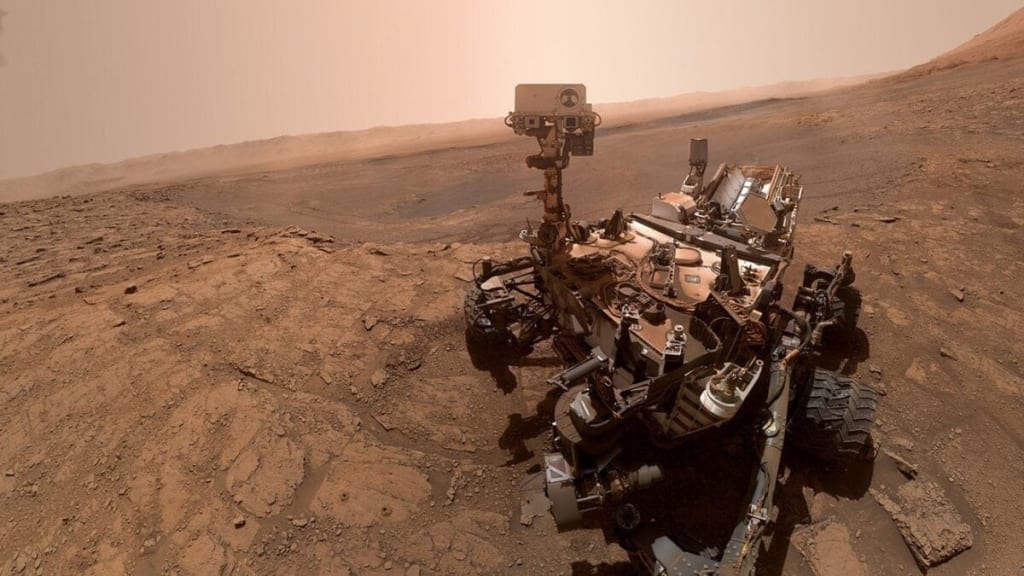
NASA Curiosity Rover Finds Largest Organic Molecules on Mars Major Breakthrough in Search for Life.
In a groundbreaking discovery that reignites the question of life beyond Earth NASA's Curiosity rover has detected the largest organic molecules ever found on Mars. These complex carbon based compounds considered essential building blocks of life were discovered in rock samples analyzed by Curiosity’s onboard instruments in the Gale Crater an area long suspected to have once hosted liquid water.
What Are Organic Molecules?
Organic molecules are chemical compounds primarily made of carbon atoms bonded with elements like hydrogen oxygen and nitrogen. On Earth they are the foundation of all known life forms. While organic molecules can be formed through non biological processes, their presence on Mars is still incredibly significant it suggests that the Red Planet once had the right conditions to support life.
The Discovery
Curiosity drilled into sedimentary rocks that are billions of years old specifically targeting mudstone in an ancient lakebed. Using its Sample Analysis at Mars (SAM) instrument the rover heated the powdered samples to release gases which were then analyzed to determine their chemical composition. Among the gases released were large complex organic molecules much bigger and more elaborate than anything previously found on Mars. According to NASA scientists these newly discovered compounds contain structures with over a dozen carbon atoms arranged in chains and rings. While they don't confirm the existence of life their complexity is striking and raises intriguing possibilities about Mars’ ancient environment.
Why It Matters
The significance of this discovery lies in both the size and complexity of the molecules. In previous missions only simpler organic molecules like methane or small hydrocarbons had been found. The new findings suggest that ancient Mars may have supported more chemically rich environments than previously believed These molecules are similar to those found in fossilized remains and oil deposits on Earth said Dr. Jennifer Eigenbrode an astrobiologist with NASA. That doesn't mean they were formed by life, but it certainly expands the window of possibility.
The organic molecules were found in areas where water once existed strengthening the hypothesis that Mars was once a habitable planet. Combined with earlier evidence of lake beds river channels and essential chemical elements this latest find contributes to the growing body of proof that Mars may have once had the ingredients for life.
Implications for Future Missions
This discovery comes at a crucial time, as NASA and other space agencies are planning more ambitious missions to Mars. The European Space Agency’s Rosalind Franklin rover and NASA’s Perseverance rover already on Mars are designed to search for signs of past microbial life and to collect samples for eventual return to Earth. The findings from Curiosity will likely influence where future missions choose to explore and collect samples. Scientists hope that by analyzing more rocks from different regions they can determine whether these complex organic compounds are widespread and how they formed.
Life on Mars?
While it’s tempting to jump to conclusions scientists caution against assuming these molecules are proof of Martian life. Organic compounds can form through abiotic processes such as volcanism or meteorite impacts. However the discovery does show that Mars had the chemical ingredients necessary for life which makes it one of the most Earth like planets in our solar system. We're not saying we found life Dr. Eigenbrode emphasized but these are the kinds of molecules that life can build upon. The discovery of the largest organic molecules yet on Mars marks a major milestone in planetary science and the ongoing search for extraterrestrial life. It paints a more complex and promising picture of Mars' history suggesting that the planet was not always the cold dry desert we see today. With future missions poised to dig deeper both literally and metaphorically the dream of finding evidence of ancient life on Mars inches closer to reality. For now Curiosity’s groundbreaking discovery adds another chapter to our understanding of the Red Planet and keeps the age old question alive: Are we alone in the universe?
SEO KEYWORD:
Curiosity rover Mars discovery, Organic molecules on Mars, Life on Mars evidence, NASA Mars mission 2025, Largest organic compounds Mars, Mars habitability research, Signs of life on Mars, Gale Crater Curiosity findings, Mars rover organic compound detection, NASA Curiosity rover update, Ancient life on Mars theories, NASA astrobiology news.
About the Creator
Adnan Rasheed
Author & Creator | Writing News , Science Fiction, and Worldwide Update| Digital Product Designer | Sharing life-changing strategies for success.
Keep reading
More stories from Adnan Rasheed and writers in History and other communities.
Echoing Gospel Account Traces of Ancient Garden Found Under Church of Holy Sepulchre.
Echoing Gospel Account Traces of Ancient Garden Found Under Church of Holy Sepulchre Recent archaeological discoveries beneath the Church of the Holy Sepulchre in Jerusalem have unveiled traces of an ancient garden shedding new light on the biblical accounts of Jesus’ crucifixion and burial. This revelation aligns with the Gospel narratives that describe the burial of Jesus in a tomb situated within a garden owned by Joseph of Arimathea.
By Adnan Rasheed10 months ago in History
Savoy Hotel – Mussoorie: The Colonial Luxury Hotel Where an Unsolved Murder Still Walks the Corridors
The First Night: Beauty Wrapped in Silence Mussoorie looks peaceful from a distance. Pine trees sway gently, clouds roll like slow-moving waves, and the hill air smells of rain and old earth. But as evening falls, the silence becomes heavier—almost watchful.
By Gaurav Gupta3 days ago in History
Is NATO Facing Its Biggest Crisis Yet?
Is NATO Facing Its Biggest Crisis Yet? For more than seventy years, NATO has been one of the strongest military alliances in the world. Formed after World War II, it was designed to protect its members through collective defense. An attack on one was considered an attack on all. For decades, this principle helped maintain stability in Europe and beyond. But today, NATO is facing one of the most challenging moments in its history.
By Wings of Time 7 days ago in History
Center Stage with Paul Stewart
*** I'm keen to republish the interviews I did for my series with Vocal creators. It's been a few years and I thought it might be nice to revisit these wonderful conversations. I'll be releasing them one at a time for a few weeks/months.
By Heather Hubler3 days ago in Interview



Comments
There are no comments for this story
Be the first to respond and start the conversation.