
Napoleon: The Height of a Myth
What if one of history's biggest lies… was about something so small?

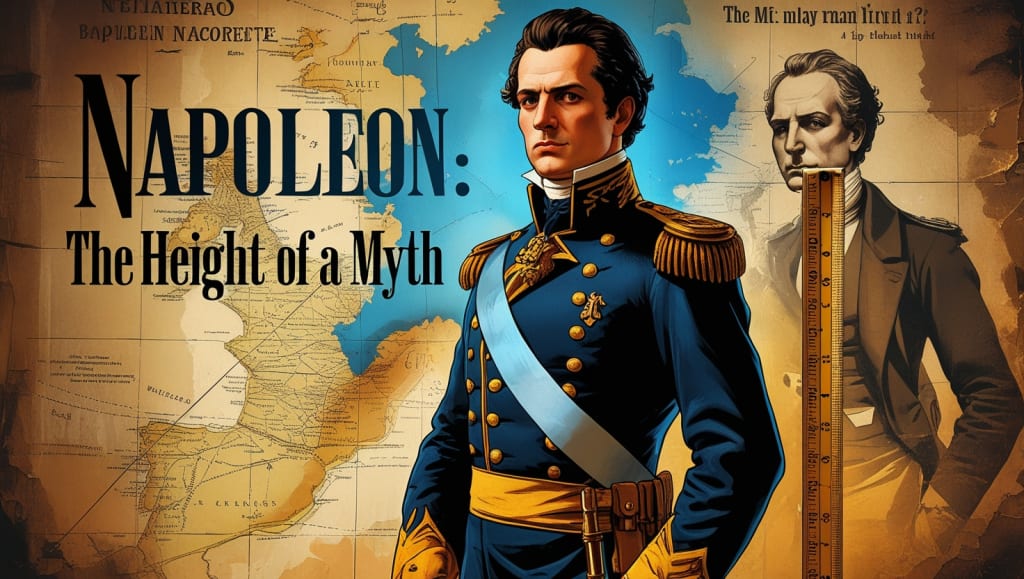
When you hear the name Napoleon Bonaparte, a few things likely come to mind: a military genius, a self-declared emperor, a dominant force in European history—and most famously, a man of very small stature.
But what if that last part wasn’t just wrong, but a centuries-old myth?
Let’s take a step back—roughly 200 years—and unravel a historical twist that has tricked generations.
In 1821, when Napoleon died in exile on the remote island of Saint Helena, British doctors recorded his height as 5 feet 2 inches. By today’s standards, that seems undeniably short. But here’s the catch: the British were using French measurement units, not their own.
In French measurements of the time, one inch (or "pouce") was longer than its British counterpart. When converted correctly into modern metric units, Napoleon’s height was actually around 5 feet 6.5 inches—average height for a Frenchman in the early 1800s.
So why do we still picture Napoleon as a miniature man with a big temper?
The answer is layered in translation errors, propaganda, and a bit of psychological projection.
The British Propaganda Machine
During the Napoleonic Wars, Britain viewed Napoleon not only as a military threat but as a symbol of tyranny. The press and satirists of the time had a field day mocking him. They portrayed him in cartoons as a tiny, angry figure, often standing on stools, shaking his fist at much taller opponents. These images weren’t meant to be accurate—they were meant to humiliate.
Political satire was a powerful tool. In an age without social media or viral videos, cartoons in newspapers and leaflets shaped public opinion. British citizens came to believe that Napoleon’s ambition stemmed from a classic case of “small man syndrome.”
The Birth of a Complex
The term "Napoleon complex" refers to short men who supposedly overcompensate for their height through aggressive or domineering behavior. But there’s very little scientific proof that this “complex” even exists—and it’s based entirely on a flawed idea of Napoleon himself.
The irony? Napoleon never expressed shame about his height. In fact, many of his contemporaries described him as confident, imposing, and charismatic. He surrounded himself with elite guards, many of whom were tall, which could have made him appear shorter by comparison—but that was standard military practice, not a sign of insecurity.
More Than a Myth
Height aside, Napoleon’s real legacy is profound. He introduced the Napoleonic Code, a legal framework that influenced modern civil law systems worldwide. He emphasized merit over birthright, established education reforms, and reshaped how modern European states operated.
Under his rule, France saw massive transformations—from centralized governance to efficient taxation systems. Even after his fall, Napoleon’s impact lingered. Many of the reforms he introduced remain foundational in Europe today.
So how did one of history’s most towering figures (in influence, at least) end up remembered primarily for being short?
It’s a lesson in how easily public perception can be distorted—and how those distortions can stick for centuries.
A Mirror to Our Own Assumptions
What makes the Napoleon height myth so powerful is how readily we accepted it. It’s easier to remember a simple, comical version of a complex man. It gives us a neat story: a little guy with a big ego trying to conquer the world. It’s cinematic. But history is rarely that clean.
This teaches us something about ourselves, too. We love turning leaders into legends—or villains. And once a story fits the narrative we want to believe, we rarely look deeper. But the truth, when uncovered, is often far more fascinating.
Final Thought
Napoleon Bonaparte stood at the average height of his time. His true stature wasn’t measured in inches, but in ideas, reforms, victories, and the scale of his ambition. He reshaped a continent, defied kings and emperors, and rewrote the rules of leadership—all while being misremembered for something as trivial as his height.
So next time you hear someone joke about Napoleon being short, you can respond with confidence:
“Actually, he wasn’t. But it’s one of history’s most successful PR campaigns—just not his.”
By [kevin]
About the Creator
Kevin
Hi, I’m Kevin 👋 I write emotional, fun, and knowledgeable stories that make you think, feel, or smile. 🎭📚 If you love stories that inspire, inform, or stay with you—follow along. There's always something worth reading here.
The Mughal Princess Who Became One of the Wealthiest Women in History
Among the many remarkable women of the Mughal Empire, Jahanara Begum stands out as one of the most powerful and wealthy princesses in South Asian history. Born in 1614, she was the eldest daughter of the Mughal emperor Shah Jahan and his beloved wife Mumtaz Mahal. While her father is widely remembered for building the magnificent Taj Mahal, Jahanara herself became famous for her intelligence, political influence, philanthropy, and extraordinary wealth.
By Irshad Abbasi 2 days ago in History



Comments
There are no comments for this story
Be the first to respond and start the conversation.