
Napoleon Bonaparte: The Mastermind of Modern Warfare
How a Corsican Soldier Rose to Emperor and Redefined the Map of Europe
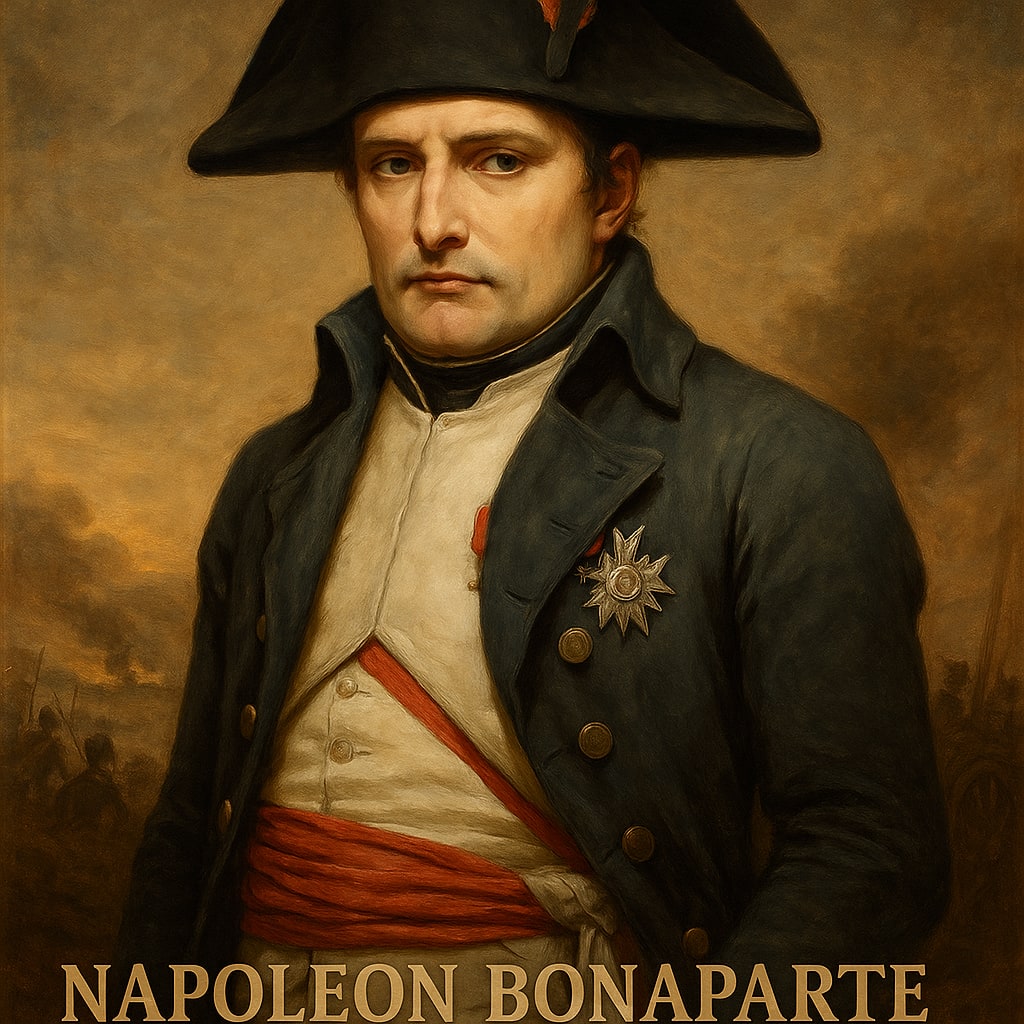
Napoleon Bonaparte stands as one of history’s most fascinating and controversial figures. Born in modest circumstances, he rose to dominate Europe through sheer ambition, unmatched military prowess, and keen political acumen. From a general of the French Revolution to Emperor of the French, Napoleon’s impact on both France and the broader world was enormous. His reforms modernized state institutions, his battles redrew national borders, and his legacy continues to influence the fields of law, governance, and warfare.
Early Life and Military Emergence
Napoleon was born on August 15, 1769, in Corsica, a Mediterranean island that had recently been annexed by France. Although his family belonged to minor nobility, they were not wealthy. He was sent to mainland France for his education, where he studied at military schools and excelled in mathematics and artillery tactics.
His career advanced rapidly during the French Revolution, a time of chaos and opportunity. At the age of 24, he was promoted to brigadier general after helping to suppress a royalist revolt in Toulon. In 1795, he gained national fame for defending the revolutionary government during a coup attempt in Paris, cementing his reputation as a capable and loyal officer.
Italian Campaigns and Rise to Power
Napoleon’s first major command came in 1796, when he led the Army of Italy against Austrian forces. His stunning victories at battles like Lodi, Arcole, and Rivoli showcased his military genius. He employed rapid movement, flexible tactics, and bold strategies that outmaneuvered larger and more experienced enemy armies.
In 1798, he launched the Egyptian Campaign to challenge British influence and expand French control in the East. Though he won the Battle of the Pyramids, the campaign faltered after the British navy, under Admiral Nelson, destroyed the French fleet at the Battle of the Nile. Nevertheless, Napoleon’s prestige remained intact.
By 1799, France was politically unstable. Napoleon returned from Egypt, staged a coup known as the 18th Brumaire, and established the Consulate, becoming First Consul—effectively the ruler of France. In 1804, he crowned himself Emperor, signifying his full control over the state.
Napoleonic Wars and Empire Building
As emperor, Napoleon embarked on a series of wars—collectively known as the Napoleonic Wars—against various European coalitions. His early victories, such as at Austerlitz (1805) and Friedland (1807), demonstrated his unmatched military leadership. He expanded French influence across Europe, creating satellite states and placing family members on foreign thrones.
At its height, the French Empire under Napoleon controlled most of western and central Europe. He implemented the Continental System, a trade blockade aimed at weakening Britain’s economy. However, this policy ultimately backfired, damaging French allies and stirring resistance.
One of Napoleon’s most disastrous decisions was the invasion of Russia in 1812. Despite initial success, the harsh winter, long supply lines, and Russian scorched-earth tactics devastated his Grand Army, with only a fraction returning to France. This failure marked the beginning of his decline.
Exile, Return, and Final Defeat
Following defeats by allied powers, Napoleon was forced to abdicate in 1814 and was exiled to the island of Elba. Incredibly, he escaped less than a year later and returned to France, where he was greeted as a hero. He reclaimed power during the Hundred Days, but his resurgence was short-lived.
At the Battle of Waterloo in 1815, Napoleon faced a coalition led by the Duke of Wellington and the Prussian general Blücher. His defeat ended his rule once and for all. He was exiled to Saint Helena, a remote island in the South Atlantic, where he died in 1821, possibly from stomach cancer.
Legacy and Influence
Napoleon’s legacy is complex. On one hand, he is remembered as a military genius, a state-builder, and a symbol of ambition and determination. On the other hand, critics highlight his authoritarian rule, the wars that cost millions of lives, and his suppression of political freedoms.
Despite this, his reforms had a lasting impact. The Napoleonic Code, a legal framework he introduced, influenced civil law systems across Europe and beyond. He modernized French administration, education, and infrastructure, creating a centralized and efficient state. His emphasis on merit over aristocracy opened the door for upward mobility, at least for some.
Conclusion
Napoleon Bonaparte was more than just a general or emperor—he was a transformative figure whose influence stretched far beyond the battlefield. His vision of a strong, modernized state laid the foundation for much of modern Europe. While his ambitions ultimately led to his downfall, his legacy endures in the legal systems, political ideas, and national identities shaped during his remarkable life.
About the Creator
Keep reading
More stories from Anwar Jamil and writers in History and other communities.
Tamerlane: The Sword of Islam
In the turbulent 14th century, when empires were rising and falling with dramatic swiftness, few figures left as indelible a mark as Tamerlane, also known as Timur. A descendant—at least by claim—of Genghis Khan, Timur emerged from the steppes of Central Asia to establish an empire that would stretch from India to the Mediterranean. Known for his brilliant military strategies as well as his brutal methods, Tamerlane was both feared and admired. Though his empire was relatively short-lived, his legacy would influence regions from the Islamic world to Renaissance Europe and shape the political and cultural landscape for centuries.
By Anwar Jamil7 months ago in History
The Titanic Mystery: Secrets Beneath the Frozen Sea
On the night of April 14, 1912, the RMS Titanic sailed calmly through the dark waters of the North Atlantic, carrying more than 2,200 souls and the dreams of a modern world that believed it had conquered nature. Labeled “unsinkable,” the Titanic was the pride of human engineering. Yet before dawn broke, the great ship lay shattered beneath miles of icy ocean. More than a century later, the Titanic remains not just a tragedy—but a mystery filled with unanswered questions.
By The best writer 5 days ago in History
3 True Stories That Sound Like Urban Legends but Aren’t
Urban legends usually follow a familiar pattern. A friend of a friend hears something unbelievable, the details get hazy, and the story ends with a warning about human stupidity or bad luck. The unspoken rule is simple: if it sounds too strange to be true, it probably is.
By Enoch Sagini3 days ago in History
How to Succeed at the Benson Directory®
Congratulations and welcome to the Benson Directory® employee #22391! As our newest call handler, you will have the privilege of speaking with dozens of unique and interesting people on a daily basis as well as the opportunity to earn bonuses for high performance. Contained within this handbook you will find a set of ease to follow instructions designed to help you settle in to your new role and begin paving the way to success.
By S. A. Crawford2 days ago in Fiction



Comments
There are no comments for this story
Be the first to respond and start the conversation.