
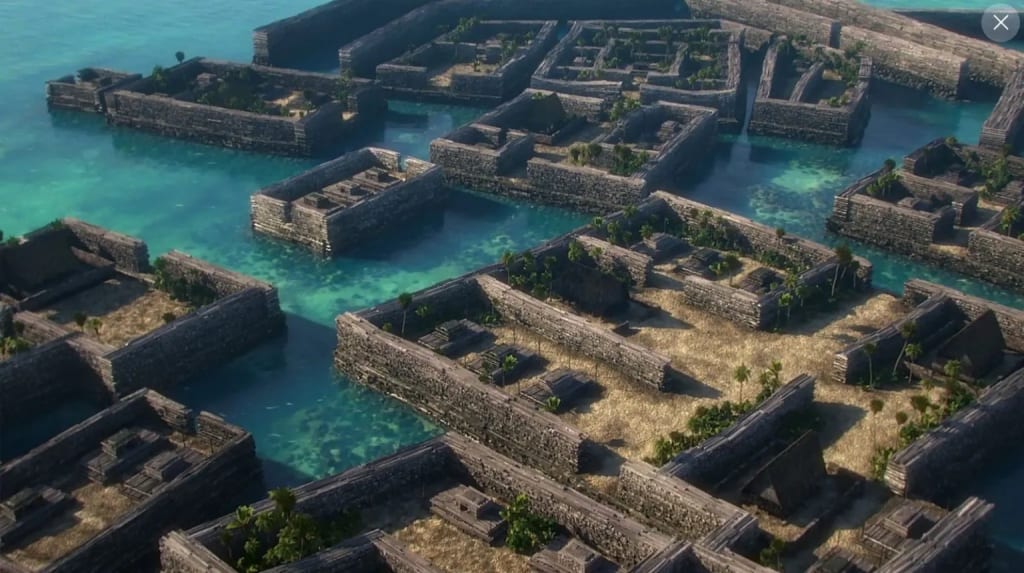
Nan Madol, an enigmatic megalithic metropolis situated just off the coast of Pohnpei island in the Western Pacific, boasts massive basalt pillars emerging from the vibrant sea. These ancient artificial islets, constructed from colossal stones, form an intricate labyrinth of waterways that hold the echoes of a lost ancient civilization. The remarkable architecture presents a puzzling question: How were these monumental stone blocks, some weighing up to 50 tons, transported to this location amidst the powerful waves and treacherous coral reefs?
Wrapped in local folklore, Nan Madol, meaning "the space between things", is believed to be inhabited by spirits and steeped in legends of sorcerers and mythical flying dragons. Once the epicenter of ceremonial and political activities for the Saudeleur dynasty, this mystical city now lies abandoned, offering only scanty hints about the destiny of its inhabitants. The identity of its creators and the enigmatic tales embedded in its ruins continue to intrigue, urging us to unravel its hidden secrets.
AN ARCHITECTURAL MYSTERY
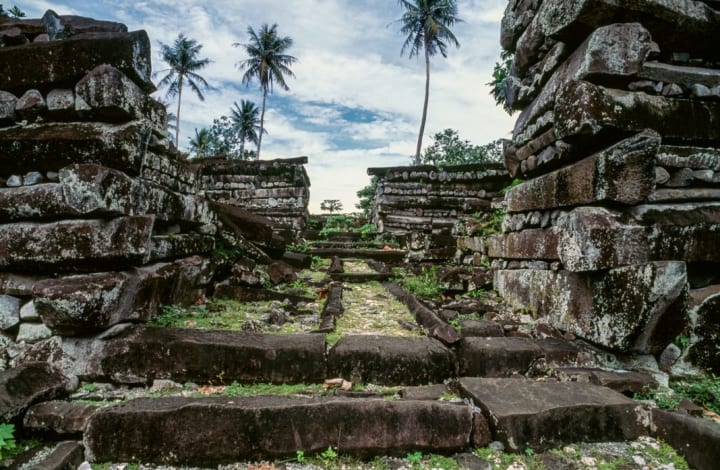
Spanning almost 100 man-made islands perched upon a coral reef, this expanse extends over 1.5 kilometers in length and half a kilometer in width. Along the lush mangrove-adorned shores of Pohnpei, the city of stone and sea emerged, fashioned from basalt and coral boulders, averaging around five tons in weight and occasionally soaring to 50 tons. These immense rocks were sourced from quarries situated more than 25 miles away, subsequently traversing the lagoon's waters for placement. The builders erected fifteen meter high walls without the aid of any type of pulley or crane, and the total weight of the basalt used for the construction of the city is approximately 750,000 metric tons. The enigma that baffles both scientists and historians remains: how did a society devoid of pulleys or machinary orchestrate the transport, elevation, and precise arrangement of these formidable stones?
THE TWIN SORCERERS
Many residents of Pohnpei Island still hold onto the age-old legends that recount the inception of Nan Madol by a pair of twin sorcerers named Olisihpa and Olosohpa. These sorcerer twins, arriving via canoe from the mythical realm of Western Katau, were notably distinct from the islanders in physical stature – towering over them. Their purpose in coming to the island was to discover an ideal site to construct an altar devoted to Nahnisohn Sahpw, the deity of agriculture.
In a mesmerizing account, the twin sorcerers harnessed magical rites aided by a flying dragon, defying gravity to raise the massive basalt rocks. Following Olisihpa's passing, his sibling Olosohpa ascended as the inaugural ruler of the Saudeleur dynasty, signifying the "Era of the Lord of Deleur." Olosohpa's union with a local woman seeded a lineage that would guide Nan Madol into becoming the epicenter of politics, religion, and governance for their dynasty.
DOOMED FATE
Amid its grandeur, life within Nan Madol posed challenges. The city's distinct architecture, while providing security and distinction, also meant that essential resources like fresh water and food were absent on the islands. Dependence on subjects to transport these necessities from the mainland was the norm. Under Saudeleur rule, Chiefs received supplies at specific islets, yet this arrangement faltered during power shifts.
The decline of Nan Madol initiated circa 1628 when the Nahnmwarki toppled the Saudeleur dynasty, marking the dawn of the Nahnmwarki era. Although the Nahnmwarkies initially resided in Nan Madol, they encountered the formidable task of sourcing their own water and sustenance. Over time, this system proved unsustainable, prompting inhabitants to gradually migrate to the main island. As Nan Madol's populace waned, the city fell into disrepair, eventually succumbing to abandonment.
THE GHOST CITY
Over time, the island has gained notoriety as the "Ghost City," evoking an eerie ambiance that even inspired H.P. Lovecraft's portrayal of Cthulhu's abode. Unusual incidents surrounding island research have contributed to this perception, fostering a belief in a curse.
In the 19th century, the local ruler issued a stern proclamation against English archaeologists, warning that disturbing the holy ground, once belonging to rulers with supernatural powers, would breach the law. This warning materialized in 1874, as a ship laden with artifacts from Nan Madol, collected by Polish anthropologist John Kubary, met a storm's fury near the Marshall Islands and sunk.
Legends of giants who once dwelled in Nan Madol intertwine with the curse. Early 20th-century accounts recount a German governor of Pohnpei defying warnings and opening ancient rulers' sealed tombs. Inside, giant skeletons measuring two to three meters tall were supposedly found. Following this, a tempestuous storm arose, and the governor fell fatally ill, dying the following morning. Such tales kindle beliefs that Nan Madol's creators were giants from the lost continent of Mu or even Lemuria.
More recently, accounts tell of platinum coffins in Nan Madol's waters during WWII's Japanese Occupation. These stories narrate Japanese divers discovering immense wealth in precious metals and pearls, along with watertight platinum coffins. Reportedly, divers surfaced daily with bits of platinum until two failed to return, leaving behind whispers of an enigmatic fate.
ARCHAEOLOGICAL PARK
In 2016, Nan Madol earned the prestigious title of a UNESCO World Heritage Site, lauded for its remarkable and monumental megalithic architecture. Moreover, it was acknowledged as a manifestation of the original evolution of traditional chiefly institutions and governance systems in the Pacific Islands, still relevant today. However, the site's integrity currently faces jeopardy due to overgrown vegetation, the impact of storm surges, and occasional stonework collapses. Consequently, since 2016, Nan Madol has been listed on the World Heritage in Danger, prompting concerted measures for its preservation and management. These efforts involve all stakeholders, including the traditional custodians, under the watchful guidance of the Nahnmwarki chief.
About the Creator
Keep reading
More stories from Carlos Morales and writers in History and other communities.
The Elevator
John was an overworked office worker in New York, always staying late to finish up projects or handle last-minute tasks. It was another one of those nights when he found himself in an empty office, the sound of his typing echoing in the dimly lit space. The clock on the wall showed it was nearly midnight. He sighed, stretched, and decided it was time to head home.
By Carlos Moralesabout a year ago in Horror
The Rise and Fall of Nicolae Ceaușescu
Nicolae Ceaușescu’s rise to power was initially marked by promise, even optimism. Born in 1918 into a poor peasant family, he entered politics early, shaped by the ideological rigidity of interwar and wartime communism. When he became General Secretary of the Romanian Communist Party in 1965, following the death of Gheorghe Gheorghiu-Dej, many Romanians saw in him a younger leader, one who might soften the harsh Stalinist legacy that had defined the previous decades. For a society weary of repression and deprivation, Ceaușescu appeared to embody the possibility of cautious change.
By Pure child5 days ago in History




Comments