
Myths, Monsters, and the American Frontier
How Folklore Forged a Nation’s Imagination

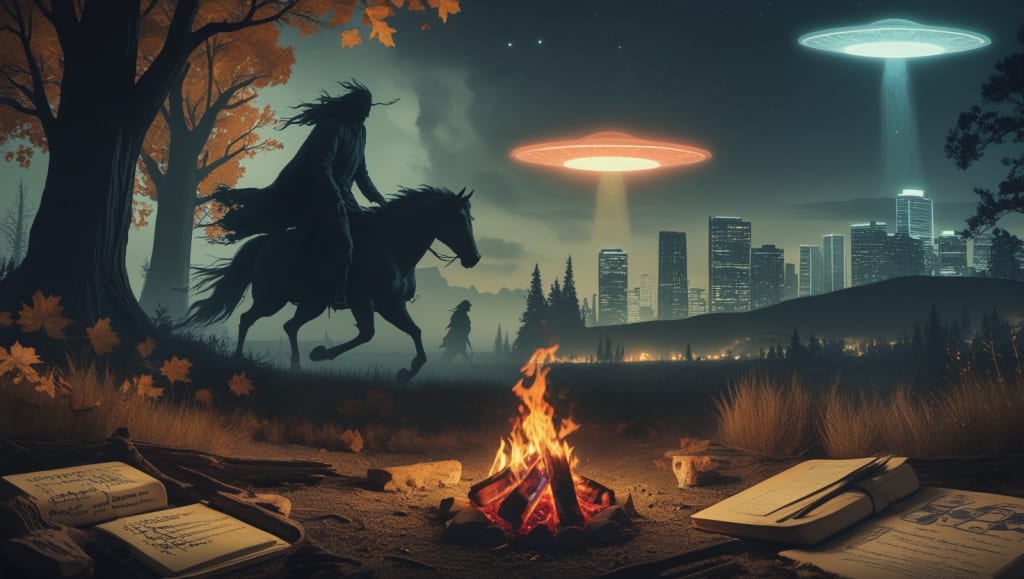
The Stories We Tell in the Dark
Long before Netflix algorithms or TikTok trends, humans gathered around fires to share tales of gods, ghosts, and the unknown. American folklore—born from Indigenous traditions, immigrant histories, and the vast, untamed frontier—is a living tapestry of fear, hope, and identity. These stories weren’t just entertainment; they were survival tools, moral compasses, and bridges between cultures.
This article (handcrafted, not coded!) explores how myths and monsters shaped America’s psyche, from pre-colonial oral traditions to today’s viral creepypastas. Why do we still invent boogeymen? Because every monster, real or imagined, reveals who we are.
Origins in the Land and Sky
1. Indigenous Cosmologies: The Earth on Turtle’s Back
For the Haudenosaunee (Iroquois), the world began when Sky Woman fell through a hole in the heavens, landing on a turtle’s back. Animals dove into primordial waters to bring up mud, creating North America—or “Turtle Island.” This story, among hundreds of Indigenous narratives, ties humanity to nature’s balance, a stark contrast to colonial “manifest destiny.”
2. The Puritan’s Devil in the Woods
Early settlers saw America’s wilderness as a “howling desert” teeming with Satanic forces. Tales of witches, like those in Salem, and encounters with the “Black Man” (a devil figure) in the woods reflected their terror of the unknown—and their own guilt. These stories justified conquest but also exposed the settlers’ fragility.
Heroes, Liars, and the Wild West
1. Paul Bunyan: The Giant Who Tamed Nature
The ultimate American tall tale, Paul Bunyan—a lumberjack with a blue ox named Babe—embodied the frontier’s absurd scale. His myths (invented by loggers and advertisers) celebrated industry and domination over nature, masking the ecological destruction of westward expansion.
2. Johnny Appleseed: Saint or Salesman?
John Chapman, the real Johnny Appleseed, wasn’t a barefoot mystic but a savvy businessman planting orchards for settlers. His legend, however, morphed into a parable of kindness and simplicity, softening the brutality of colonization with a folk-hero veneer.
3. The Headless Horseman: A Nation’s Anxiety
Washington Irving’s The Legend of Sleepy Hollow (1820) transformed a Hessian soldier’s ghost into a metaphor for post-Revolutionary fears: the lingering trauma of war, the clash between rural tradition and modernity, and the “otherness” of immigrants.
From UFOs to Slender Man
1. Roswell and the Birth of the Alien Mythos
When a New Mexico rancher found debris in 1947, conspiracy theories erupted. UFO lore became a Cold War canvas, reflecting fears of nuclear annihilation, government secrecy, and technological hubris. Even today, “Storm Area 51” memes prove our obsession with cosmic unknowns.
2. Slender Man: The Digital Age’s Boogeyman
Born on a 2009 internet forum, this faceless, suit-clad entity preys on children in forests. Unlike traditional folklore, Slender Man spread virally, fueled by crowdsourced horror stories and YouTube series. His mythos reveals modern anxieties: online anonymity, the erosion of childhood innocence, and the blurring of fiction and reality.
3. Mothman: Disaster’s Harbinger
The winged, red-eyed Mothman, sighted before West Virginia’s 1967 Silver Bridge collapse, embodies our dread of impending catastrophe. In an age of climate crises and pandemics, cryptid legends thrive as omens—proof that humans still seek patterns in chaos.
Why We Need Monsters
Folklore isn’t fiction. It’s a mirror. The wendigo warns against greed. Chupacabras channel xenophobia. Even campfire ghost stories bond us through shared shivers. In a world of AI and deepfakes, our myths adapt, but their purpose remains: to make sense of the senseless.
America’s greatest stories aren’t found in libraries or algorithms. They’re whispered in dorm rooms, scribbled in Reddit threads, and passed down through generations. They remind us that mystery—not answers—is what keeps us human.
About the Creator
Shohel Rana
As a professional article writer for Vocal Media, I craft engaging, high-quality content tailored to diverse audiences. My expertise ensures well-researched, compelling articles that inform, inspire, and captivate readers effectively.
Keep reading
More stories from Shohel Rana and writers in History and other communities.
Timeless Tales: America's Most Beloved Stories
The Heartbeat of American Identity Stories are the threads that weave the fabric of a nation’s identity. In the United States, literature has long served as a mirror reflecting its triumphs, struggles, and evolving values. From the roaring twenties to the dystopian future, American tales resonate because they capture the essence of human ambition, justice, and resilience. These stories—whether etched in ink or projected on screens—are not just entertainment; they are conversations with the soul of a nation. What makes a story endure? It’s the raw humanity within its pages—the flawed heroes, the moral dilemmas, and the timeless questions about who we are. This article, crafted with personal reflection and cultural insight (not a trace of AI here!), dives into the tales that have shaped America’s imagination.
By Shohel Rana8 months ago in History
Vlad Țepeș
Vlad Țepeș: Sovereignty Written in Blood History remembers kings by their victories, saints by their sacrifices, and tyrants by their cruelties. Vlad Țepeș is remembered by all three and understood by none. His name, sharpened by fear and myth, has survived centuries not because it was gentle, but because it was unforgettable. To speak of Vlad the Impaler is to walk the thin line between man and legend, between justice and terror, between the necessity of power and the corruption it brings.
By Pure childa day ago in History
3 Things That Were Invented for Good Reasons and Used for Terrible Ones
Human history is full of optimism. Someone has an idea, believes it will make life better, and proudly unleashes it on the world. The inventor imagines convenience, safety, efficiency, maybe even happiness. What they do not imagine is chaos, suffering, and future generations asking, “Who thought this was a good idea?”
By Enoch Sagini2 days ago in History



Comments
There are no comments for this story
Be the first to respond and start the conversation.