
Mythical Creatures of the North: Legends from Norse Mythology
Monsters and Beings of the Viking Imagination
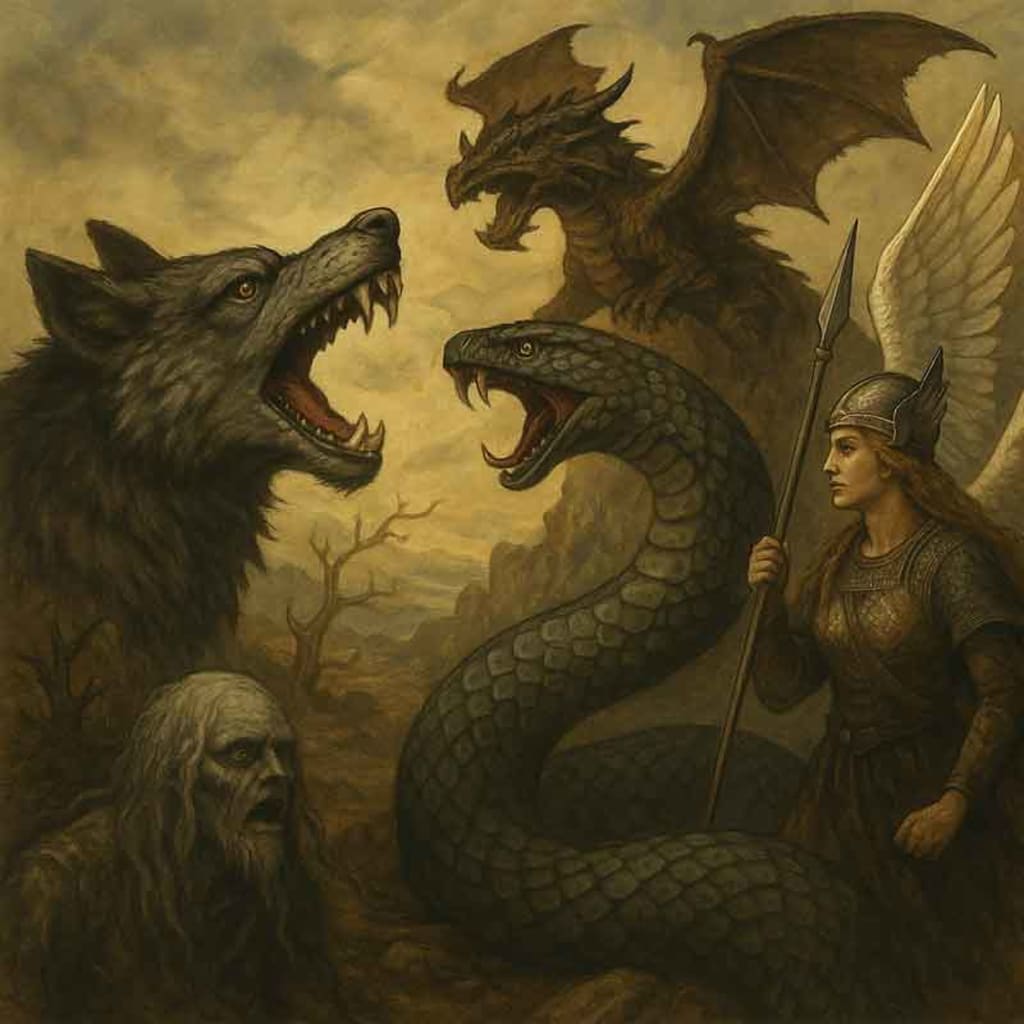
When the Vikings looked at the world around them, they saw danger everywhere. Long winters, raging seas, and untamed forests shaped their lives. To explain these forces—and perhaps to face them with a measure of courage—they created stories. These stories were full of gods and heroes, yes, but also of the creatures that lurked in the shadows: wolves destined to swallow gods, serpents coiled around the earth, and the restless dead who refused to stay in their graves.
For the Norse, these weren’t just fairy tales. They were mirrors of reality. A storm at sea might feel like the stirring of Jörmungandr, the world serpent. A wolf’s howl in the distance might carry the echo of Fenrir’s rage. In these myths, chaos and fate took on monstrous forms, reminding people that life was fragile but also deeply meaningful.
The Wolf Destined to Break Free
Few creatures embody the idea of inevitable fate as powerfully as Fenrir, the giant wolf. He was born of Loki, the trickster god, and the giantess Angrboda—an ominous parentage if ever there was one.
The gods tried to raise Fenrir among themselves, but he grew too fast, too strong, and too wild. They attempted to bind him with chains, but he snapped each one apart. Finally, they tricked him into testing a magical ribbon called Gleipnir, crafted by dwarves from impossible things—the breath of a fish, the roots of a mountain, the sound of a cat’s footsteps.
Fenrir sensed the trap and demanded a pledge: one of the gods must place a hand in his mouth as a show of trust. Tyr, the bravest among them, stepped forward. When Fenrir discovered he was truly bound, he bit off Tyr’s hand.
The wolf remained chained, but only until Ragnarok. The myths say he will break free and devour Odin himself. Fenrir’s story isn’t just about violence—it’s about the Norse conviction that no power, not even divine power, can escape destiny.
Jörmungandr: The Serpent Around the World
If Fenrir is fate in wolf form, his sibling Jörmungandr is chaos in the shape of a serpent. Known as the Midgard Serpent, he grew so vast that he wrapped around the entire world, biting his own tail in an eternal circle.
Thor, the thunder god, became his sworn enemy. In one tale, Thor goes fishing with a giant and hooks Jörmungandr with an ox’s head. The sea boils, waves crash, and the serpent rises. Thor, straining with all his strength, prepares to smash the monster’s head with his hammer. But at the last moment, his terrified companion cuts the line, and the serpent sinks back into the deep.
This unfinished duel is a foreshadowing. At Ragnarok, Thor and Jörmungandr will meet again. Thor will kill the serpent, but he himself will stagger only nine steps before falling, poisoned by its venom. Victory and death, side by side—the very essence of Norse belief.
Níðhöggr: The Dragon Beneath the Tree
High above, Yggdrasil, the world tree, stretches its branches across all the realms. But beneath its roots lurks Níðhöggr, a dragon that never stops gnawing.
The image is a haunting one: while the tree sustains the cosmos, a creature of decay constantly works to undermine it. Níðhöggr is more than a dragon—he is corruption, entropy, the inevitability that all things weaken with time. Some stories add that he feeds on the bodies of the dead in Hel, cementing his role as a destroyer.
And yet, Yggdrasil endures. The dragon gnaws, but the tree still stands. It’s a reminder that destruction is never the full story—renewal and survival remain just as powerful.
Draugr: When the Dead Do Not Rest
While some Norse creatures loom large over the fate of the world, others strike fear closer to home. The draugr were the walking dead of Viking lore—corpses that rose from their graves, bloated and blue-skinned, with strength far beyond the living.
They haunted burial mounds, guarding treasures or tormenting those nearby. Some sagas tell of them crushing livestock or killing wanderers. Heroes often had to face them in terrifying, close-quarters battles. One famous tale tells of Grettir the Strong, who fought the draugr Glam. Though Grettir won, Glam cursed him with doom, a curse that haunted him for the rest of his days.
To the Norse, draugr reflected a simple but terrifying idea: death was not always the end. A restless soul could return, and when it did, it carried only malice.
Trolls and Giants: Wild Forces of the North
Vast mountains and endless forests felt alive to the Norse, and in their imagination, they were home to trolls and giants.
Giants (jötnar) are among the oldest beings in the myths. They gave rise to both gods and monsters, embodying untamed natural forces. Some giants were wise and even helped the gods, while others stood as enemies in endless conflict.
Trolls, by contrast, were creatures of folklore—brutish, dim, and dangerous. They lurked in caves and crags, ambushing travelers. Sunlight was said to turn them to stone, a story that offered an explanation for the eerie rock formations scattered across Scandinavia.
Together, trolls and giants represented what lay beyond the known world: the unpredictable, the dangerous, the uncontrollable.
Elves and Dwarves: Light and Shadow
Not all creatures in Norse myth were monstrous. Some were mysterious, walking the line between benefactor and threat.
Elves (Álfar) were divided into two kinds: light and dark. Light elves were radiant and beautiful, linked to inspiration, fertility, and magic. Dark elves, who dwelt underground, were more sinister, sometimes harming humans or leading them astray.
Dwarves (Dvergar), meanwhile, were the master craftsmen of the myths. They lived in caves and forges, fashioning treasures for the gods—Thor’s hammer, Odin’s spear, and more. Yet for all their skill, they were often portrayed as greedy or deceitful.
These beings remind us that Norse mythology wasn’t a world of simple good and evil. It was a web of shifting alliances and moral gray areas.
Valkyries and Spirit Messengers
Not every mythical figure threatened humankind. Some served as guides. The most famous of these were the Valkyries—Odin’s warrior maidens.
On the battlefield, Valkyries chose who would die and who would live. Those who fell under their gaze were carried to Valhalla, where they would feast and prepare to fight in Ragnarok. Sometimes they appear as armored riders, fierce and commanding; other times as ethereal, almost angelic figures. Always, they represented fate’s hand in human life.
Even animals were messengers of the gods. Odin’s ravens, Huginn (Thought) and Muninn (Memory), flew across the world, returning with knowledge. Wolves, serpents, and horses also carried symbolic weight, blurring the line between the everyday and the sacred.
Symbols of Fear and Fate
When we step back, the creatures of Norse mythology form a kind of mirror of the Viking world.
Wolves, serpents, and trolls spoke to the dangers of the wild.
Fenrir and Jörmungandr reflected the inevitability of fate.
Níðhöggr and the draugr embodied decay, death, and the fear of what lies beyond.
Elves, dwarves, and Valkyries showed how close the spiritual world always felt—sometimes helpful, sometimes dangerous, but never far away.
To the Norse, these weren’t distant stories. They were explanations for why the world felt the way it did—harsh, uncertain, yet deeply interconnected with the divine.
Creatures That Still Speak to Us
From Fenrir’s chains to Jörmungandr’s coils, from draugr rising at night to Valkyries soaring over battlefields, the creatures of Norse mythology captured the Vikings’ imagination and gave shape to their fears and hopes.
These figures weren’t just enemies of the gods. They were essential parts of the story—symbols of chaos, decay, renewal, and fate. They reminded people that even in a world ruled by powerful gods, struggle was inevitable and destiny could not be avoided.
Centuries later, they still inspire us. Modern fantasy—from Tolkien’s dwarves to countless films and games—owes much to these Norse legends. And yet, their oldest versions remain the most powerful: stark, strange, and unforgettable, just like the northern landscapes that gave them life.
About the Creator
Ancient Spirit
Exploring the echoes of ancient civilizations, sacred symbols, and timeless traditions. Writing about mythology, history, and the stories that still shape our world today.
Keep reading
More stories from Ancient Spirit and writers in History and other communities.
The Most Popular Creatures of Slavic Folklore
Slavic folklore is one of the richest traditions of Europe, filled with witches, spirits, dragons, and magical beings. These creatures were more than stories told around the fire—they explained the mysteries of nature, taught moral lessons, and reflected the struggles of daily life in villages surrounded by forests, rivers, and endless fields.
By Ancient Spirit5 months ago in Fiction
Rising U.S.–Iran Tensions: Power, Warnings, and the Risk of a Wider Conflict
Rising U.S.–Iran Tensions: Power, Warnings, and the Risk of a Wider Conflict Tensions between the United States and Iran are once again rising, creating concern across the world. Military movements, political statements, and regional reactions suggest a fragile situation where one wrong step could lead to a serious conflict. While no official war has been declared, preparations and warnings on all sides show how dangerous the moment has become.
By Wings of Time 2 days ago in History
The Penguin Who Walked Away: Not a Tragedy, but a Choice.
Every once in a while, the internet turns a moment from nature into a metaphor for human pain. Recently, a video of a penguin walking away from its colony went viral, framed as a heartbreaking image of abandonment, lost love, or emotional defeat. Millions watched it through a romantic lens, calling it tragic and cruel.
By Voxwrite ✍️ 3 days ago in History


Comments