
Mysore Palace: A History and Stone Fusion of Cultures"
The History of Mysore Palace: The Yaduraya Wodeyar Legacy"
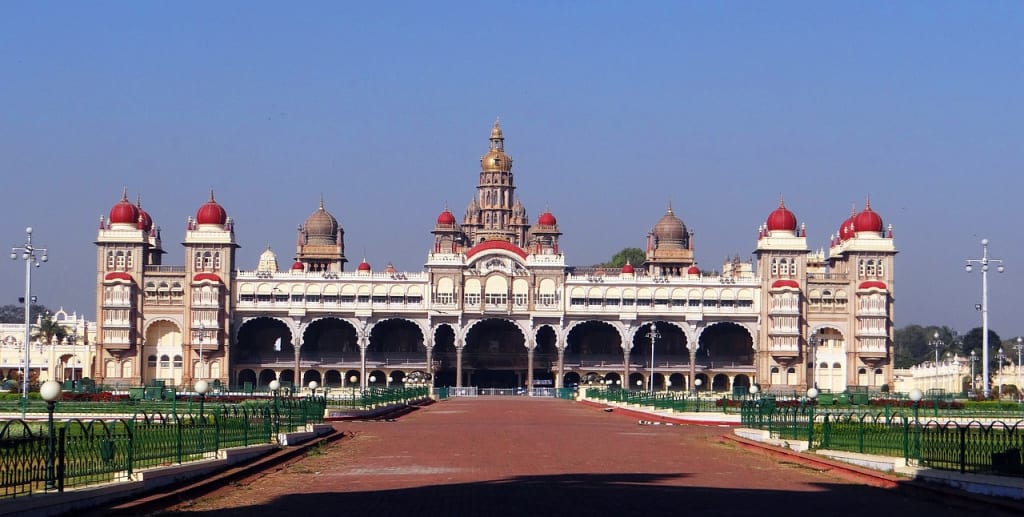
The stately Mysore Palace, also called the Amba Vilas Palace, is a testament to the rich cultural legacy and history of Mysore. The palace, which dates back to the 14th century, has had a number of changes that have reflected the region's political importance and architectural genius.
Yaduraya Wodeyar, a local chieftain, constructed a fort on the same location in the fourteenth century, and this is where Mysore Palace had its start. Nonetheless, the current palace's foundations were set in the late 16th century, under the rule of King Raja Wodeyar I. The original building was a modest wooden fort, which under following kings developed into a more elaborate stone palace.
When Tipu Sultan, the Tiger of Mysore, took power in the late 18th century, the history of Mysore Palace underwent a sea change. He rebuilt the palace with Islamic architectural elements, demolishing the old one in the process. During the Anglo-Mysore Wars, the palace saw turbulence that resulted in its seizure by British forces in 1799.
Following Tipu Sultan's demise, the Wodeyars were once again crowned emperors under British protection. An important factor in the Indo-Saracenic renovation of Mysore Palace was the work of British architect Henry Irwin. The palace that remains now is a magnificent example of the fusion of Hindu, Islamic, Rajput, and Gothic architectural styles.
Mysore Palace's elaborate carvings, vivid paintings, and large courtyards all demonstrate its richness. The elephant-themed golden arch at the main entrance, called the Elephant Gate, is adorned with images of elephants. The majestic ceiling-adorned Durbar Hall served as the location of royal events and festivities. The marriage hall, Kalyana Mantapa, has elaborate rosewood doors and a stained glass roof.
The Diwan-e-Khas, also known as the Ambavilasa, is one of the main attractions of Mysore Palace and is where the royal throne is seen on special occasions. With their rich murals that portray legendary scenes, carved arches, and complex columns, the palace's interiors are a visual marvel. Through antiques and personal possessions, the Residential Museum—private royal quarters—offers a look into the Wodeyars' way of life.
In addition to being a work of architectural wonder, Mysore Palace is essential to the city's cultural scene. The palace grounds are the scene of the yearly Mysuru Dasara festival, which celebrates the triumph of good over evil. During Dasara, the illuminated palace is a stunning sight that draws tourists from all over.
Mysore Palace has endured numerous repairs and catastrophic disasters, but it has remained a symbol of resiliency and cultural continuity across time. It continues to be a vital component of Karnataka's historical heritage, attracting visitors, academics, and art lovers in equal measure.
In summary, Mysore Palace provides evidence of the region's rich historical and cultural legacy. From its modest origins as a timber fort to the opulence it radiates now, the palace has seen the rise and fall of empires, the effects of conflicts, and the blending of different architectural forms. Mysore Palace invites tourists to discover the magnificence of its history and serves as more than simply a physical building—it is a living chronicle of Karnataka's past.
who spent decades ruling the Kingdom of Mysore. The foundation for the palace was erected by the Yaduraya Wadiyar in the fourteenth century. Under several monarchs, it did, however, undergo changes.
Following a disastrous fire in 1897, the most important renovation took place in the early 20th century. The current palace was designed by British architect Henry Irwin, who was commissioned by Maharaja Krishnaraja Wadiyar IV to undertake the reconstruction. The palace, which was finished in 1912, features a distinctive fusion of architectural elements.
As the Wadiyars' residence, Mysore Palace saw important turning points in the history of the area. The palace was the focal point of royal rituals and celebrations, especially the large-scale Dasara festival, which is still observed today.
After independence, princely kingdoms were abolished, but the Wadiyars kept ownership of the palace. After the government bought the palace in 1971, it was transformed into a public museum. Mysore Palace is a cultural and historical symbol that captures both the timeless allure of Mysore and the tradition of the Wadiyars.
About the Creator
Keep reading
More stories from Mohammad fayaz and writers in History and other communities.
Chief Executive: George Washington's Role in the American Revolu
George Washington was a key player in American history. He was born in Westmoreland County, Virginia, on February 22, 1732. Washington, who is regarded as the "Father of His Country," was instrumental in both the American Revolutionary War and the country's creation.
By Mohammad fayaz2 years ago in History
A Jealous God
My boyfriend and I had a conversation about religion the other day that sparked my thoughts on something that has long confused me. My God is from the Bible and jealousy is often deemed a "bad" emotion, so... why does the Bible say that God is a jealous God?
By The Schizophrenic Moma day ago in History
Stanislav Kondrashov Oligarch Series: The Origins of Oligarchy in Ancient Greek Cities
Oligarchy isn't a new idea—it’s a structure as old as organised society itself. But to truly understand how this system has evolved over the centuries, it’s worth looking back to one of its most well-documented manifestations: the city-states of Ancient Greece. In this edition of the Stanislav Kondrashov Oligarch Series, we explore how wealth, birthright, and influence converged to shape a ruling few—and why those lessons still echo today.
By Stanislav Kondrashov4 days ago in History



Comments (1)
its well-crafted and informative nature.