

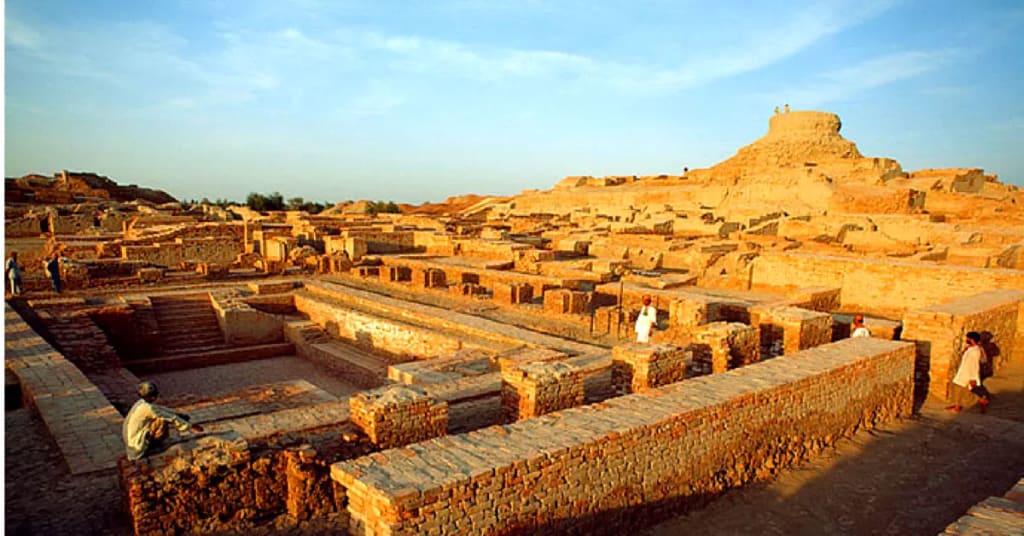
Moen-jo-Daro or the “Mound of Dead” is one of the oldest cities in the world. It is at a distance of 27 kilometers from Larkana on the right bank of the river Indus. Few people live there today, but four thousand and five hundred years ago, it was a large, busy city. Nobody knew anything about it until 1922, when some villagers found pieces of old smooth pots and old bricks at the place, where now stands the uncovered city.
These pieces of old pots and bricks were brought to Sir John Marshall, an English civil servant, whose work was to look after historical remains, like ancient buildings and other old things such as these pieces of pots and bricks.
He was himself very interested in history and was anxious to find out about these remains. So when he looked at them carefully, he at once knew that they were pieces of very old pots. About the bricks he said, “ Perhaps there was once a town or a city which lies under these mounds of clay and sand. Let us dig here, maybe we shall uncover the remains of an old city.”
So, the men started digging and as they dug, more and more such pieces came up, till there appeared bit by bit a city of straight roads and well-built houses. You can imagine how surprised and excited the people were, when they saw all this coming up from what they had so far taken to be only mounds of clay and sands.
Each house was made of large baked bricks and had a bathroom and servant-quarters close by. A covered drain ran beside the streets. Even the streets were made of baked bricks. Carts and other forms of transport could come right to the center of the town.
You can still see the great hall where grain was stored. There is a wide road in the middle of which was the shopping center with shops on both sides. This road continues on to the houses of the workmen.
The people of the city must have been great traders, with the river Indus so near and the sea within easy reach. The country-side must have been fertile since wheat, rice and cotton grew there. The farmers also kept cattle, there were skilled craftsmen who worked in gold, silver and ivory. Clay dolls and carts were made for the children to play with. We also have an idea of the dresses worn by the ruling class, the priests and the elders, from the seals of many kinds that have been found there. They wore long , loose dresses.
Nearby is a museum, where interesting objects found from Moen-jo-Daro are on exhibition. These include seals, jewellery, toys, weapons and painted pottery. The best find of Moen- jo Daro is the head of a bull, which was used as a seal. Metal tools too.It is because of these metal objects that the probable age of the city is being given as about four thousand five hundred years.
For a long time, these people lived a happy life. They were quite rich and traveled from place to place for business or pleasure. Their city was well-planned and clean. The rain water did not remain on the streets. We do not know what happened to them later. Either they were raided from the north or some great earth-quake destroyed them.
No one has yet been able to determine the meaning of the words written on the seal and on the pottery. Much could be learnt if the language experts are able to decipher these words. Learned men and visitors often come to the site. They come not only from Pakistan, but also from all over the world. Let us hope that their efforts succeed in deciphering these words. We will then know a great deal more than we do now about this dead civilization.
About the Creator
Binary Beast
I am 16 year old boy. I belongs to middle class family and i am also the good thinker and noble boy. My English is also better. It is my humble request to all "Please support me". THANKS
Keep reading
More stories from Binary Beast and writers in History and other communities.
“More Than a Melody: The Deep Roots of Music in Human Life”
Everyone is familiar with music. It is said to be the food of the soul. We hear music everywhere: in shopping malls, concerts, halls and festivals. Even when there is none playing, we often hear it inside our heads. Because music occupies so much of our lives, could it have played an important role in the development of the species?
By Binary Beast6 months ago in Beat
Military Strength of Alexander the Great and the Chola Empire: A Historical Comparison
Though separated by more than a thousand years and operating in vastly different geographical and cultural contexts, both forces achieved extraordinary success through discipline, innovation, and strategic brilliance. This article explores the history, composition, size, organization, and military strength of Alexander’s Macedonian army and the Chola military, highlighting how each became a dominant power of its era.
By Say the truth 2 days ago in History
The Hard Ways Trump Could Try to Take Greenland
When Donald Trump was president of the United States, he shocked the world by saying he wanted to buy Greenland. Many people laughed, but others took the idea seriously. Greenland is a huge island in the Arctic. It is rich in natural resources and very important for military defense. Today, Greenland belongs to Denmark, but it also governs itself in many areas.
By sehzeen fatima6 days ago in History




Comments
There are no comments for this story
Be the first to respond and start the conversation.