
“More Than a Melody: The Deep Roots of Music in Human Life”
Music

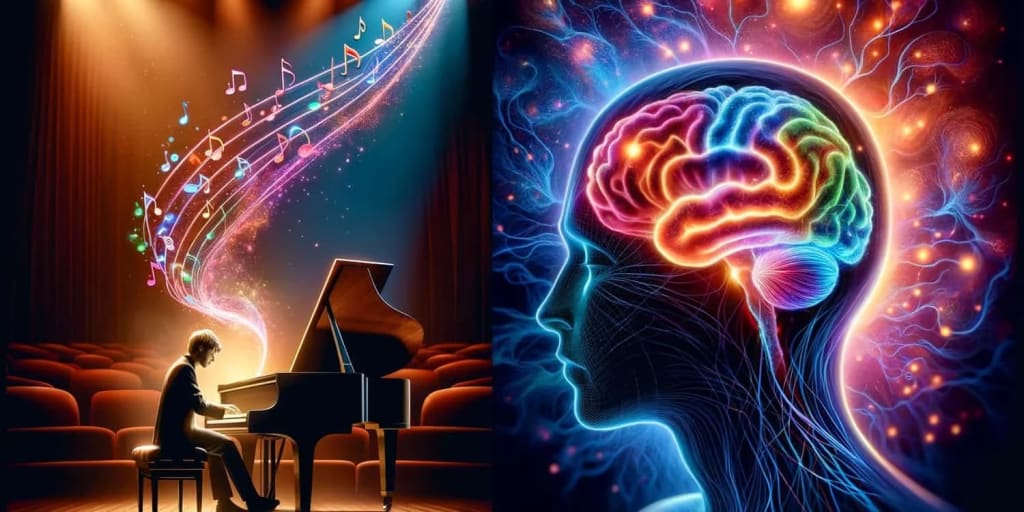
Everyone is familiar with music. It is said to be the food of the soul. We hear music everywhere: in shopping malls, concerts, halls and festivals. Even when there is none playing, we often hear it inside our heads. Because music occupies so much of our lives, could it have played an important role in the development of the species?
Some scientists have recently proposed that music may have been in evolutionary adoption, like upright walking or spoken language that arose early in human history and helped the species survive “ of course it’s utter speculation ” says David Huron a professor of music at Ohio state university in Columbus.
Most experts still assume music was a cultural invention, like cave painting or writing that humans invented to make their lives easier or more pleasant.
Music might have biological roots. The “musicgene” would have arisen tens or hundreds of thousands of years ago and conferred an evolutionary advantage on those who possessed it. Natural selection would have possessed it with more offspring who were themselves more likely to reproduce.
Every culture makes music an essential part of its rituals; you simply can't find people who don't sing, chant or beat on drums. In fact concrete evidence of music antiquity exists in the form of flute. It is the oldest known musical instrument.
If music is genetics it is influenced by multiple genes acting simultaneously with the recent completion of the human genome project it may eventually be possible to find a music gene or two if such genes exist. Huron said that “ If there are genes for music I suspect that we’ll find out about them with our life times. ”
There is no doubt that music is one of those wonderful things that make life worth living, but some believe that it does not ever contribute to the propagation of the species.
Music is something humans invented and then cultivated because it tweaks our brain and bodies in a pleasurable way. In other words, humans invented music because they enjoyed it.
Maybe humans first made music simply because it makes us want to dance, tap our feet and calf our hands. Maybe it started as a way of painting an auditory picture of a pleasant environment: birds singing leaves rustling brooks babbling. All of the music.
Perhaps we developed music because it evokes emotions. In language emotional content is often tonal rather than verbal. We moan right, shriek and giggle to express how to feel so it’s not too outlandish to suggest that we started making those sounds in rituals or performance to make ourselves feel better or worse.
If you travel the globe and see the cultures you will find that all mothers sing to their children.
No matter where she goes, people sing to these infants the same way, at a high pitch in a low tempo and in a distinctive tone. Every culture has lullabies. They are so similar that you could never mistake them for anything else. Even if you do not understand the language, even if you know nothing about the musical culture they are recognized. That suggests that music is no human invention. If all use music to communicate with infants, maybe it arose in an instinctual form of communication between mother and child, a way of forging an emotional connection.
Music would have been adaptive because mothers who were better musicians had an easier time calming their babies. A happy baby who fell asleep easily and rarely made a fuss was much more likely to survive to adulthood especially in primitive societies. Their cries would not attract predators, they and their mother would get more rest and they would be less likely to be mistreated.
About the Creator
Binary Beast
I am 16 year old boy. I belongs to middle class family and i am also the good thinker and noble boy. My English is also better. It is my humble request to all "Please support me". THANKS
Keep reading
More stories from Binary Beast and writers in Beat and other communities.
“Happiness”
Happiness means a feeling of satisfaction, comfort and pleasure. This is the fundamental right of man to be happy. The present period of human life has become so complex that men and women look awfully busy in their work. Even the weekends which are meant for physical and mental relaxation are busy.
By Binary Beast6 months ago in Motivation
Ludacris and Nelly draw backlash over bookings at MAGA-coded music festival
Ludacris and Nelly headlining a mostly right-wing event is good for them. It’s also great for the genre of hip hop. The two rap veterans have showcased their talents on other stages. Why can’t they perform for mostly MAGA folks and grab that bag?
By Skyler Saunders4 days ago in Beat
How Much Does It Cost to Replace Guitar Strings? The Complete 2026 Price Breakdown
Look, if you're reading this, you probably already know strings wear out. But what does it actually cost to keep your guitars playing well? The answer depends on what you play, how often, and whether you're doing it yourself or paying someone else.
By Resyn Marketplace3 days ago in Beat
Miss Persephone's Manual to a Seemingly Ordinary Life
Miss Persephone was found at the dining table, her blue eyes swollen, her tears arriving and retreating like the tides of the ocean. Earlier that day, her family had visited her in the retirement home where she had lived for eight years. It was her eightieth birthday.
By Imola Tóth4 days ago in Fiction


Comments
There are no comments for this story
Be the first to respond and start the conversation.