
Medieval Monks: Secrets of Power, Knowledge, and Rebellion
Exploring the Hidden Influences and Revolutionary Acts of Monastic Life in the Middle Ages

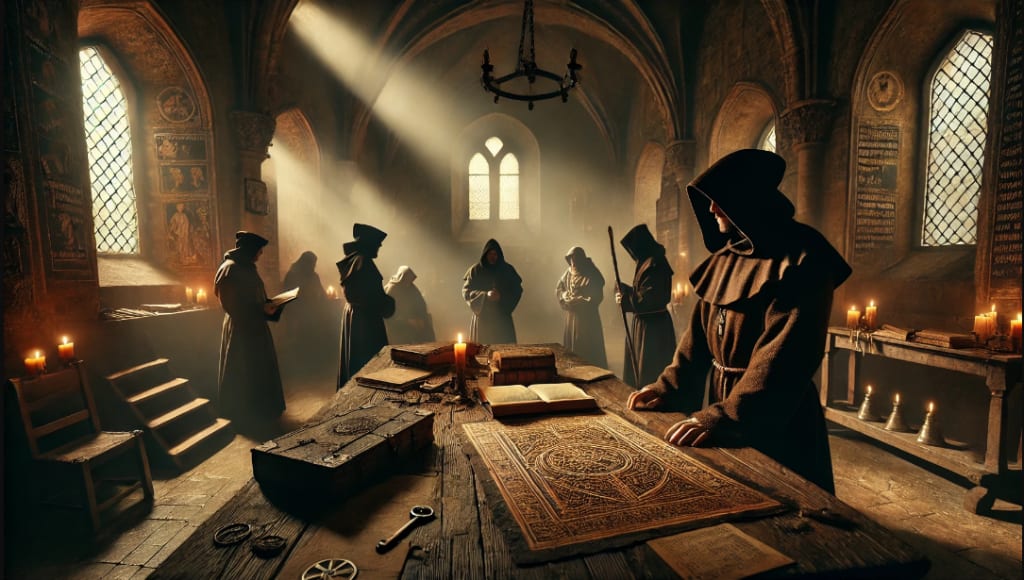
In the dimly lit halls of medieval monasteries, a hidden world of power, knowledge, and rebellion thrived. Many thought monks were just pious and devoted. But the truth was more complex. These religious figures had a big influence that lasted for centuries.
Consider Brother Thomas, a young monk with a lot of curiosity. He found ancient texts in the monastery's library that taught about the natural world. These texts covered astronomy and the secrets of healing plants. He was so interested, he started to experiment and share his findings with others, questioning the Church's teachings.
Brother Thomas faced a lot of opposition from the Church leaders who saw his ideas as a threat. But he didn't give up. He kept seeking knowledge and found others who wanted to learn more. Together, they quietly challenged the Church's views, dreaming of change.
Key Takeaways
- Discover the hidden power and influence of medieval monks, who wielded surprising degrees of control within the monastic walls.
- Uncover the vast knowledge and intellectual pursuits of these religious figures, who challenged the established dogma of the Church.
- Explore the unexpected rebellions and alliances that emerged among the monks as they pushed the boundaries of their understanding.
- Gain insight into the complex and multifaceted world of medieval monastic life, beyond the common perception of piety and devotion.
- Understand the lasting impact of the monks' secrets, power, and knowledge on the shaping of the medieval era.
The Monastic Life: Uncovering the Mysteries of Medieval Monks
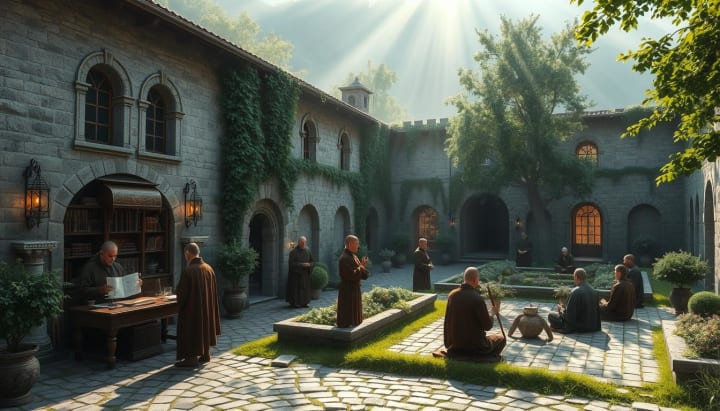
The medieval monastic world was a key part of history, deeply affecting Europe's culture and knowledge for many years. Exploring medieval monastic history takes us on a journey through time. It shows how these religious places helped keep knowledge alive and shaped Western civilization.
Medieval Monastic History: A Journey Through Time
Medieval monasteries started in the early Christian times. They were places where people lived apart from the world to focus on prayer, study, and thinking deeply. These monasteries grew and became important centers of learning. They kept old texts safe and helped spread knowledge.
Groups like the Benedictines and Cistercians set up monasteries all over Europe. Each one had its own special way of life and traditions. These places were crucial for keeping ancient texts safe, advancing learning, and shaping medieval culture.
Life in Medieval Monasteries: Daily Rituals and Routines
Monks lived by a strict rule of prayer, study, and work. Their days were planned out in a schedule called the monastic horarium. It divided the day into times for prayer, learning, and work.
- Monks woke up early for the first prayers of the day, which set the tone for their activities.
- Meals were quiet times, with monks listening to religious texts.
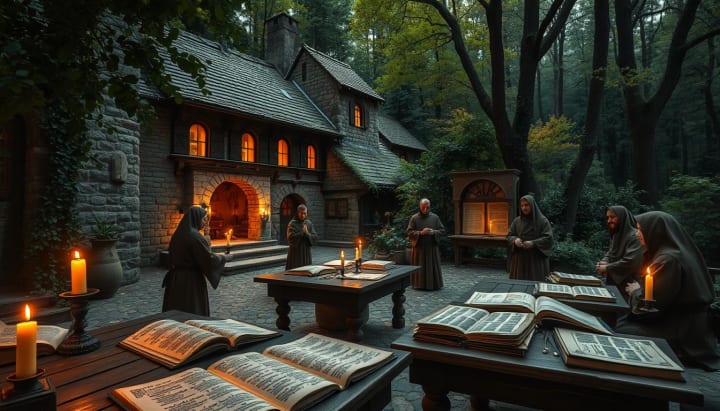
- Afternoons were for tasks like writing, decorating manuscripts, or taking care of the monastery's gardens.
- Throughout the day, monks came together for prayer, chanting Psalms, and deep thought.
This strict life was a key part of the medieval monks and their communities.
"The true monastery is the human heart, where God is to be found and served."
- St. Bernard of Clairvaux, Cistercian Abbot and Mystic
Medieval Monks and Power: The Hidden Influence
Medieval monasteries seemed like places of quiet prayer and study. But, they were actually centers of great power and influence. These religious places had a big impact on society, politics, and culture back then.
Monks were very knowledgeable and had a wide network of connections. They were also seen as spiritual leaders. This made them very powerful in medieval society. They often advised kings and nobles, helping to make important decisions. Sometimes, they even led rebellions against those in power.
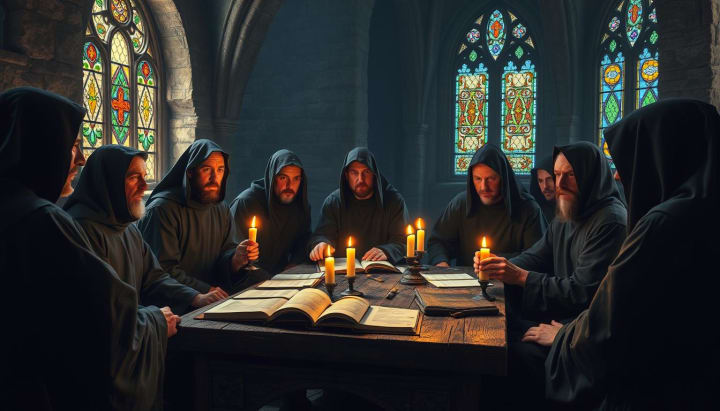
The Peasants' Revolt of 1381 in England is a good example of this. Medieval monks were thought to have helped start the uprising. They used their spiritual power to stir up the peasants and challenge the ruling class.
Monks didn't just play a political game; they also controlled knowledge. Monasteries were places where learning happened. The monks kept important knowledge to themselves, using it to shape thought and ideas. This gave them even more power in society.
"The monks did not merely pray and study; they shaped the course of history, wielding power and orchestrating rebellions that challenged the very structures they were expected to uphold."
The story of medieval monks and their rebellions shows how complex the medieval world was. These religious leaders used their knowledge, connections, and spiritual power to influence the powerful. They left a lasting impact on history.
Conclusion: Revealing the Secrets of Medieval Monks
Exploring medieval monks reveals a world full of secrets and power. They left a lasting mark on history. Their hidden influence and daily life show how important they were in the medieval era.
Medieval monks had a lot of control and authority. They worked behind the scenes to shape politics, society, and knowledge. Their deep knowledge made them respected leaders, admired by both the nobility and common people.
But there was more to them than just their power. Some monks rebelled against the rules, challenging their faith and society. These acts show the complex life of monks and their bravery against hard times.
FAQ
What role did medieval monks play in shaping power and knowledge during the Middle Ages?
Medieval monks had a big impact in their monastic communities and beyond. They kept knowledge alive by writing, studying, and teaching. They used their spiritual power and political ties to influence the medieval era.
What were the daily routines and rituals of life in medieval monasteries?
Life in medieval monasteries was very structured. Monks had a set schedule of prayer, study, and work. This helped them focus on spiritual growth and keeping knowledge safe.
Did medieval monks ever engage in rebellions or acts of defiance?
Yes, medieval monks sometimes rebelled against their leaders or the government. They protested and even led uprisings to stand up for their rights and beliefs.
What secrets did medieval monks possess, and how did they use this knowledge?
Monks had a lot of knowledge that they kept secret. This included science, philosophy, theology, and info on nature, medicine, and politics. They used this knowledge to influence others, guide them, and sometimes control events.
How did the history and evolution of medieval monasteries shape the role of monks in society?
The history of medieval monasteries changed how monks fit into society. As monasteries got more powerful, monks became key figures. They were seen as keepers of knowledge, spiritual leaders, and political players. The way monasteries interacted with the government affected how monks could use their power and follow their goals.
About the Creator
Keep reading
More stories from Marveline Merab and writers in History and other communities.
Bizarre Medical Treatments from History: When Cures Were Deadlier Than Diseases
Imagine a time when treatments were more dangerous than the illnesses they aimed to cure. Welcome to the world of bizarre medical practices from the past. A young woman once sought relief for a headache and got a "cure" that involved drilling a hole in her skull. Sadly, the outcome was devastating.
By Marveline Merababout a year ago in History
Power's Sake
When it comes to gaining power, bad people use it to gain more They never gain power to do something with it, they gain power to have it, relish in it, double it down on itself so it grows exponentially and never goes anywhere. Even if you see the people in power commit an atrocity, that is never the true goal. It is a deplorable action for sure but the action itself usually doesn't matter it's the outcome.
By Donny Foley3 days ago in History
Military Strength of Alexander the Great and the Chola Empire: A Historical Comparison
Though separated by more than a thousand years and operating in vastly different geographical and cultural contexts, both forces achieved extraordinary success through discipline, innovation, and strategic brilliance. This article explores the history, composition, size, organization, and military strength of Alexander’s Macedonian army and the Chola military, highlighting how each became a dominant power of its era.
By Say the truth 3 days ago in History
Miss Persephone's Manual to a Seemingly Ordinary Life
Miss Persephone was found at the dining table, her blue eyes swollen, her tears arriving and retreating like the tides of the ocean. Earlier that day, her family had visited her in the retirement home where she had lived for eight years. It was her eightieth birthday.
By Imola Tótha day ago in Fiction



Comments
There are no comments for this story
Be the first to respond and start the conversation.