
Malik Ambar (Abyssinian Warrior in India)
From Ethiopian Slave to Deccan Kingmaker — The Untold Story of the African Warrior Who Defied the Mughal Empire

Introduction
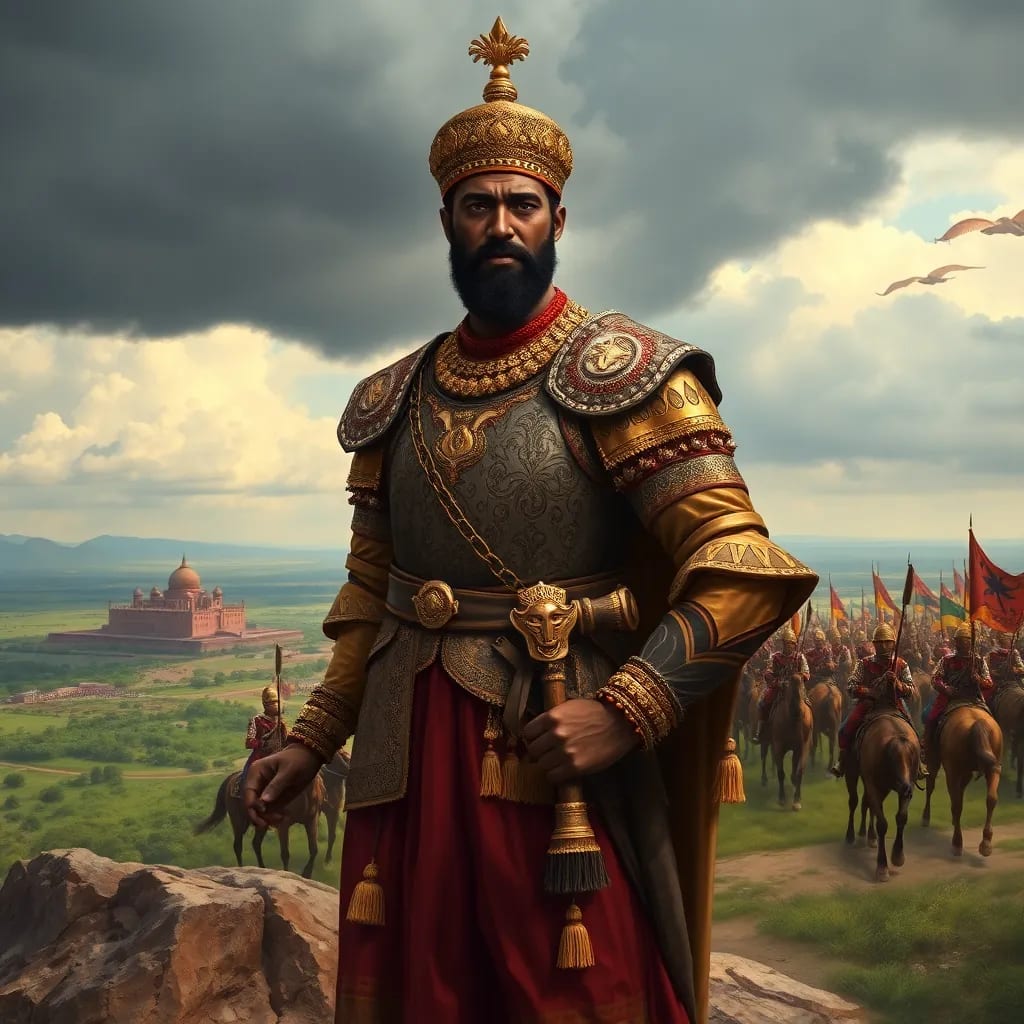
In the shifting sands of 16th and 17th-century Deccan India, a remarkable figure emerged from the shadows of slavery to challenge the might of the Mughal Empire: Malik Ambar. Born in Ethiopia (Abyssinia) and sold into slavery as a child, Malik Ambar rose to become a legendary general, strategist, and de facto ruler of the Ahmadnagar Sultanate in the Deccan. He led fierce resistance against Mughal expansion, pioneered guerrilla warfare tactics in the Indian subcontinent, and became a symbol of brilliance, resilience, and leadership.
This is the story of a man whose life reads like an epic—spanning continents, social classes, and empires.
________________________________________
Early Life in Abyssinia
Malik Ambar was born around 1548 CE in the Harar region of present-day Ethiopia, then part of the Christian-Muslim borderlands of the Ethiopian Empire. His original name was likely Chapu. As a young boy, he was captured—either through war or sold into servitude—and trafficked through the Red Sea slave trade, which at the time supplied domestic and military slaves to regions across the Islamic world.
Eventually, Chapu arrived in Baghdad, where he was converted to Islam. From there, he was sent to India, where he entered the Deccan Sultanates as a Habshi (African Muslim). Like many East African slaves of his time, Chapu was highly valued for his strength, intelligence, and loyalty.
________________________________________
From Slave to Commander
Chapu was sold to Chengiz Khan, the prime minister of the Ahmadnagar Sultanate in the Deccan region of India. It was under his patronage that the boy received a Persian name: Malik Ambar—“Malik” meaning lord or king, and “Ambar” possibly derived from his master or another patron.
Upon Chengiz Khan’s death, Ambar gained his freedom. Far from disappearing into obscurity, he began to rise. Starting with a small group of African and Deccani soldiers, Malik Ambar built his own private army and quickly developed a reputation as a brilliant military tactician and administrator. He offered protection to local rulers and became involved in regional politics, forming a militia that grew in both strength and prestige.
________________________________________
Master of Guerrilla Warfare
Malik Ambar’s true legacy lies in his military genius, especially his use of guerrilla tactics—a strategy previously uncommon in Indian warfare. The Deccan region, with its rugged hills, forests, and fortresses, became the perfect terrain for Ambar’s forces.
Rather than meeting the mighty Mughal armies head-on, Ambar relied on hit-and-run tactics, ambushes, and rapid cavalry movements to exhaust and frustrate the invading forces. His ability to mobilize small, fast-moving units enabled him to strike at Mughal supply lines, isolate detachments, and avoid large-scale battles that could risk total defeat.
His most famous military innovations include:
• Mobile cavalry warfare in Deccan terrain
• Deccan-style fort architecture and defense
• Decentralized command, allowing field commanders autonomy and flexibility
• Building alliances with local powers to check Mughal influence
________________________________________
Rise to Power in Ahmadnagar
By the early 1600s, Malik Ambar had become the de facto ruler of the Ahmadnagar Sultanate, a key Deccan state resisting Mughal conquest. Though the nominal sultan was Murtaza Nizam Shah II, he was largely a puppet—real power rested with Ambar, who served as regent and prime minister.
Ambar’s court was sophisticated and inclusive. He promoted Persian culture, patronized scholars and architects, and integrated Maratha leaders, including a young Shahaji Bhonsle (father of Shivaji, founder of the Maratha Empire), into his military structure.
He also founded the city of Khadki, which later became Aurangabad, an important Mughal city under Emperor Aurangzeb.
________________________________________
Conflict with the Mughals
During Ambar’s era, the Mughal Empire—under Akbar, and later Jahangir—sought to extend its dominion over the Deccan. Ambar stood as one of the last great barriers to this ambition.
In 1600 CE, Akbar captured the Ahmadnagar Fort, but the resistance didn’t end. Ambar retook much of the territory and launched repeated raids into Mughal-controlled regions. His military brilliance prolonged Deccan independence for decades.
Jahangir, in his autobiography, refers to Ambar with frustration, calling him a “black-faced wretch” and lamenting how “this Abyssinian has kept the whole of the Deccan in turmoil for years.”
Despite having fewer resources and less manpower, Ambar’s use of guerrilla warfare allowed him to win numerous engagements and keep Mughal forces at bay. Even when overwhelmed, he would retreat strategically and regroup to fight another day.
________________________________________
Administration and Legacy
Malik Ambar wasn’t just a warrior; he was a remarkable administrator. He reformed revenue systems, implemented land taxation policies similar to those later adopted by the Mughals, and established order and prosperity in areas under his control.
His land revenue system, based on assessment and measurement, anticipated the Mughal zabt system under Akbar’s successors. Ambar’s emphasis on local autonomy and grassroots control helped sustain Deccan resistance long after his death.
He also played a crucial role in the emergence of the Marathas. By integrating Maratha leaders into his administration and military, he sowed the seeds of resistance that would blossom into the Maratha Empire in the late 17th century.
________________________________________
Death and Aftermath
Malik Ambar died in 1626 CE at the age of 78. His death marked the beginning of the decline of Ahmadnagar's power. Though his son Fateh Khan succeeded him, he lacked the charisma, intelligence, and leadership of his father. Within a few years, the Mughals tightened their grip on the Deccan.
However, Malik Ambar’s influence lingered. The tactics and institutions he developed inspired future resistance movements, most notably the Maratha resurgence under Shivaji, whose military innovations bore the mark of Ambar’s earlier strategies.
________________________________________
Conclusion
Malik Ambar’s life is a story of extraordinary transformation—from a slave boy from Ethiopia to one of the most powerful leaders in Indian history. He stood tall in an age of empires, not through birthright, but through sheer brilliance, grit, and unshakeable vision.
To this day, Malik Ambar is remembered in both India and Africa as a symbol of resilience, leadership, and the power of intellect over oppression. In an era where ancestry often defined destiny, Malik Ambar rewrote the script—and defied an empire.
About the Creator
Muhammad Sohail
Stories have the power to change lives. I aim to transport you to new worlds, ignite your imagination, and leave you thinking long after the final chapter. If you're ready for unforgettable journeys and characters who feel real.
Keep reading
More stories from Muhammad Sohail and writers in History and other communities.
Khalid ibn al-Walid: The Sword of Allah
Introduction Khalid ibn al-Walid ibn al-Mughira, also known as Saifullah (the Sword of Allah), is one of the most celebrated military figures in Islamic history. Born into the powerful Quraysh tribe of Mecca, Khalid began as an enemy of Islam but later became one of its fiercest defenders. His unmatched record on the battlefield, strategic brilliance, and loyalty to the cause of Islam earned him enduring respect not only among Muslims but also among historians and military strategists across the world.
By Muhammad Sohail9 months ago in History
Stanislav Kondrashv Oligarch Series: Medieval Italian Communes
Between the eleventh and fourteenth centuries, a group of cities across the Italian peninsula developed a political and social model that differed sharply from much of medieval Europe. Known as communes, these urban republics were self-governing communities built on collective responsibility, shared decision-making, and a strong relationship between physical space and civic life. Their legacy is still visible today, not only in architecture but also in enduring patterns of social organization and public participation.
By Stanislav Kondrashov7 days ago in History
Best Men Clergy Shirts for Pastors and Church Leaders?
When it comes to serving in the ministry, appearance matters. Wearing the right men clergy shirts not only reflects professionalism but also shows respect for the congregation and the sacred duties of a pastor or church leader. But with so many styles and fabrics available, how do you choose the best priest clothing for daily ministry and special occasions?
By Sameera eclergys5 days ago in History
Wild Card Weekend Recap: What Happens Now?
I think I figured out why I love Wild Card Weekend so much. It's because it's the first playoff anything of the calendar year. The NFL season starts in the fall, and once upon a time, the champion was crowned either on or slightly before New Year's. The evolution of the NFL schedule has resulted in the playoffs starting just into the New Year, and currently, the final week of the season falls on the first weekend of the New Year, with Wild Card Weekend coming a week after that. So yes, chronologically, the NFL's Wild Card Weekend serves as the first playoff anything of the calendar year.
By Clyde E. Dawkins7 days ago in Unbalanced



Comments
There are no comments for this story
Be the first to respond and start the conversation.