
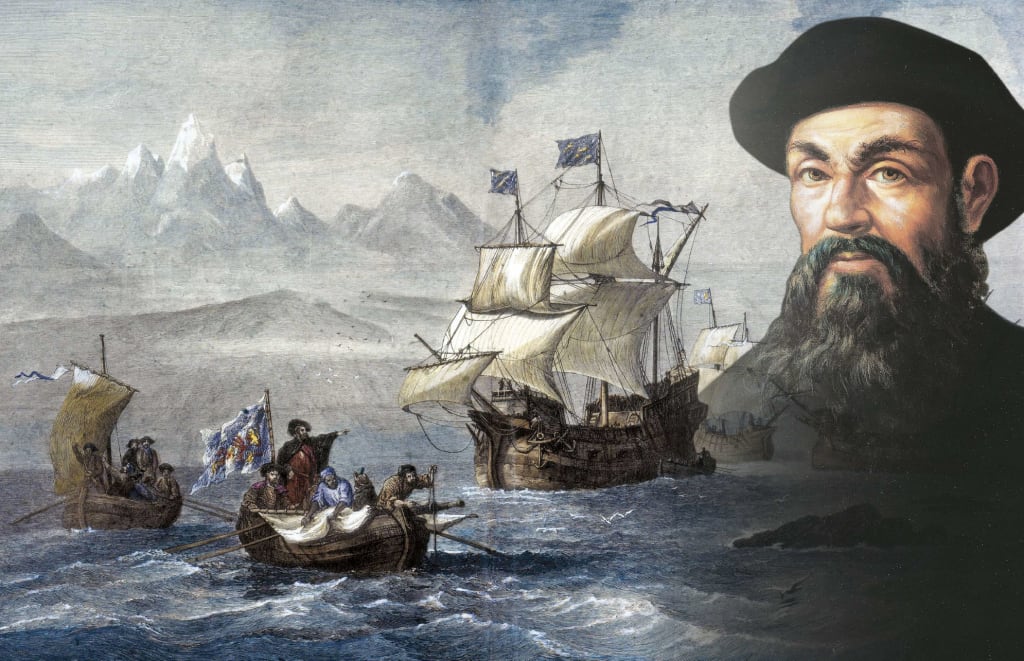
Magellan's Circumnavigation stands as a remarkable testament to human curiosity, determination, and the unquenchable thirst for exploration. Led by Portuguese explorer Ferdinand Magellan, this daring expedition marked a pivotal moment in the history of navigation, expanding the boundaries of human knowledge and forever altering our understanding of the world. This essay delves into the details of Magellan's historic journey, highlighting its significance, challenges, achievements, and lasting impact on the course of history.
I. Historical Context
In the early 16th century, the Age of Exploration was in full swing. The maritime powers of Europe were fervently seeking new trade routes to access valuable resources and establish connections with the East. Portugal and Spain, in particular, were leading the way in exploring uncharted territories. The Treaty of Tordesillas (1494) had divided the newly discovered lands between these two nations, with Spain claiming sovereignty over the west and Portugal over the east. This treaty created a sense of rivalry and competition, spurring explorers to seek alternative routes to reach the riches of the East.
II. Ferdinand Magellan: The Visionary Explorer
Ferdinand Magellan, a skilled navigator and explorer from Portugal, was one of the pioneers of this era. Frustrated by Portugal's reluctance to support his grand vision of reaching the Spice Islands by sailing westward, Magellan turned to the Spanish crown for backing. In 1519, King Charles I of Spain granted Magellan the necessary resources to embark on his ambitious voyage of circumnavigating the globe.
III. The Expedition Takes Sail
On September 20, 1519, Magellan set sail from Seville, Spain, with a fleet of five ships: the Trinidad, the San Antonio, the Concepción, the Victoria, and the Santiago. His goal was to find a western passage to the Spice Islands, known for their lucrative trade in spices, especially cloves.
The journey was fraught with challenges from the outset. The expedition faced treacherous weather, uncharted waters, and hostile encounters with indigenous peoples along the way. The fleet made its way to South America, navigating through the treacherous waters of what is now known as the Strait of Magellan, named in honor of the explorer.
IV. Pacific Crossing: Trials and Tribulations
After successfully navigating the strait, Magellan's fleet entered the vast expanse of the Pacific Ocean. The crew endured months of grueling hardships, including severe scarcity of food and drinkable water, resulting in malnutrition and illness. The journey across the Pacific was a true test of their resolve and the limits of human endurance.
V. Discovery of the Philippines
In March 1521, the expedition reached the Philippines, where Magellan's crew encountered new cultures and formed alliances with local chiefs. Tragically, Magellan himself was killed during a skirmish with indigenous warriors on the island of Mactan. Despite this setback, the remaining crew pressed on, determined to fulfill Magellan's vision.
VI. The Journey's End and Legacy
Only one ship, the Victoria, managed to complete the circumnavigation. Under the command of Juan Sebastián Elcano, the Victoria returned to Spain on September 6, 1522, marking the first recorded voyage around the world. This achievement showcased humanity's ability to overcome seemingly insurmountable challenges and fueled the fire of exploration for generations to come.
Magellan's Circumnavigation had profound implications for our understanding of the Earth's geography. It provided concrete evidence that the Earth was indeed round, debunking the long-held belief in a flat Earth. The voyage also highlighted the immense size of the planet, challenging prevailing notions of its dimensions.
The expedition had a lasting impact on navigation, trade, and cultural exchange. The knowledge gained from the journey laid the groundwork for more accurate maps and charts, enabling subsequent explorers to navigate with greater precision. It also paved the way for future global trade routes, ultimately reshaping the world economy.
Magellan's Circumnavigation remains an enduring symbol of human exploration and determination. It was a journey of courage and resilience, as well as a testament to the power of curiosity and the pursuit of knowledge. Through countless challenges and hardships, the expedition reshaped our understanding of the Earth and the possibilities of exploration. Magellan's legacy lives on as a reminder that the pursuit of the unknown has the potential to reshape not only our maps but also the very fabric of human history.
About the Creator
How the Pyramids Changed the World’s Understanding of Engineering
Few structures in human history have inspired as much wonder, debate, and admiration as the pyramids of ancient Egypt. Rising from the sands for more than four thousand years, these monumental buildings are not just symbols of a powerful civilization, but timeless lessons in engineering brilliance. Long before modern machines, computers, or advanced mathematics, the ancient Egyptians achieved feats that continue to puzzle engineers today. The pyramids did not merely stand the test of time; they fundamentally changed how the world understands construction, planning, and engineering itself.
By Binan Mooonabout 22 hours ago in History
Can World War III Be Prevented?
Can World War III Be Prevented? The idea of World War III is no longer limited to history books or fictional movies. Rising global tensions, regional wars, arms buildups, and political rivalries have made many people wonder whether another world war is possible—and more importantly, whether it can still be prevented. While the risks are real, global conflict is not inevitable. Prevention depends on choices made by leaders, institutions, and societies today.
By Wings of Time 5 days ago in History



Comments
There are no comments for this story
Be the first to respond and start the conversation.