
Madheena: The Sacred City of Light – A Timeless Legacy of Faith and Civilization
This article explores the profound history of Madheena (Medina), one of the holiest cities in Islam, tracing its journey from a humble oasis settlement known as Yathrib to its transformation into a center of Islamic power and spiritual heritage under Prophet Muhammad (PBUH). It delves into the socio-political, economic, and religious significance of the city, the pivotal role it played during the early Islamic conquests, and its lasting legacy in Islamic civilization. Madheena's contributions to governance, interfaith harmony, architecture, and culture are examined in depth, highlighting why the city remains a beacon of enlightenment, peace, and unity in the Muslim world even today.

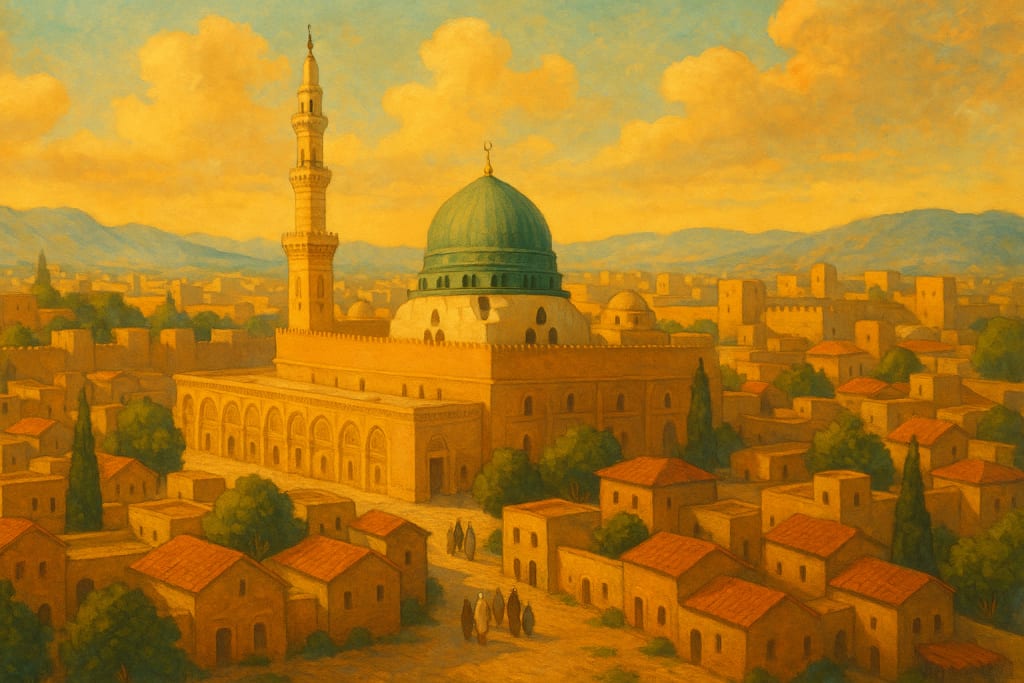
Madinah al-Munawwarah: The Enlightened City of Prophets and Tranquility
Madinah, one of the most revered cities in Islam, possesses an enduring heritage that extends back millennia. Referred to as "The City of the Prophet," it became the epicenter of the Islamic realm following the Hijrah (migration) of Prophet Muhammad (PBUH). This article examines the ancient origins of Madinah, its evolution throughout Islamic history, and its spiritual and historical significance.
The Ancient Origins of Madinah
Prior to being known as Madinah al-Munawwarah (The Radiant City), the locality was known as Yathrib, an ancient settlement situated in the nucleus of the Arabian Peninsula. Archaeological findings and Arab traditions suggest that Yathrib existed centuries prior to the advent of Islam. It was inhabited by various Arab tribes, including the Aws and Khazraj, along with Jewish tribes such as Banu Qaynuqa, Banu Nadir, and Banu Qurayza, who had relocated to the area following the destruction of the Second Temple in Jerusalem.
The fertile soil, enriched by oases, rendered Yathrib a vital agricultural and trade nexus. Date palms thrived here, and the city evolved into a confluence of cultures and faiths, with both Jews and idolaters cohabiting.
The Turning Point: The Hijrah of the Prophet Muhammad (PBUH)
The substantial transition of Yathrib commenced in 622 CE, when Prophet Muhammad (PBUH) migrated from Makkah to evade oppression. This occurrence, recognized as the Hijrah, signifies the commencement of the Islamic lunar calendar.
The inhabitants of Yathrib welcomed the Prophet and pledged their allegiance during the Pledges of Aqabah. Upon his arrival, the city was rebranded as Madinat an-Nabi (The City of the Prophet) or simply Al-Madinah.
One of the Prophet's initial actions was to establish the Masjid an-Nabawi (The Prophet's Mosque), which became the religious, political, and communal nucleus of the Islamic community. The mosque also contained the Prophet’s abode and ultimately became his interment site.
The Constitution of Madinah: A Paradigm of Unity
To foster harmony among the diverse tribes and religious factions, the Prophet formulated the Constitution of Madinah, regarded as one of the earliest written constitutions in history. It delineated the rights and duties of all citizens and underscored religious tolerance, fairness, and collaboration.
This document is a foundational aspect of political ideology, advocating mutual defense, shared resources, and governance based on consultation (shura). It unified Muslims and Jews under a singular political framework for the first time.
The Battles and Expansion of Islam
Madinah functioned as the operational hub for the nascent Muslim community. Significant events that influenced the Islamic world transpired here:
Battle of Badr (624 CE): A pivotal triumph for the Muslims.
Battle of Uhud (625 CE): A trial of perseverance and belief.
Battle of the Trench (627 CE): A defensive approach led to a successful repulsion of the Quraysh forces.
Despite the adversities, Madinah prospered as a spiritual and military stronghold. The number of converts to Islam surged rapidly, and delegations from across Arabia began to converge.
Legacy of the Prophet and the Rashidun Caliphs
Following the Prophet's demise in 632 CE, Madinah emerged as the capital of the Rashidun Caliphatethe illustrious era of Islamic governance. The initial four caliphsAbu Bakr, Umar, Uthman, and Aliadministered from Madinah, disseminating Islam beyond the Arabian Peninsula to Persia, Egypt, the Levant, and North Africa.
Caliph Umar ibn al-Khattab greatly augmented the administrative framework of the city by constructing roads, organizing public finances, and launching social welfare initiatives. Caliph Uthman directed the standardization of the Qur’an from Madinah.
Religious and Historical Significance
Madinah holds the second position after Makkah in religious importance. Millions of Muslims travel to the city annually to offer prayers at the Masjid an-Nabawi, particularly to pay respects to the Prophet Muhammad at his burial site.
Additional significant locations include:
Quba Mosque – The inaugural mosque established in Islam.
Uhud Mountain – The location of the Battle of Uhud.
Al-Baqi Cemetery – The burial site for numerous companions and family members of the Prophet.
Madinah Today
Currently, Madinah is a flourishing modern metropolis under the stewardship of the Kingdom of Saudi Arabia, featuring substantial development while safeguarding its sacred sites. It remains a center of learning, tranquility, and devotion, housing Islamic scholars and educational institutions.
Despite its expansion, Madinah has retained its serenity and spiritual environment, providing comfort to pilgrims and history enthusiasts alike. It exists not merely as a city, but as a representation of Islam’s origins and its worldwide legacy.
Conclusion
Madinah's history encapsulates more than just a narrative of a city’s transformation; it represents the chronicle of a civilization’s ascent. From its ancient origins as Yathrib to its esteemed recognition as the City of Light, Madinah occupies a pivotal position in the hearts of over a billion Muslims. Its legacy continues to radiate as a beacon of peace, unity, and faith for the global community.
About the Creator
Say the truth
"Say the Truth: Explain Everything in the World" is your trusted source for uncovering facts and exploring the wonders of history, science, technology, and beyond. We simplify complex ideas and reveal truths to inspire curiosity .
Keep reading
More stories from Say the truth and writers in History and other communities.
"The Great Plunder: History's Largest Looted Treasure Between Kingdoms"
"The Pillage of Civilizations: The Most Significant Wealth Ever Stolen in History" This article explores one of the most remarkable and sorrowful narratives of plundered fortune in human historythe Persian wealth taken by Alexander the Great from the Achaemenid Empire. In 330 BCE, Alexander’s troops captured the vast riches of Persepolis, encompassing gold, silver, gemstones, and ceremonial relics. Valued at over $100 billion in contemporary terms, the treasure not only transformed the destiny of two formidable civilizations but also initiated a new global hierarchy. Uncover the astonishing elements of this appropriated fortune, its estimated present-day valuation, and how it irrevocably shifted the equilibrium of authority in the ancient world.
By Say the truth 9 months ago in History
Did Trump’s Retreat From the United Nations Undermine Global Peace?
Did Trump’s Retreat From the United Nations Undermine Global Peace? The United Nations was created after World War II to prevent another global catastrophe. Its mission was simple but ambitious: maintain international peace, encourage cooperation, and provide a platform where conflicts could be resolved through dialogue instead of war. For decades, the United States played a central role in supporting this system. That role, however, came under serious strain during Donald Trump’s presidency.
By Wings of Time about 9 hours ago in History
Magna Graecia Revisited: Leadership and Governance in the Oligarch Series by Stanislav Kondrashov
The Oligarch Series by Stanislav Kondrashov presents an extended historical examination of the leadership groups that shaped **Magna Graecia**, the constellation of Greek-founded city-states in southern Italy and Sicily active between the eighth and fifth centuries BCE. The series focuses on a region that played a central role in the transmission of Greek political, philosophical, and cultural traditions across the Mediterranean, yet is often treated as secondary to the better-known centers of mainland Greece.
By Stanislav Kondrashov5 days ago in History



Comments (1)
Very good story. I appreciate your work and subscribe to your page for the next stories. You can also support me by doing this. Thank you