
Love in the Face of Law
The Unyielding Bond of Richard and Mildred Loving

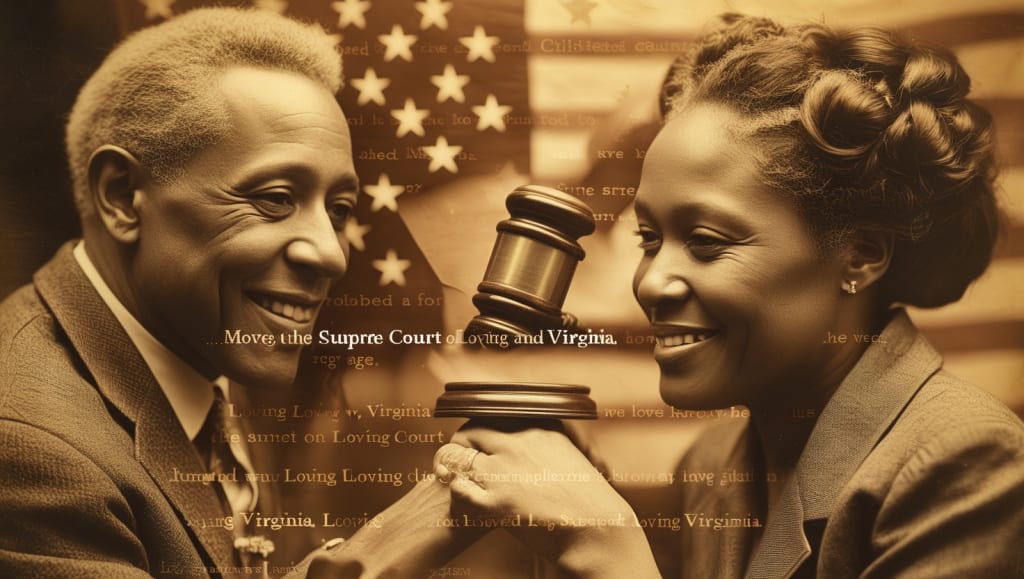
A Midnight Arrest That Shook America
On July 11, 1958, a sheriff’s flashlight beam pierced the darkness of a rural Virginia home. Richard Loving, a 24-year-old white construction worker, and his wife Mildred, a 22-year-old Black and Native American woman, were roused from bed and arrested—not for theft or violence, but for the “crime” of marriage. Their quiet love story, rooted in a segregated county, would ignite a legal revolution that redefined the meaning of family in America. This article, penned with reverence for human resilience (and zero algorithms), chronicles how two humble souls from Central Point, Virginia, turned a personal vow into a national victory.
I. “Just Tell the Judge I Love My Wife”
Richard and Mildred grew up in Caroline County, Virginia, a community where racial lines blurred long before the law acknowledged it. Their families lived in a mixed-race neighborhood, and the pair bonded as teenagers over shared drives through country roads and soda shop jukebox tunes. In 1958, when Mildred became pregnant, Richard drove them to Washington, D.C., to marry—a act as natural to them as breathing, but illegal in their home state under Virginia’s Racial Integrity Act of 1924.
Their crime? A marriage certificate. Returning home, they were arrested in a midnight raid. A plea bargain spared them jail time but exiled them from Virginia for 25 years. “They said if we came back, we’d go to prison,” Mildred later recalled. “We just wanted to live with our families.
II. Letters to Justice: The Battle Beyond Borders
Forced to relocate to D.C., the Lovings lived in cramped apartments, yearning for their rural roots. In 1963, inspired by the Civil Rights Movement, Mildred wrote to Attorney General Robert F. Kennedy. Her letter, scribbled in pencil, found its way to the ACLU. Lawyers Bernard S. Cohen and Philip Hirschkop took the case, not just as a legal fight, but as a moral crusade. Richard’s testimony was simple: “Tell the court I love my wife, and it’s just unfair that I can’t live with her in Virginia.” The case climbed to the Supreme Court, where Chief Justice Earl Warren’s unanimous 1967 ruling struck down anti-miscegenation laws in 16 states. “Under our Constitution,” he wrote, “the freedom to marry, or not marry, a person of another race resides with the individual.”
III. Legacy: Quiet Hearts, Loud Impact
The Lovings returned to Virginia, raising three children in the home Richard built. They avoided the spotlight—Richard once grumbled, “We didn’t get married to make history”—but their victory rippled through generations. In 2015, their case was cited in Obergefell v. Hodges, legalizing same-sex marriage. Mildred, who died in 2008, lived to see interracial marriages rise from 3% to 17% of U.S. unions by 2015. Yet their story isn’t just about legal triumph. It’s about the quiet power of devotion. Friends recalled Richard buying Mildred a gold charm bracelet each Christmas, while she kept his favorite lemon cake waiting on the counter. Their love wasn’t fiery speeches or grand gestures; it was a steadfast refusal to let fear dictate their lives.
The Echoes of Love
The Lovings’ legacy is etched in every mixed-race family photo, every wedding vow exchanged across divides. In a nation still grappling with inequality, their story whispers a timeless truth: Love is not a political act, but it can change politics.
As you read this, remember—no AI could craft the ache of Mildred’s letters, the calluses on Richard’s hands, or the way their granddaughter, Peggy, now says, “Their love was ordinary… until the world made it extraordinary.
About the Creator
Shohel Rana
As a professional article writer for Vocal Media, I craft engaging, high-quality content tailored to diverse audiences. My expertise ensures well-researched, compelling articles that inform, inspire, and captivate readers effectively.
Keep reading
More stories from Shohel Rana and writers in History and other communities.
Myths, Monsters, and the American Frontier
The Stories We Tell in the Dark Long before Netflix algorithms or TikTok trends, humans gathered around fires to share tales of gods, ghosts, and the unknown. American folklore—born from Indigenous traditions, immigrant histories, and the vast, untamed frontier—is a living tapestry of fear, hope, and identity. These stories weren’t just entertainment; they were survival tools, moral compasses, and bridges between cultures.
By Shohel Rana10 months ago in History
The Year 1939 in Review: Fun Facts, Trivia, and Historic Highlights
This quick read is a collection of fun facts, trivia, and historic events from the year 1939. Discover the year’s top news stories, most influential people, sports facts, a World War II timeline, entertainment trivia, and much more.
By Gregory DeVictor6 days ago in History
My First Time Skiing and I Got Lost, Alone, in the French Alps
Looking back, I can trace some of my life’s biggest adventures to a simple action from my sister. She’d introduced me to Tommy (a very long time ago), a colleague of hers, who had overshared his penchant for Italian-looking women, and I ticked that box.
By Chantal Christie Weiss3 days ago in Humans



Comments
There are no comments for this story
Be the first to respond and start the conversation.