
Louis Leakey's beef with Kenyatta
The two were locked in an ethnographic battle and a race to get their works published


Despite having a meticulous 1400-page work about the Kikuyu people written, Jomo Kenyatta beat Louis Leakey by having the first Kikuyu ethnographic book Facing Mount Kenya, printed in 1938. As a PhD holder, Leakey could not help but hold resentment for Kenyatta who was now a published author (without even having a degree) while his own magnum opus gathered dust in a safe. Leakey was considered by many others but mostly himself as the expert on Kikuyu knowledge. Its as though he owned that knowledge and it was only his to disseminate. In fact, Leakey believed Kenyatta had plagiarized some of his material on circumcision rites without acknowledgement.

It may actually be the other way around. According to Nicholas Rankin, Mbiyu had spoken about a European student who had borrowed one of Kenyatta’s papers and stayed with it for too long. To their surprise, they learnt that he would go on to include the work in full as part of his book. In the preface to Facing Mount Kenya, Kenyatta addressed ‘the professional friends of the African’ who ‘monopolise the office of interpreting his mind and speaking for him.’ Both of these references are likely about Louis Leakey.
So, when they met each other at Bronislaw Malinowski’s Thursday Seminars in London, the air between them was certainly tense. It doesn’t help either that with his eloquence and ability to make his presence felt, Kenyatta had slowly become Malinowski’s favourite. In Trapped In History, Nicholas Rankin relates a time when Kenyatta and Leakey got into a heated argument in class regarding irua (circumcision rites). The discussion began calmly in English but the language switched to Kikuyu as tensions intensified.
To worsen this rift, Leakey may have felt as though he lost his Koinange friends to Kenyatta. Mbiyu Koinange who was his childhood friend and the best man at his second wedding was now bosom buddies with Kenyatta. Not only were they together during the seminars, Mbiyu had helped Kenyatta work on Facing Mount Kenya including lending him the attire Kenyatta is wearing in the cover. Back in Kenya, Senior Chief Koinange was also alienating himself further and further away from the Leakeys after losing a land case.

The late 1930s found Leakey at a disadvantaged position. Having lost the Koinange friendship, the Rhodes Trust cosign, his archaeological reputation and a series of sex scandals marring his reputation, he found himself desperate for some relevance. Promptly, he was offered an opportunity to ‘keep an eye’ on kikuyu radicalism and saw it as an opportunity to retaliate against Kenyatta indirectly. He disliked the politics of the Kikuyu Central Association either due to their radical demands or the Kenyatta endorsement. He leaped at the offer as he was also quite suited to it as a result of his upbringing.

He established a network of informants all over Kiambu district called Voluntary Intelligence Officers. With them he kept a steady stream of information of varying sensitivity allowing him to penetrate the inner workings of the KCA. Leakey himself would travel from town to town in Kiambu district ‘collecting government rumors floating around among the peasantry’. The leadership of KCA was also closely under close surveillance with all their movements being tracked for subversion and secretive activities.
Having gathered sufficient proof, on 20th May 1940, Leakey led a raid on the KCA headquarters skimming their papers for evidence. The British were jumpy due to the Italian military presence in Italian Somaliland(Djibouti) and Leakey was convinced that KCA leaders were indeed corresponding with them. As a result of this accusation, The Kikuyu central association, the Ukamba Members Association and the Taita Hills Association were all banned.
Leakey was the only witness called against them in the appeal hearing. A lengthy document he had written on the supposed activities of the KCA was one of the evidence pieces referred to despite most of it being hearsay. When challenged by KCA secretary general George K. Ndegwa to provide any solid evidence against them, he had naught but a copy of Hitler’s Mein Kampf (freely on sale in Nairobi at the time),found at the KCA headquarters. His translation was also questioned by Ndegwa who felt Leakey assumed an accusatory tone when translating. No other witnesses were called to the stand as Leakey could not compromise his intelligence network.
In the end, Leakey won. The detainees were banished to the North and the political parties were permanently banned. In his autobiography published thirty years later, Leakey regretted the banning of KCA. In By the Evidence: Memoirs (1932-1952), Leakey noted that ‘If the association had been allowed to remain in being, I feel that most of its members would have remained loyal to the British.’ Infact it is the very banning of this organization that created ‘a good deal of anti-British feeling in an influential section of the population.’
About the Creator
HINGES OF TIME
Unlock the past with Hinges of Time⏳.
A community for history lovers, discourse and knowledge.
Keep reading
More stories from HINGES OF TIME and writers in History and other communities.
BULLA KARATASI MASSACRE
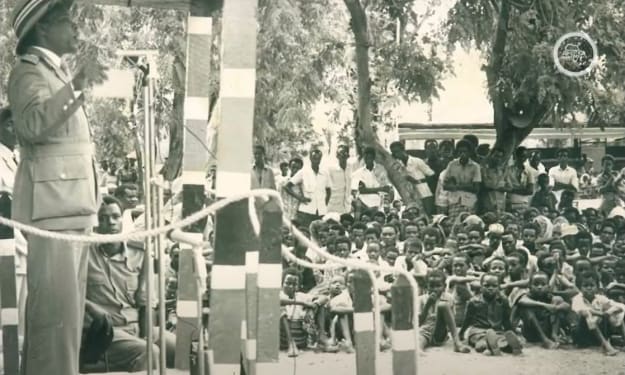
Garissa was burning by 7 am on November 11, 1980. During the night, the Provincial Commissioner had declared a State of Emergency imposing a daytime curfew over the whole province. The police and military contingents in armoured vehicles descended on the town, shooting at everyone and everything. Houses were set on fire while locked from the outside. Innocent civilians were beaten up and killed while women faced sexual atrocities. A message was shouted from a loudspeaker as the sunrose urging everyone in the town to gather at Garissa Primary School. Indeed, many of them never even made it there, and for the ones who did, more suffering awaited them.
By HINGES OF TIME11 months ago in History
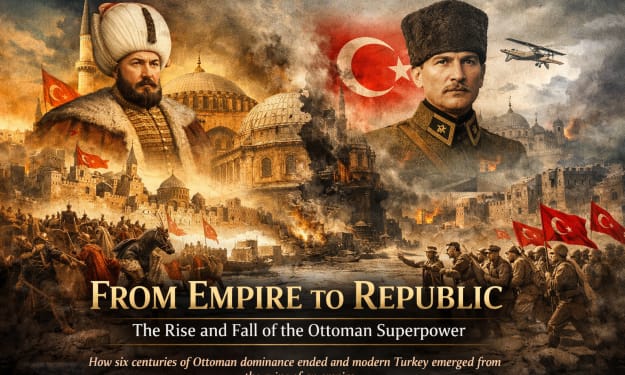
From Empire to Republic: The Rise and Fall of the Ottoman Superpower
For more than six centuries, the Ottoman Empire stood as one of the most powerful and influential states in world history. Stretching across three continents—Europe, Asia, and Africa—it controlled strategic trade routes, diverse populations, and some of the most important cities of the medieval and early modern world. Yet by the early twentieth century, this once-mighty empire collapsed, giving birth to the modern Republic of Turkey. The story of its rise and fall is one of military brilliance, political struggle, and dramatic reform.
By Irshad Abbasi about 12 hours ago in History


Comments
There are no comments for this story
Be the first to respond and start the conversation.