
“Lord of Fortune: The Costliest Idol in History – The Wealth of Tirupati Balaji”
Standing tall in the sacred hills of Tirumala, the idol of Lord Venkateswara—known as Balaji—is not only a revered symbol of faith but also the most valuable religious idol in the world. Covered in tons of gold, embedded with centuries-old diamonds, emeralds, and rubies, this ancient statue draws millions in devotion and donations every year. This article uncovers the spiritual and historical significance of the idol, traces its royal patronage, and offers a modern net worth estimation—placing its value between $400 million and $500 million USD. It stands as a testament to divine devotion and unmatched opulence.

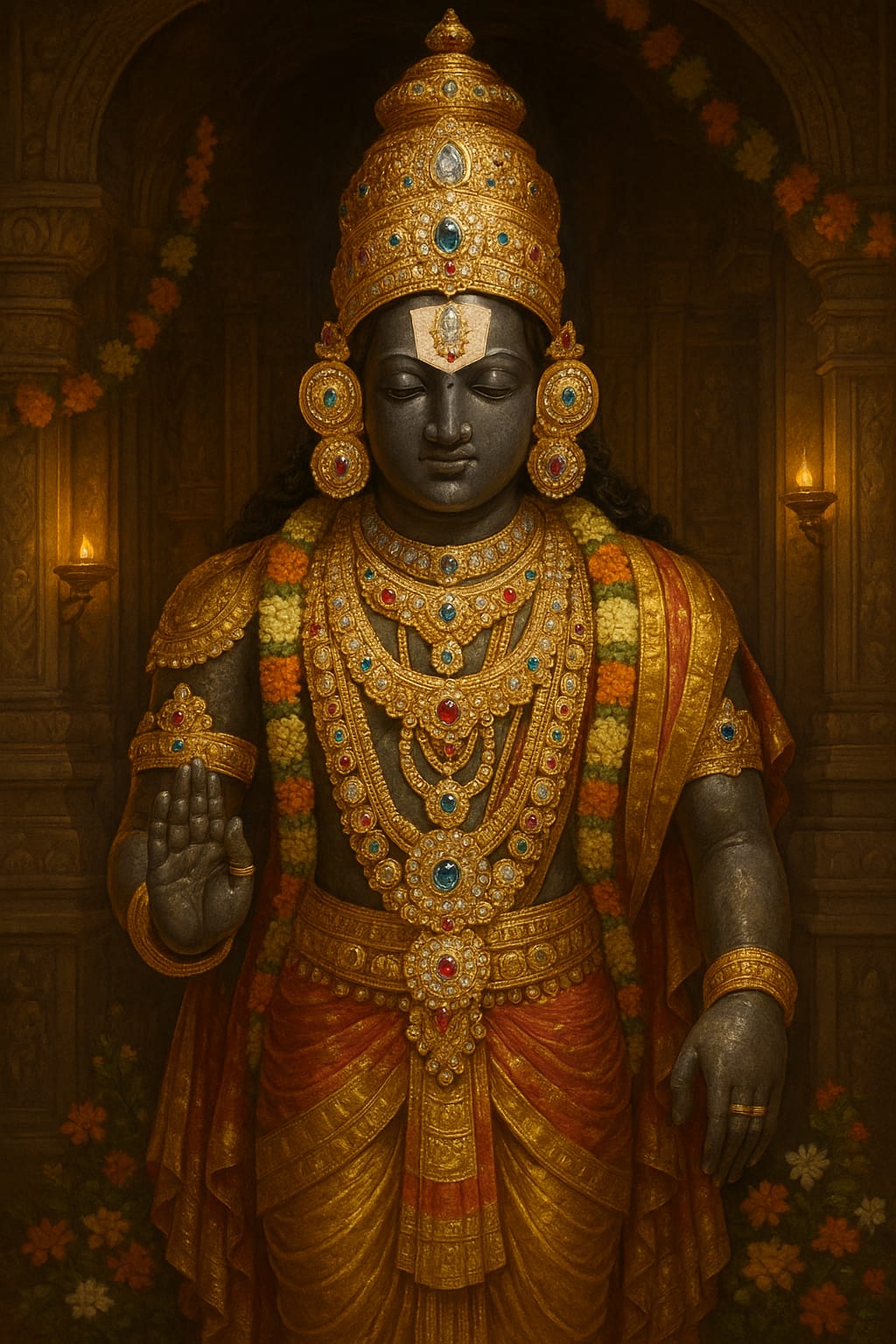
The World’s Most Expensive Idol: The Unrevealed Narrative of Tirupati Balaji’s Golden Wealth
Among the globe’s most revered deities, the statue of Lord Venkateswara at Tirumala, Andhra Pradesh, serves not only as a spiritual lighthouse but also as an emblem of extraordinary affluence. Sculpted from sacred black stone and embellished with immense quantities of gold, diamonds, and other precious gems, this idolvenerated by millionsis appraised as the priciest in documented history. This article examines its origins, religious importance, priceless embellishments, and the contemporary valuation of both the idol and the temple's assets.
Introduction: The Living Divinity of the Peaks
Perched atop the Tirumala hills in southern India, the temple of Lord Venkateswara, commonly referred to as Balaji, ranks among the wealthiest religious locations globally. Millions of devotees ascend to Tirupati each year to catch a glimpse of the revered idol, believed to be over 2,000 years old. Beyond its spiritual significance, the idol itselfstanding approximately 8 feet in heightis a repository of unparalleled historical and monetary value.
In this article, we delve into the background, composition, and financial appraisal of the world’s most costly religious idol.
The Idol: Artistry and Myth
The principal deity, Lord Venkateswara, is crafted from a unique variety of black granite or Shaligrama stone, traditionally believed to possess magnetic and healing attributes. In accordance with ancient Vaishnavite customs and temple lore, this idol is said to be self-manifested (Swayambhu)not created by human artisans.
It is embellished with:
A colossal diamond-encrusted crown (appraised alone to be valued at over $50 million USD)
Numerous gold adornments, including necklaces, girdles, and anklets
An ancient gem known as Navaratna Kirita, set with nine precious stones
A thick gold plating covering various sections of the idol itself
Emeralds, sapphires, rubies, and pearls, some of which trace back to the Vijayanagara Empire (14th–16th century CE)
Historical Support and Contributions
Rulers from diverse Indian dynastiesincluding the Cholas, Pandyas, Vijayanagara monarchs, and Marathashave offered priceless ornaments to the deity throughout the centuries. Noteworthy contributions encompass:
Krishnadevaraya’s Crown (early 1500s): Composed of solid gold and adorned with diamonds and emeralds.
British Raj-era Contributions: Despite colonial governance, affluent merchants and aristocrats persistently donated substantial gold reserves and gemstones to the deity.
Even contemporary celebrities and industrialists contribute considerable quantities of gold and funds to the idol and temple annually. The deity is adorned differently each day and during various seasons, with specific sets of jewelry designated for special festivals.
Temple Vaults and Concealed Riches
In addition to the ornaments adorning the idol, the Tirumala Tirupati Devasthanams (TTD) trust oversees concealed vaults filled with gold and gemstones gifted over the centuries. The temple receives:
Approximately 30–35 million USD in cash donations each year
Hundreds of kilograms of gold, with nearly 60,000 kg accumulated as per recent reports
Daily offerings of diamonds, rubies, and exotic jewels
The vaults, many of which remain inaccessible to the public, are estimated to harbor treasures worth over $20 billion USD, much of which was originally presented to the idol itself.
Valuation Estimate: Analyzing the Idol’s Worth
To evaluate the contemporary worth of the Tirupati Balaji idol and its immediate embellishments:
Component Estimated Contemporary Worth
Diamond Crown $50 million USD
Gold Ornaments (Necklaces, Waistbands, Anklets, Armlets) $150–200 million USD
Gemstones (Emeralds, Rubies, Sapphires, Pearls) $100–150 million USD
Historical Items (Navaratna Crown, Ancient Jewelry) $75–100 million USD
Total Idol Wealth Estimate $375–500 million USD
Note: This does not encompass the temple’s additional assets such as real estate, reserves, or vaults.
Cultural and Spiritual Worth: Beyond Monetary Value
For worshippers, however, the riches of the idol cannot be quantified in gold or currency. Lord Venkateswara is revered as “the deity who alleviates debt,” believed to bestow blessings, health, and prosperity upon anyone who approaches with genuine intent. Each ornament or coin presented is regarded as an expression of faith, rather than mere economics.
Furthermore, the idol’s distinctive essence, time-honored rituals, and emotional ties with millions render it culturally invaluable.
Comparisons with Other Idols
While numerous religious figures globally possess significant worth, the Tirupati idol surpasses many in terms of collective wealth, importance, and enduring reverence. Other notable examples include:
The Golden Buddha of Thailand (5. 5 tons of gold; $250 million+)
Jagannath idols of Puri (inestimable due to relics within)
Padmanabhaswamy temple vault idols in Kerala (unopened treasures potentially exceeding $22 billion USD)
Nonetheless, due to its exceptional visibility, documentation, and historical complexity, the Balaji idol retains the status of the most ornately adorned deity in the contemporary world.
Conclusion: Divine Wealth and Eternal Devotion
The idol of Lord Venkateswara transcends being a mere divine artifact; it serves as the spiritual nucleus of South India and a repository of historical richness. With an estimated net worth approaching half a billion dollars, it stands as a monument to steadfast faith, continuous royal sponsorship, and the profound legacy of temple wealth in India.
In a society fixated on material wealth, the narrative of Tirupati Balaji serves as a reminder that genuine value resides where affluence intertwines with reverence, and where gold transforms into the sacred in the hands of devotees.
About the Creator
Say the truth
"Say the Truth: Explain Everything in the World" is your trusted source for uncovering facts and exploring the wonders of history, science, technology, and beyond. We simplify complex ideas and reveal truths to inspire curiosity .
Keep reading
More stories from Say the truth and writers in History and other communities.
Throne of Gold: The Hidden Wealth of the Pandiyan Kings
Throne of Gold: The HiThrone of Gold: The Hidden Wealth of the Pandiyan Kings Introduction: The Heritage of the Pandiyas Among the ancient Tamil monarchies, the Pandiyan dynasty distinguished itself due to its significant cultural and economic impact. Centered in Madurai, the Pandiyan rulers governed a thriving trade empire from as early as the 6th century BCE to the 14th century CE. Their dominion spanned the fertile lands of southern Tamil Nadu, critical ports along the Indian Ocean, and essential trade routes connecting the East and West.
By Say the truth 9 months ago in History
Savoy Hotel – Mussoorie: The Colonial Luxury Hotel Where an Unsolved Murder Still Walks the Corridors
The First Night: Beauty Wrapped in Silence Mussoorie looks peaceful from a distance. Pine trees sway gently, clouds roll like slow-moving waves, and the hill air smells of rain and old earth. But as evening falls, the silence becomes heavier—almost watchful.
By Gaurav Gupta4 days ago in History
Nobel Peace Prize
The Nobel Peace Prize has stood as one of the world’s most recognized honors. Awarded annually in Oslo, it is meant to celebrate individuals or organizations that have made significant contributions toward peace, diplomacy, and humanitarian progress. While its mission appears straightforward, the Nobel Peace Prize has never been free from debate. In recent years, conversations surrounding global politics—particularly discussions about the Trump Nobel Peace Prize—have brought renewed attention to how peace is defined, measured, and rewarded in the modern era. The Origins and Meaning of the Nobel Peace Prize The Nobel Peace Prize was established by Alfred Nobel, the Swedish inventor best known for creating dynamite. In his final will, Nobel directed that a portion of his wealth be used to recognize efforts that foster peace among nations, reduce standing armies, or promote diplomacy and cooperation. Since its first award in 1901, the prize has honored activists, diplomats, organizations, and world leaders whose actions shaped international dialogue. Unlike other Nobel categories, the peace prize is awarded by a Norwegian committee rather than a Swedish institution. This distinction reflects Nobel’s desire to separate the prize from national interests and focus instead on global responsibility. Over time, the definition of “peace” has expanded. Early recipients were often disarmament advocates or mediators. More recent laureates have included human rights defenders, climate activists, and international organizations working in conflict zones. Politics and the Nobel Peace Prize Despite its humanitarian ideals, the Nobel Peace Prize has always intersected with politics. Recognizing peace efforts often means evaluating political leadership, international negotiations, and long-term consequences—none of which are easy to measure in real time. Some awards have been widely celebrated, while others sparked controversy. Critics often argue that certain laureates were honored prematurely, before the lasting results of their actions became clear. Supporters counter that the prize is meant to encourage peace efforts, not merely reward completed achievements. This tension has made the Nobel Peace Prize a reflection of global priorities at any given moment, rather than a simple historical judgment. Donald Trump and Nobel Peace Prize Discussions Few modern political figures have generated as much debate in connection with the Nobel Peace Prize as Donald Trump. During and after his presidency, conversations about a potential Trump Nobel Prize emerged repeatedly, particularly among supporters who pointed to his role in diplomatic initiatives. The phrase Trump Nobel Peace Prize gained traction following agreements and negotiations in regions long marked by conflict. Advocates argued that these diplomatic efforts aligned with Alfred Nobel’s vision of reducing international tension through dialogue rather than force. At the same time, critics questioned whether these actions met the broader ethical and humanitarian standards traditionally associated with the award. They pointed to domestic divisions, foreign policy controversies, and unresolved global conflicts as reasons for skepticism. This divide highlights a core challenge of the Nobel Peace Prize: peace is rarely absolute, and political leadership is often complex and contradictory. Trump Nobel Peace Prize 2026: Speculation and Context As global politics continue to evolve, speculation around a Trump Nobel Peace Prize 2026 has appeared in media discussions and public commentary. It is important to note that nominations for the Nobel Peace Prize are confidential for decades, and speculation does not confirm consideration or selection. However, the mere discussion of Trump Nobel Peace Prize 2026 reflects how the award has become part of broader cultural and political conversations. Supporters view such recognition as validation of diplomatic achievements, while critics see the speculation as politicizing an institution meant to rise above partisan debate. This dynamic is not unique to Trump. Many past leaders, from various ideological backgrounds, were debated heavily before or after receiving the prize. The Nobel Peace Prize often mirrors global disagreements rather than resolving them. How the Nobel Committee Makes Its Decision Each year, hundreds of nominations are submitted by qualified individuals, including academics, lawmakers, and previous laureates. The Nobel Committee evaluates these nominations through research, expert consultation, and internal debate. The process considers intent, impact, and long-term significance. However, because peace efforts often unfold over years or decades, the committee must make decisions without full historical clarity. This reality explains why some awards age gracefully while others remain controversial. The committee rarely responds directly to public pressure or online campaigns. Media attention, including discussions around a Trump Nobel, does not guarantee influence over the final decision. The Broader Impact of the Nobel Peace Prize Beyond individual recipients, the Nobel Peace Prize plays a symbolic role. It brings global attention to issues that might otherwise be ignored, from humanitarian crises to fragile peace processes. Even controversial nominations can spark meaningful debate about what peace truly means in the modern world. The prize also raises questions about accountability. When leaders are considered for such recognition, the public is encouraged to examine policies, outcomes, and moral responsibility more closely. In this sense, discussions surrounding the Trump Nobel Peace Prize are not just about one individual. They reflect deeper conversations about diplomacy, leadership, and the evolving standards by which peace is judged. Conclusion: A Prize That Reflects the World The Nobel Peace Prize remains one of the most influential and debated honors in global society. Its power lies not only in recognizing peace efforts but also in challenging the world to think critically about conflict, cooperation, and responsibility. Whether discussions involve historic activists or modern political figures like those associated with Trump Nobel Peace Prize 2026 speculation, the award continues to reflect the complexities of international relations. Peace is rarely simple, and neither is the process of honoring it. Ultimately, the Nobel Peace Prize serves as a reminder that striving for peace is an ongoing journey—one shaped by ideals, actions, and the difficult choices that define human history.
By Saboor Brohi 4 days ago in History
Center Stage with Paul Stewart
*** I'm keen to republish the interviews I did for my series with Vocal creators. It's been a few years and I thought it might be nice to revisit these wonderful conversations. I'll be releasing them one at a time for a few weeks/months.
By Heather Hubler4 days ago in Interview



Comments
There are no comments for this story
Be the first to respond and start the conversation.