
Brothers of the Red Sea: The Barbarossa Legacy
The two Barbarossa brothers — Aruj and Hayreddin — start as corsairs fighting Christian pirates and European powers. As Aruj falls in battle, Hayreddin pledges loyalty to the Ottoman Sultan and becomes admiral of the fleet. The story follows his transformation from pirate to respected naval commander, feared across Europe.

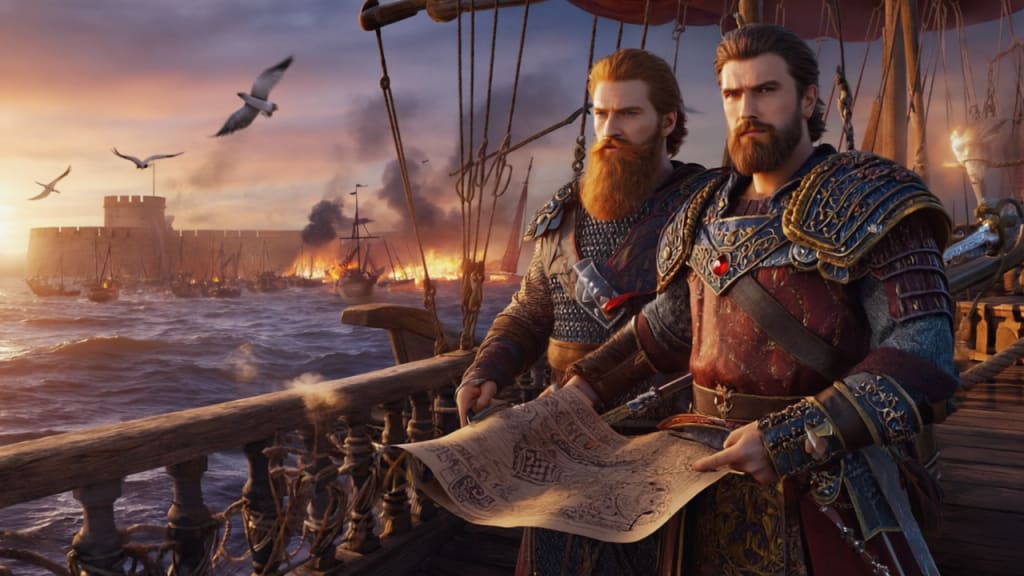
The sea was not blue—it was bronze, burning under the Mediterranean sun and soaked with the blood of empires. On its restless waves sailed two brothers, born of a Turkic father and a Christian Greek mother on the island of Lesbos: Aruj and Khizr.
They were known to the world as the Barbarossa brothers, named not by choice, but by fear—Red Beards who ruled the sea.
At first, they were corsairs. Pirates, some called them. But to many oppressed Muslims of Al-Andalus, they were saviors. They raided Christian ships, not for gold alone, but to rescue exiles and prisoners dragged from the shores of Granada. Aruj, the elder, was fire: bold, fearless, brutal. Khizr—later to be known as Hayreddin—was the wind: calculating, wise, relentless.
The year was 1516 when Aruj declared himself Sultan of Algiers after driving out the Spanish. For a moment, it seemed the Mediterranean would bow to the brothers. But Spain retaliated with fury. During a desperate siege in Tlemcen, Aruj was caught. He refused to surrender. His body was paraded by Spanish troops, his head impaled on a spear.
Khizr buried his grief beneath steel. Vengeance became his wind. He knew their survival now depended on greater power—so he pledged loyalty to Sultan Selim I of the Ottoman Empire, offering Algiers to the Sultan in return for protection. The Sultan accepted, granting him a new name: Hayreddin — “Goodness of the Faith.”
Hayreddin was no longer just a corsair. He became Kapudan Pasha, Grand Admiral of the Ottoman fleet.
From his flagship, Sultana, Hayreddin turned the Mediterranean into a battlefield of thunder and fire. In 1538, he faced a coalition of Christian fleets at the Battle of Preveza, led by the famed Genoese admiral Andrea Doria. Outnumbered, outgunned—but not outmatched—Hayreddin used the wind and islands like chess pieces. He shattered the Christian navy, securing Ottoman supremacy at sea for decades.
But Hayreddin was not just a commander. He was a statesman, a builder, a guardian of refugees. His ports were safe havens. His navy carried not only soldiers, but scholars, traders, and exiles fleeing the Inquisition.
Despite his fearsome legacy, he rarely celebrated victory. Every sea breeze that brushed his beard reminded him of Aruj, of their promise—to never let Muslim blood be forgotten on Christian ships.
In his final years, Hayreddin retired to Istanbul. He built a grand residence near the Golden Horn and penned his memoirs. Sailors whispered that he still woke in the night, listening to the wind, as if waiting for his brother’s voice to return on the tide.
When he died in 1546, the call to prayer echoed over the Bosporus. Sultan Suleiman himself ordered that his tomb face the sea. “Let him guard the waters even in death,” the Sultan said.
Today, in Istanbul, the Tomb of Hayreddin Barbarossa still stands. And every year, the Turkish navy salutes him as they pass, honoring the pirate who became an admiral, and the brother who turned vengeance into legacy.
Author's Note:
This story blends historical facts with dramatized narrative to reflect the spirit and struggle of the Barbarossa brothers. Their transformation from corsairs to commanders represents the complex power shifts of the early 16th-century Mediterranean—where religion, empire, and the sea collided.
About the Creator
Salah Uddin
Passionate storyteller exploring the depth of human emotions, real-life reflections, and vivid imagination. Through thought-provoking narratives and relatable themes, I aim to connect, inspire, and spark conversation.
Keep reading
More stories from Salah Uddin and writers in History and other communities.
The Color of Secrets
Germany, 1936 The scent of chemicals always clung to Jakob Levin’s skin—fixer, developer, and fear. His tiny photo lab on a side street in Berlin operated under strict silence. He kept his head down, hands steady, and eyes unblinking behind thick spectacles. Being a Jewish man in Hitler’s Germany was already dangerous. But Jakob’s camera had begun to see more than it should.
By Salah Uddin7 months ago in History
Power's Sake
When it comes to gaining power, bad people use it to gain more They never gain power to do something with it, they gain power to have it, relish in it, double it down on itself so it grows exponentially and never goes anywhere. Even if you see the people in power commit an atrocity, that is never the true goal. It is a deplorable action for sure but the action itself usually doesn't matter it's the outcome.
By Donny Foley5 days ago in History
How Case Documents Are Maintained in Philadelphia County
Case documentation forms the backbone of judicial accountability in Philadelphia County. Every filing, order, transcript, and judgment plays a defined role in preserving procedural accuracy and historical reference. The methods used to preserve these materials reflect long-standing legal standards combined with structured administrative practice. This article explains how case documents are created, organized, stored, reviewed, and preserved within Philadelphia County, with a clear focus on factual processes rather than commentary or promotion.
By Owen Perryabout 8 hours ago in History




Comments
There are no comments for this story
Be the first to respond and start the conversation.