Latest Stories
Most recently published stories in History.
Movie Review - OPPENHEIMER
Directed by - Christopher Nolan Screenplay by - Christopher Nolan Produced by - Emma Thomas, Charles Roven, Christopher Nolan Starring - Cillian Murphy, Emily Blunt, Matt Damon, Robert Downey Jr., Florence Pugh, Josh Hartnett, Casey Affleck, Rami Malek Music - Ludwig Göransson Released - July 21, 2023 Running time - 180 minutes Language - English Budget - $100 million Box office - $174.2 million
By BALAJI IAS3 years ago in History
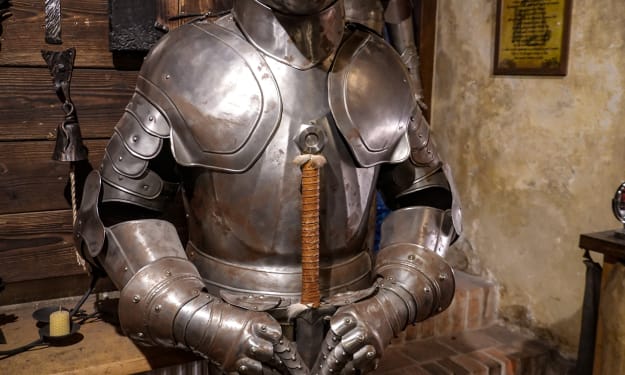
Buying Medieval Armor in the 21st Century: Taking a Step Back in Time
In the rapidly advancing 21st century, modern technology has taken the forefront in defense and warfare. Nevertheless, Medieval armor, which played a significant role throughout history, holds not only military significance but also cultural and artistic value. Acquiring Medieval armor in the present day provides a unique opportunity to own these historical treasures and forge a connection with the past. In this article, we will explore the process of purchasing Medieval armor in the 21st century and delve into its contemporary significance.
By Çağan Küçük3 years ago in History
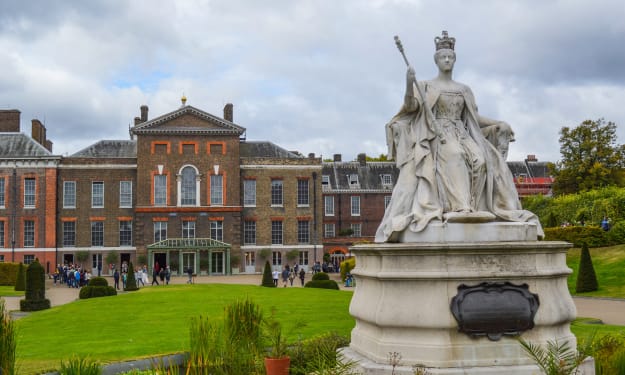
The Royals: A Billion-Pound Dilemma Shaking the Nation!
Prepare to be awestruck as we delve into the astonishing world of the British royal family - a tale of opulence, power, and grandeur. Unraveling the mysteries behind their vast fortunes and exquisite treasures, this jaw-dropping exposé is set to spark fierce debates and ignite a viral storm!
By Temitope Gold3 years ago in History
Why China is losing the microchip war
The development of chips began in the United States with the government believing that they would always have access to the best ones. However, by the late 1960s, many chip companies had moved their manufacturing and assembly to other countries, where labor was cheaper. This led to other countries investing in their own chip industry as well. In 2012, Zongchang Yu.left his job as an engineer at a company called ASML....the only company in the world that can make thismachine. This machine makes the most advanced semiconductor chips or microchips in the world.After he left ASML he started two newcompanies,one in the US and one in China. US and ASML lawyers would later allege that Yu recruited other ASML engineers to his US company... that they brought with them stolen information about AMSL's machine... and that it was all backed by the Chinese government. This story is just one small piece of China's monumental effort to transform one of the world's most global and significant industries: semiconductors. But China's effort has increasingly locked it in a struggle with the United States. This isn't about market share. This isn't about tariffs. This is about security. So how exactly did China and the US enter into a Cold War over computer chips? [pensive, driving electronic music] music fades] This is the first semiconductor chip invented in the 1950s by engineers in the US. It's a piece of silicon with four transistors on it. The more transistors, the more powerful the chip. By 1960 ngineers had already made one with four times the transistors... and each year they figured out ways to add more. So since the early 1960s, semiconductors have improved at an exponential rate. This is Chris Miller, author of Chip WarThe founder of Intel, Gordon Moore predicted in 1965 that the computing power produced by a single chip would double every year or so and that rate has held true roughly up to the present. The first companies dedicated to making chips were in the US where they really just had one main customer: the US government.
By mouad ouijer3 years ago in History
Đuka Tesla
Introduction: In the realm of scientific genius, few names shine as brightly as Nikola Tesla's. Known for his revolutionary work in electrical engineering, Tesla's inventions and discoveries have left an indelible mark on the modern world. However, behind every great mind, there often lies a lesser-known story, and in the case of Nikola Tesla, this holds true for his sister, Đuka Tesla. While her brother's fame has overshadowed her contributions, Đuka played a crucial role in supporting Nikola throughout his life, and her own story is one of strength, resilience, and familial devotion.
By ARUL KARTHIK SASI3 years ago in History
10 Diabolical Things Supposedly Hidden Away in the Vatican
The Vatican Secret Archives, founded in 1611 by Pope Paul V, have long been shrouded in mystery, housing some of the Church's oldest and most valuable documents. Access is limited to Vatican officials and qualified academics with letters of recommendation, further fueling rumors and speculations about the hidden contents within. In this blog, we delve into ten diabolical theories that have been whispered about what might be concealed in the Vatican Secret Archives.
By Ally Allany3 years ago in History
5 greatest scientific discoveries
Unquestionably, the past ten years have been among the most productive in terms of scientific discovery ever. Scholars from all fields have examined theories, discovered evidence, and traveled to locations that have caused us to reconsider how well we understand not only our own planets but also the entire universe. It was also the decade in which we began to comprehend one of the biggest problems that humanity has ever faced. Pluto despite having been unceremoniously downgraded from being a fully fledged planet in 2006 that year also saw the launch of the New Horizons spacecraft that was destined to travel to the farthest reaches of our solar system to study the dwarf planet it finally reached its destination in July of 2015 in the images and data that were sent back were astonishing far from being the boring frozen rock that some had expected it was found to have moving glaciers floating ice mountains and a huge frozen sea made of solid nitrogen the ice is constantly moving Arbit at a slow rates because it is warmed by the pressure above it which in turn causes it to rise the constant replenishment of the top layer of ice creates a surface structures that no one had expected and that has given a new introduction and understanding to what happens on the mysterious dwarf planets at the edge of our solar system number four the Higgs bosons it took the construction of the world's largest machine at a cost of just under five billion dollars but in 2012 it was finally announced that the mysterious Higgs a Bolton also known as the god particle have been discovered at the Large Hadron Collider in CERN Switzerland the particle had first been theorized in 1964 and is one of the most influential pieces of the subatomic world the reason that it's so important is that the standard model of physics which includes familiar particles like electrons and protons and um from such as muons and quarks doesn't actually explain why objects have mass the elusive Higgs boson particle, which exists in the Higgs field and is responsible for mass owing to its interaction with other particles, is the solution, His finding confirmed the last piece of the standard model of physics, and now researchers may use the LHC to start looking into even crazier phenomena number three. The first Kepler probe was launched in 2009 and was used to study distant stars and measure the amount of light they emit flu. For thousands of years, people have gazed up at the sky wondering what's up there. As astronomical instruments were developed, we learned that there are countless stars in the universe and that there are other planets in our own solar system. However, it was impossible to learn how common it is for planets to orbit stars. number three the world's climates throughout the Earth's history the climate has changed drastically there have been periods of extreme heat and extreme cold and there's no doubt that things are noticeably changing again during our lifetimes what's different this time though is that the changes are largely due to human behavior something that became clearer than ever in the last decade and we've begun to understand the extent to how it's affecting the planet in 2012 400 billion tons of ice was lost from Greenland and more than 250 two billion tons of ice has been lost from Antarctica every year throughout the decade this is an increase of almost six times the amount being lost just thirty years earlier and at the current rate the world's sea levels are expected to rise by 3 feet by the year 2100 this would directly affect the homes and lives of at least 630 million people but the consequences are far further reaching human activity has meant that 40% of all amphibian species more than 33% of marine mammals and 10% of insect species are endangered and things continues to get worse while the last decade was the time where the extent of the problem was beginning to be fully realized let's hope that the next decade is when the solution is finally found lastly, the top black holes Black holes have long been among the universe's most enigmatic things, but owing to experts who have devoted their time to researching the phenomenon, we now know a lot more about them and they are really a lot more fascinating than you may imagine. Black holes are normally created when massive stars die and all of the material collapses in on itself to produce a very tight structure. Because of their enormous gravity, black holes cause some extremely strange things to occur in 2016 - The discovery of black hole collisions supported Einstein's 1916 prediction that they would produce gravitational waves, which are ripples in space-time. This incredible discovery wasn't the biggest black hole discovery of the past ten years, but it was still significant because a team using the event horizon telescope was able to take the first-ever picture of a single black hole. This black hole is located at the center of the Messier 87 galaxy, which is 54 million light-years away from Earth. Its mass is enormous, equal to 6.5 billion of our Suns. Black holes like those are believed to be at the center of every galaxy, and their existence. Thank you all so much for reading; see you next time. 2010 was a fantastic year for scientific discoveries, and we've learnt so much about the world and cosmos around us. I, for one, am eager to see what happens next.
By Omotayo Obasanjo3 years ago in History
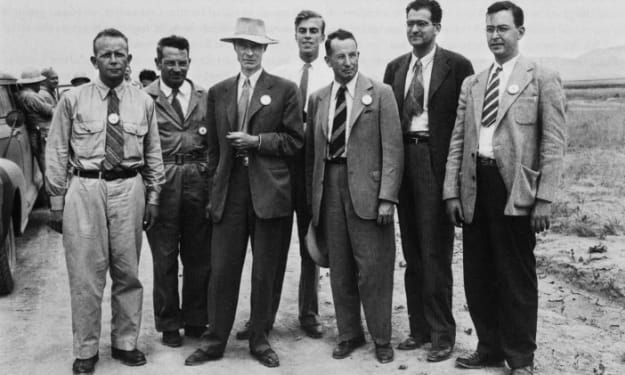
J. Robert Oppenheimer: Father of the Atomic Bomb and Key Figure in WWII
J. Robert Oppenheimer, born Julius Robert Oppenheimer on April 22, 1904, in New York City, was an American physicist and one of the key figures in the development of the atomic bomb during World War II. Often referred to as the "father of the atomic bomb," his contributions to science and his role in the Manhattan Project profoundly shaped the course of history.
By Jay Rathod3 years ago in History
Industries Flourishing During War and Thriving in the Post-War Era: A Tale of Two Economies
Introduction War, with its devastating consequences, has a profound impact on economies worldwide. While some industries benefit during times of conflict, others find opportunities to rebuild and thrive in the post-war era. In this article, we'll explore the top 10 industries that flourish during the war and those that strive to benefit in the aftermath, supported by real-life examples from previous conflicts. Additionally, we'll highlight the top five countries that have historically benefited from war-driven economic growth.
By Benny Bhali3 years ago in History