
J. Robert Oppenheimer: Father of the Atomic Bomb and Key Figure in WWII
American Physicist and Father of the Atomic Bomb
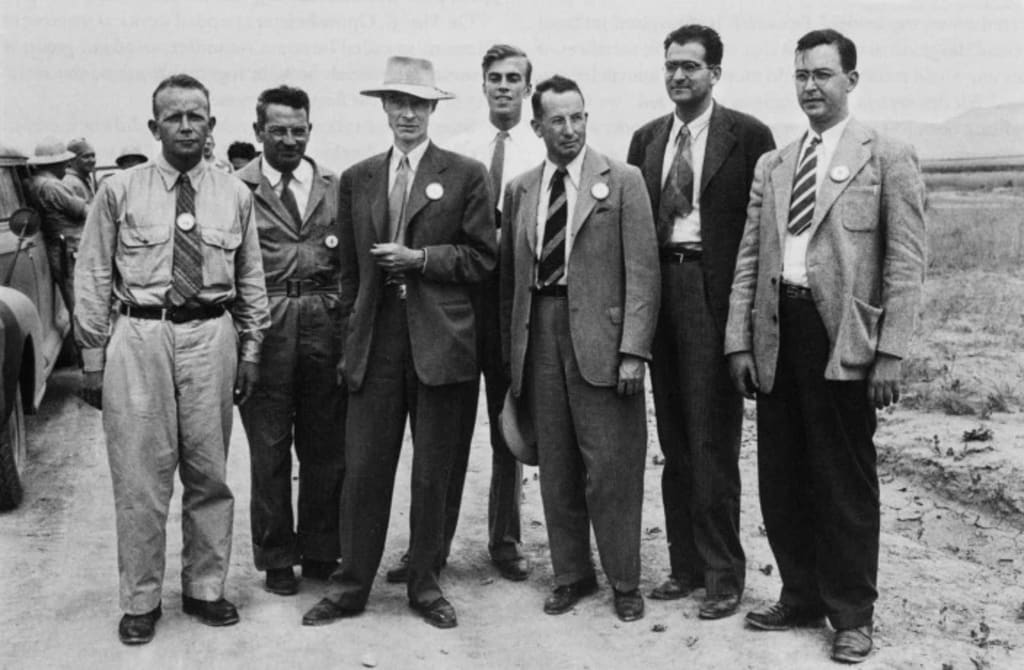
J. Robert Oppenheimer, born Julius Robert Oppenheimer on April 22, 1904, in New York City, was an American physicist and one of the key figures in the development of the atomic bomb during World War II. Often referred to as the "father of the atomic bomb," his contributions to science and his role in the Manhattan Project profoundly shaped the course of history.
Early Life and Education:
Oppenheimer came from a family of Jewish immigrants who had fled anti-Semitic persecution in Germany. His father, Julius Oppenheimer, was a successful textile importer, and his mother, Ella Friedman, came from a wealthy family. From an early age, Oppenheimer showed remarkable intellectual curiosity and a passion for knowledge.
After attending the Ethical Culture Fieldston School, he went on to Harvard University, where he studied chemistry, literature, and philosophy. He graduated summa cum laude in 1925, showing a strong inclination toward theoretical physics. Pursuing his academic interests further, Oppenheimer traveled to England and studied at the Cavendish Laboratory at the University of Cambridge under the supervision of prominent physicists such as J.J. Thomson and Paul Dirac.
Career and Scientific Contributions:
Upon returning to the United States, Oppenheimer earned his Ph.D. in physics from the University of Göttingen in Germany in 1927. Throughout the 1930s, he made significant contributions to quantum mechanics, quantum field theory, and cosmic ray research. He became a professor at the University of California, Berkeley, where he collaborated with other leading scientists, including Enrico Fermi and Niels Bohr.
Oppenheimer's work on neutron stars and black holes laid the groundwork for our understanding of these phenomena. He also made crucial contributions to the theoretical aspects of nuclear fission, which became of immense importance during World War II.
The Manhattan Project:
In 1942, the United States government established the top-secret Manhattan Project, with the goal of developing an atomic bomb before Nazi Germany could. Oppenheimer was appointed as the scientific director of the project, leading a diverse team of scientists at the Los Alamos Laboratory in New Mexico.
During the project, Oppenheimer faced the moral and ethical dilemmas associated with creating such a devastating weapon. He famously quoted the Hindu scripture, the Bhagavad Gita, saying, "Now I am become Death, the destroyer of worlds" after witnessing the first successful test of an atomic bomb on July 16, 1945.
Later Years and Legacy:
Following World War II, Oppenheimer continued his career in academia, becoming the director of the Institute for Advanced Study in Princeton, New Jersey. However, his involvement with left-wing causes and associations with suspected Communists during the era of McCarthyism led to his security clearance being revoked in 1954.
Despite the controversy and setback, Oppenheimer remained a prominent figure in the scientific community and contributed to the development of the hydrogen bomb. He also advocated for the peaceful use of atomic energy and pushed for international cooperation on nuclear disarmament.
J. Robert Oppenheimer received numerous awards and honors for his scientific achievements, including the Enrico Fermi Award and the Medal of Merit. He passed away on February 18, 1967, leaving behind a complex legacy as a brilliant physicist, the leader of the Manhattan Project, and a symbol of both the potential and perils of scientific discovery.
In the decades that followed, Oppenheimer's contributions to science and the development of the atomic bomb continued to be a subject of intense debate and historical analysis, making him one of the most enigmatic figures of the 20th century.
About the Creator
Keep reading
More stories from Jay Rathod and writers in History and other communities.
What Is ChatGPT?
ChatGPT is an artificial intelligence (AI) language model created by OpenAI, an organization dedicated to advancing AI in a safe and beneficial way. The ChatGPT model was first introduced in 2019 and has since become a popular tool for natural language processing, chatbot development, and more.
By Jay Rathod3 years ago in Education
The Crown of Ash and Gold
In the final era of the ancient kingdom of Aurelion, the world seemed to change its tone. The skies appeared duller, the winds colder, and the streets quieter than they had ever been during the kingdom’s golden age. Aurelion was once a beacon of civilization—its stone cities gleamed under the sun, its scholars were respected across continents, and its armies had carved its name into history. Yet no empire, no matter how mighty, can escape the slow test of time.
By The best writer 6 days ago in History
Why August Wilson’s Joe Turner’s Come and Gone Feels Urgent on Today’s Broadway Stage by NWO Sparrow
Why August Wilson’s vision of identity and movement resonates in today’s political climate by NWO Sparrow Joe Turner’s Come and Gone returns with urgency, reflection, and cultural weight
By NWO SPARROWa day ago in History
The Devil's Cut
“Comrade, finally you’re awake.” The voice was smooth, sensual. A flickering incandescent bar was all that lit the white, sterile room. All Vladimir remembered was everything going black. He tried to move his arms and found them strapped to the gurney.
By Matthew J. Fromm5 days ago in Fiction




Comments
There are no comments for this story
Be the first to respond and start the conversation.