
Kumarastrapradarshana(The showcase of skills by princes)
The story of showcase of skills by the kuru princes

The Gathering of the Royal Court and People of Hastinapura
The Kumaras Tapradarshana was organized by Guru Dronacharya, the revered teacher of both the Pandavas and Kauravas. Having trained the princes in the various arts of warfare, archery, and weaponry, Drona felt it was time to demonstrate their progress to the kingdom. He arranged a grand tournament where the princes would perform feats of skill to showcase their mastery and strength.
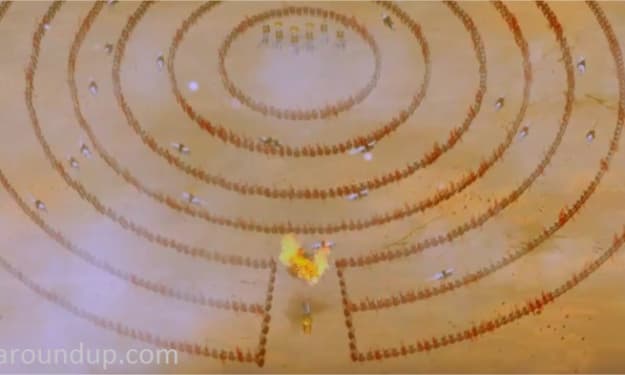
The day of the event dawned with great excitement. The royal family, including King Dhritarashtra, Queen Gandhari, and Kunti, along with elders like Bhishma and Vidura, took their seats in a grand arena set up for the event. Citizens from all over Hastinapura gathered, eager to see the princes, who were known for their abilities. Colorful banners adorned the arena, and there was an atmosphere of festivity and anticipation.
The Display of Skills by the Kuru Princes
The tournament began with the princes demonstrating basic skills, progressing to more advanced techniques. Duryodhana, the eldest Kaurava, led the display, wielding his mace with exceptional strength and agility. He swung it with ease, showcasing his power and mastery in close combat, his performance greeted by cheers from his supporters.
Bhima, the second Pandava, then took center stage. Known for his immense strength, Bhima was a powerful mace fighter, and his duel with Duryodhana was the highlight of the showcase. The two cousins, though rivals, engaged in a friendly yet intense battle, each trying to outdo the other. Their clash was fierce, with the crowd roaring as they matched each other’s strength and skill.
After the mace display, other weapons were introduced. Nakula and Sahadeva, the youngest Pandavas, displayed their expertise in swordsmanship and horsemanship, performing with remarkable finesse. Nakula, known for his beauty and charm, captivated the audience with his graceful moves, while Sahadeva, the wise and reserved twin, impressed everyone with his calculated and precise strikes.
Arjuna’s Unmatched Archery Skills
The highlight of the tournament came when Arjuna, the third Pandava and Drona’s favorite student, stepped forward to demonstrate his archery skills. Arjuna had shown exceptional dedication to archery, often practicing alone at night to perfect his craft. His dedication and discipline were apparent as he took his position, calm and focused.
Arjuna’s display began with hitting stationary targets with perfect accuracy. Then he moved on to hitting moving targets, which he struck effortlessly. Drona then challenged him to shoot targets while blindfolded, and Arjuna performed this feat with remarkable precision, leaving the audience in awe.
As a final test, Drona released a mechanical bird on a pole, a famously difficult moving target that required intense focus to hit accurately. Arjuna, drawing his bow, listened intently as Drona asked him what he saw. “I see only the eye of the bird,” Arjuna replied, blocking out everything else in his view. With that singular focus, he released his arrow, hitting the bird’s eye dead center. The crowd erupted in applause, and even the royal family was visibly impressed. Arjuna’s display solidified his place as the most skilled archer of his generation, and his mastery was acknowledged by all present.
The Arrival of Karna and the Brewing Rivalry
Just as the tournament seemed to be concluding, a young warrior entered the arena, his appearance regal and his expression confident. This warrior was Karna, who had heard of the tournament and sought to challenge Arjuna’s skills. Unknown to all, Karna was Kunti’s firstborn son and Arjuna’s elder brother, though he himself was unaware of his royal lineage.
Karna stepped forward and declared his intent to match Arjuna’s prowess, particularly in archery. His presence and confidence took everyone by surprise. Karna’s challenge was bold, and Duryodhana, seeing an opportunity to find an ally against the Pandavas, quickly befriended him. He declared Karna the king of Anga, granting him royal status to enable him to compete against Arjuna on equal terms.
The arrival of Karna and his subsequent challenge to Arjuna marked the beginning of a fierce rivalry that would grow throughout their lives. Although Arjuna and Karna exchanged words of challenge, both demonstrated respect for each other’s skills, though underlying tensions were already brewing.
The Impact of the Kumaras Tapradarshana
The Kumaras Tapradarshana was more than just a display of skills; it was an event that shaped the relationships and rivalries between the princes. For Dronacharya, it was a moment of pride as he saw the fruits of his teaching. But for the Pandavas and Kauravas, it was a foreshadowing of the divisions and alliances that would eventually lead to the epic battle of Kurukshetra.
The citizens of Hastinapura left the event with mixed feelings. While they were proud of the Kuru dynasty’s strength, the display had revealed the growing discord and competition between the princes. Arjuna’s brilliance in archery, Bhima’s unmatched strength, Duryodhana’s aggression, and Karna’s sudden entrance all hinted at the complex, intertwining destinies of the Kuru princes and foreshadowed the great conflict that lay ahead.
In time, the rivalries witnessed at the Kumaras Tapradarshana would erupt into the devastating war of the Mahabharata, where the princes would face each other not as family but as warriors fighting for dharma, honor, and their respective beliefs.
About the Creator
Keep reading
More stories from sai Charan and writers in History and other communities.
A Teacher’s Revenge: Dronacharya’s Test of Loyalty and the Capture of King Drupada
Drona’s Friendship with Drupada and the Broken Promise Long before he became the revered teacher of the Pandavas and Kauravas, Dronacharya had a close friendship with Drupada, the prince of the kingdom of Panchala. They had studied together as young boys, trained under the same teachers, and shared a deep, brotherly bond. Drupada, admiring Drona’s skill and knowledge, had once promised him, “When I become king, half of my kingdom will be yours. Together, we will rule as friends, sharing wealth and power.”
By sai Charanabout a year ago in History
The Red Sea Crisis and the Fragility of Global Trade
The Red Sea Crisis and the Fragility of Global Trade The Red Sea has quietly become one of the most critical pressure points in global affairs. Once seen mainly as a commercial shipping route connecting Asia, Europe, and Africa, it is now a zone of rising military tension, disrupted trade, and geopolitical rivalry. What happens in this narrow stretch of water is no longer a regional issue—it is reshaping global economics and international security.
By Wings of Time 7 days ago in History
3 Times Safety Rules Were Written After It Was Already Too Late
Safety rules like to pretend they are proactive. They wear reflective vests, carry clipboards, and speak confidently about prevention. But history knows the truth: many safety rules were written after something went catastrophically wrong, when prevention was no longer an option and regret had already filled out the paperwork.
By Enoch Sagini7 days ago in History


Comments
There are no comments for this story
Be the first to respond and start the conversation.