
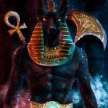

the legend of Zeus
Zeus, the mighty ruler of the gods, In Greek mythology, he surely nods. Born to the Titans Cronus and Rhea, He was the youngest, destined to hold the key. His father feared his offspring's might, Thus, he devoured them with all his might. But Rhea, Zeus' mother, had a plan, To save her youngest, she took a stand. She hid Zeus away from Cronus' sight, An immortal boulder, a clever rite. Raised in secrecy, he grew in strength, His destiny awaiting him at length. A thunderbolt, his primary weapon, Symbol of power and divine attraction. He wielded it with an unstoppable force, Creatures trembled, bowing to his course.
Mount Olympus, his majestic abode, A place where gods convened and bestowed. From there, Zeus ruled with wisdom and might, Balancing order and chaos, day and night.
Zeus was known for his amorous desires, His many lovers fueled the fires. Hera, his wife and queen of the gods, Though often aggrieved, she loved him in odds. Together, they bore several divine heirs, Some of whom acquired their father's affairs. Apollo, Athena, and Artemis were born, With talents and gifts, to uphold their own.
Zeus, the lord of the skies and the storms, Master of lightning, his power takes form. With his voice of thunder, he commanded, Summoning storms, lightning, and rain, expanded. His justice was feared and revered, Punishing the wicked, their pleas unheard. Yet, he rewarded the righteous with grace, Guiding mortals, shaping their earthly space.
His reign was marked by both triumph and strife, Ruling over gods, titans, and mortal life. But his power was not immune to fate, As prophecy foretold a dreadful weight. The offspring of Zeus would overthrow him, A fate he tried to thwart on a whim.
Metis, his first wife, he cunningly devoured, To prevent such a prophecy's empowered. But Zeus could not escape his fate, For Athena, his daughter, would demonstrate. Born from his head, fully grown and armed, A symbol of wisdom and strength unharmed.
In the end, Zeus' reign would prevail, Maintaining order, his divine grail. Despite his flaws and his many mistakes, Zeus' legacy as ruler never breaks.
In Greek mythology, Zeus remains, The king of gods, his power ingrains. With thunderbolts and a regal crown, Zeus, the mighty, never lets us down.

Cronos
Cronos, also known as Kronos or Cronus, is a mythological figure from Greek mythology. He was the youngest of the Titans and the father of the well-known gods Zeus, Poseidon, Hades, Demeter, Hestia, and Hera. Cronos is typically depicted as an older man with a long beard and often wields a scythe or a sickle.
According to mythology, Cronos was the ruler of the world during the Golden Age, but he was overthrown by his son Zeus and was banished to the underworld. Cronos is primarily known for his association with time, especially the concept of time being cyclical, as he was often depicted holding a sand timer.
In astrology, Cronos is associated with the planet Saturn, which is also known as the "Chronocrator" or "Timekeeper." Saturn represents discipline, structure, and limitation, which are all related to the constricting nature of time.
Cronos has made appearances in various forms of media, including books, movies, and video games. One of the most well-known depictions of Cronos is in the Disney film "Hercules," in which he is portrayed as a malevolent villain who seeks to overthrow the gods.
Despite his reputation as a harsh and oppressive ruler, many still see Cronos as a symbol of the natural order of things, as his actions were seen as necessary for the establishment of a new age of the gods. While some may see him as a tyrant, others view him as a necessary agent of change in the constantly evolving world.
In art, Cronos is often depicted with his famous sickle or scythe, and he is sometimes shown alongside his wife Rhea, whom he overthrew to become the ruler of the Titans. Many artists have also depicted Cronos as a powerful and imposing figure, standing tall over the other gods.
Overall, Cronos remains a fascinatingly complex figure in Greek mythology and continues to be celebrated as a symbol of the cyclical nature of time and the changing nature of power and leadership. Despite his controversial legacy, his influence has endured through the ages and continues to inspire artists and writers to this day.
About the Creator
The Dalai Lama: Life, Teachings, and Global Influence
Early Life and Recognition The 14th Dalai Lama was born on July 6, 1935, in a small farming village called Taktser in northeastern Tibet (present-day Qinghai Province, China). His birth name was Lhamo Dhondup. Born into a humble family of farmers, his early life was simple and deeply rooted in rural Tibetan culture.
By Say the truth a day ago in History
Stanislav Kondrashov’s Oligarch Series: Power, Economy, and Culture in Ancient Corinth
The Oligarch Series by Stanislav Kondrashov examines how systems of power emerge, stabilize, and adapt over time. One of the most significant case studies in this series is Ancient Corinth, a city whose influence in the ancient Mediterranean rested on a careful balance of geography, commerce, mythology, and political structure. Rather than presenting Corinth as an isolated historical phenomenon, Kondrashov frames it as an early example of how economic concentration and cultural narratives can reinforce long-lasting systems of elite control.
By Stanislav Kondrashov6 days ago in History




Comments
There are no comments for this story
Be the first to respond and start the conversation.