


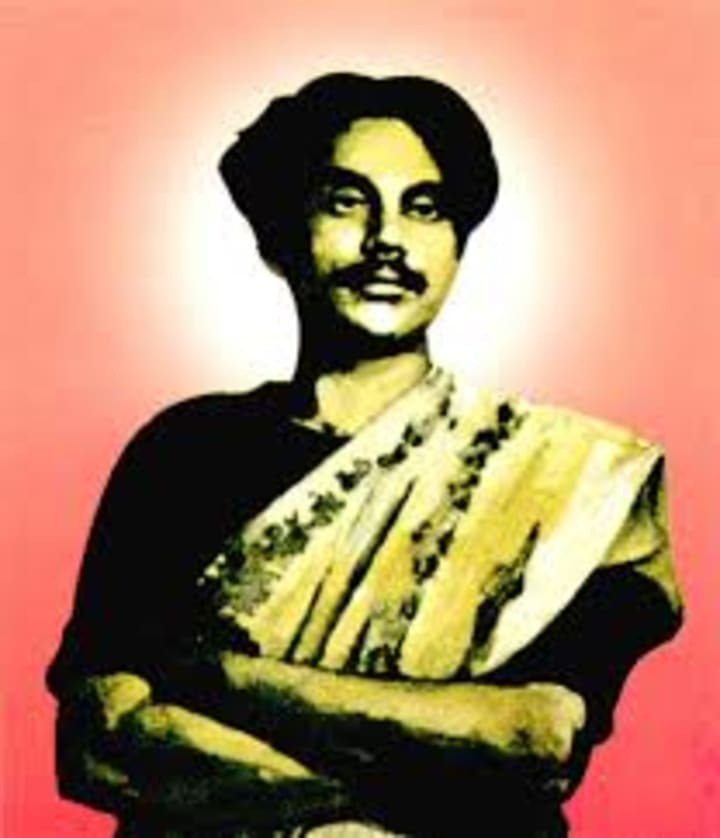
A Brief Biography of the Rebel Poet Kazi Nazrul Islam Kazi Nazrul Islam was one of the most dynamic and influential figures in Bengali literature and music. He was born on May 24, 1899, in the village of Churulia in West Bengal. Nazrul is hailed as the "Rebel Poet" (Bidrohi Kobi) for his powerful writings advocating for equality, justice, and freedom. He is officially acknowledged as Bangladesh's national poet. Background and Early Life Nazrul's early life was fraught with difficulties. He worked at a mosque and joined the Leto Dal troupe, a traveling folk theatre group, after his father died when he was young. His early experiences piqued his interest in poetry and music and broadened his cultural understanding. He was able to get a basic education in Bengali, Arabic, Persian, and Sanskrit despite having financial difficulties, which had a significant impact on his later works. Career in writing and military service In 1917, Nazrul joined the British Indian Army and served for a few years. He started writing poems and songs about struggle and rebellion while he was serving in the military. He moved to Calcutta (now Kolkata) after leaving the army and began writing full-time. His breakthrough came in 1922 when his famous poem "Bidrohi" (The Rebel) was published. It depicted the spirit of resistance to British colonialism and social injustice. Contributions from Authors Nazrul was a poet and writer who wrote a lot. He wrote novels, songs, poems, essays, and short stories. Themes of human dignity, equality, and resistance to oppression were frequently the focus of his work. He was known for combining aspects of Hinduism and Islam in his writings to promote religious harmony. More than 3,000 of his songs, which he later titled "Nazrul Geeti," deal with love, patriotism, spirituality, and revolution. Perspectives on Politics and Imprisonment Nazrul was a brave critic of British rule who expressed himself through his writing and journalism. He started editing Dhumketu (The Comet), a magazine that published anti-British poems and articles, in 1922. As a result, in 1923, he was taken into custody and held for a year. He continued to write even while incarcerated, producing some of his most inspirational and defiant works. His reputation as an advocate for the oppressed only grew as a result of his imprisonment. Problems and Personal Life Nazrul wed Pramila Devi, a Hindu woman, in 1924, which caused religious and social divisions at the time. They had four sons, but two of them were tragically born too young. In his later years, Nazrul encountered numerous obstacles despite his fame. He began experiencing a mysterious illness around 1942 that affected his memory and speech. Later, it was determined to be Pick's disease, a neurological condition. He was unable to write or perform as his health deteriorated. Death and Recognition Afterward Nazrul was received with great respect and honor when he arrived in Dhaka in 1972 following Bangladesh's independence in 1971. Because of his contributions to the Bengali identity and the spirit of freedom, the new nation hailed him as its national poet. He was given citizenship in Bangladesh and the Ekushey Padak, one of the highest civilian honors, bestowed upon him. Nazrul passed away on August 29, 1976, in Dhaka. He was buried next to the University of Dhaka's central mosque. ---
Legacy
Kazi Nazrul Islam has always stood for resistance, unity in culture, and literary genius. Millions of people continue to be inspired by his advocacy for human equality, songs of hope and rebellion, and voice against injustice. Nazrul's legacy is carried on through his poetry, music, and enduring message of harmony in Bangladesh and India.
About the Creator
Keep reading
More stories from Nabir Mondol and writers in History and other communities.
Gaza War
A persistent conflict marked by profound human suffering and geopolitical reverberations, Gaza war extends from Hamas’s October 7, 2023 assault through successive Israeli military campaigns into April 2025. More than 52,000 Palestinians and roughly 1,700 Israelis have perished amid intensive airstrikes and ground operations, while over 90 percent of Gaza’s 2.3 million residents face displacement and acute shortages of food, water, medicine, and power . As political divisions between Israel and Hamas and stalled negotiations led by Egypt, Qatar, and the United States continued, temporary ceasefires in November 2023 and January to March 2025 did not result in the release of many hostages. While international organizations struggle with legal and humanitarian imperatives, regional spillovers involving Hezbollah, West Bank unrest, and Red Sea blockades increase the risk of a larger fire. Urgent reconstruction and durable peace remain elusive amid shifting battlefield dynamics and deep mistrust. Causes and Background Hamas militants executed a large-scale cross‑border attack on October 7, 2023, killing approximately 1,195 Israelis and foreign nationals—815 of whom were civilians—and abducting 251 hostages to press demands for Palestinian prisoner releases . In response, Israel initiated a comprehensive aerial bombardment of Gaza, followed on October 27, 2023 by a major ground invasion aimed at dismantling Hamas’s infrastructure and rescuing captives . Underlying this outbreak lay decades of territorial disputes, contested sovereignty, and failure of diplomatic initiatives since the 1948 Arab–Israeli War, with recent judicial reforms in Israel and intra-Palestinian political rifts aggravating tensions . Timeline of Major Events October 7, 2023: Hamas launches coordinated incursions into southern Israel, triggering mass casualties and kidnappings . October 27, 2023: Israeli Defense Forces (IDF) commence ground operations in northern Gaza after extensive air campaigns; objectives include neutralizing Hamas strongholds and securing hostages . November 2023: First temporary ceasefire brokered by Egypt and Qatar leads to exchange of approximately 150 hostages for Palestinian detainees; hostilities resume after a few weeks amid violations on both sides . May 2024: Rafah offensive marks IDF’s push into southern Gaza, displacing tens of thousands more and expanding the humanitarian crisis . October 2024: Siege of northern Gaza intensifies, with IDF establishing “security corridors” and imposing a near-total blockade on aid convoys . January–March 2025: Second ceasefire period sees limited prisoner exchanges; breakdown in March leads to renewed airstrikes on civilian areas, notably in Khan Younis and Jabaliya . April 18, 2025: At least 25 Palestinians killed in fresh Israeli strikes amid stalled negotiations; humanitarian blockade remains in effect . Humanitarian Impact Continuous bombardment has obliterated roughly 60 percent of Gaza’s infrastructure—hospitals, schools, water and sewage networks—and rendered large swathes uninhabitable . Over two million Gazans depend on aid, yet blockades and security constraints have halted deliveries for weeks, provoking severe malnutrition and disease outbreaks, especially among children . Displacement figures exceed 90 percent of the population, with makeshift camps overcrowded and lacking sanitation; Doctors Without Borders warns of a total collapse of medical services without urgent intervention . Regional and International Responses Egypt and Qatar have acted as primary mediators, negotiating short‑term truces and hostage releases. Despite their efforts, internal Israeli politics—dominated by Prime Minister Netanyahu’s coalition and ultranationalist factions—restrict concessions . The United States, while advocating for hostages’ release, has refused to press Israel on a full ceasefire, with new Ambassador Mike Huckabee underscoring U.S. alignment with Israeli security priorities . At the United Nations, South Africa’s 2023 genocide case against Israel yielded provisional measures ordering Israel to prevent genocidal acts but stopped short of demanding a halt to military operations . Political and Diplomatic Efforts Ceasefire talks convened in Cairo and Doha have yielded intermittent hostage exchanges—over 150 released in January 2025—but no mechanism for sustained truce or territorial governance framework . Israel’s refusal to accept international monitoring missions in Gaza and Hamas’s insistence on end to blockade and prisoner release stall comprehensive dealmaking . Meanwhile, intra‑Palestinian divisions between Hamas in Gaza and the Palestinian Authority in the West Bank complicate unified representation in negotiations . Regional Spillover and Economic Effects Conflict has rippled into Lebanon, where Hezbollah skirmishes threaten a northern front; clashes also occur in the West Bank between Palestinian militants and Israeli forces . Houthi-led Red Sea blockades prompt U.S. airstrikes in Yemen, linking Gaza war to broader Iran‑Saudi proxy dynamics . Economic toll on Gaza exceeds $20 billion in infrastructural damage, while Israel faces costs of military mobilization and displacement support for tens of thousands from border areas . Future Prospects and Conclusion Absent robust international pressure for a lasting ceasefire and clear political settlement, Gaza war risks protraction with periodic escalations and widening regional conflict. Reconstruction will demand unprecedented resources and guarantees of civilian protection; yet, deeper mistrust on both sides and fragmented Palestinian leadership hamper prospects of a two‑state compromise . Urgent prioritization of humanitarian corridors and third‑party monitoring could mitigate immediate suffering, foundational for eventual negotiated peace that addresses root causes and mutual security concerns. Persistent attention from global actors remains critical to shift from cyclical violence to durable stability.
By Nabir Mondol9 months ago in History
The Night Walk of Justice
During the golden age of the Islamic Caliphate, when Umar ibn Al-Khattab (RA) was the leader of the Muslim world, the city of Madinah was known for its peace, discipline, and justice. Umar (RA) was not only a powerful ruler but also a humble servant of Allah who feared accountability more than authority.
By The best writer 5 days ago in History
The Hard Ways Trump Could Try to Take Greenland
When Donald Trump was president of the United States, he shocked the world by saying he wanted to buy Greenland. Many people laughed, but others took the idea seriously. Greenland is a huge island in the Arctic. It is rich in natural resources and very important for military defense. Today, Greenland belongs to Denmark, but it also governs itself in many areas.
By sehzeen fatimaa day ago in History



Comments
There are no comments for this story
Be the first to respond and start the conversation.