
Isaac Newton: The Father of Modern Science
How One Man’s Genius Changed the Way We Understand the Universe
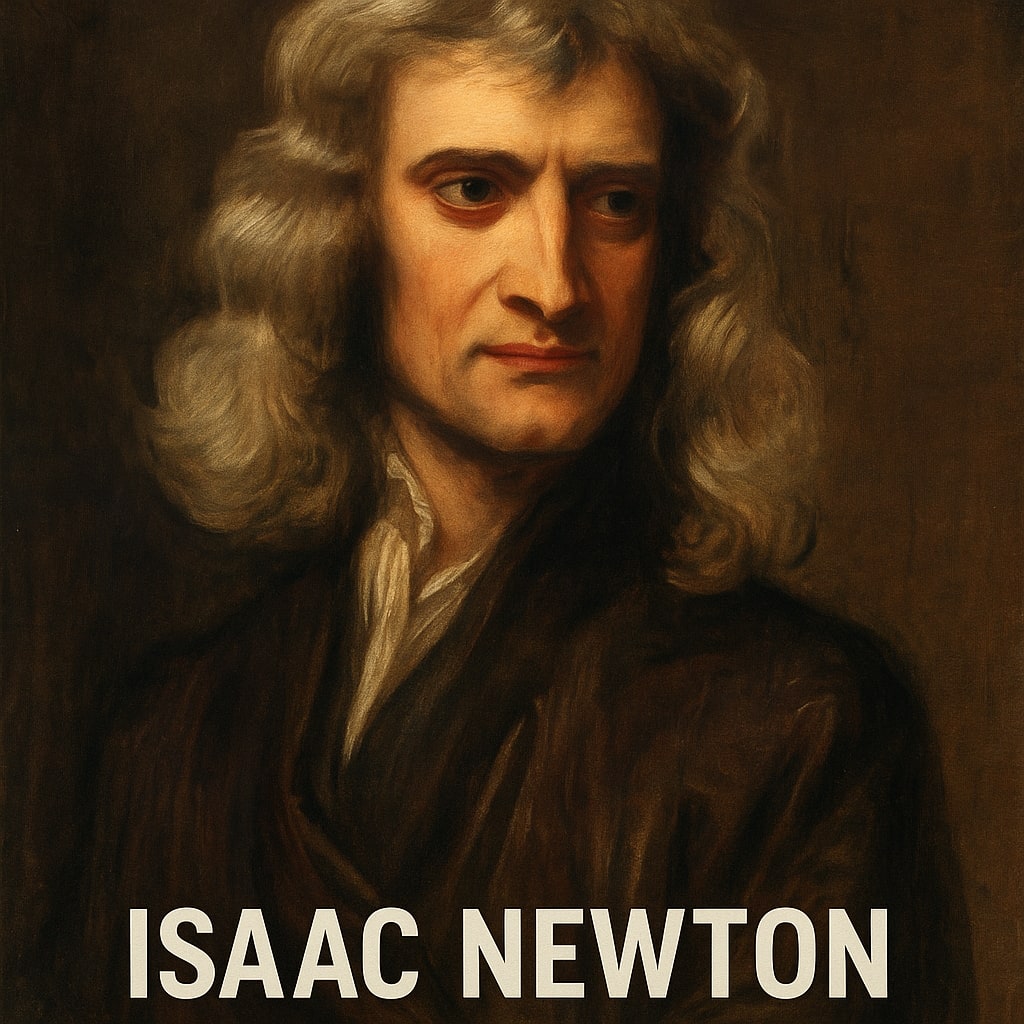
Sir Isaac Newton (1643–1727) is widely regarded as one of the greatest scientists in human history. His contributions to physics, mathematics, and astronomy laid the groundwork for centuries of scientific thought and innovation. With discoveries such as the laws of motion, the theory of universal gravitation, and the development of calculus, Newton transformed not only how people understood the natural world, but also how they explored and investigated it.
Early Life and Education
Isaac Newton was born on January 4, 1643, in Woolsthorpe, a small village in England. He was a premature baby, not expected to survive, but he grew into a curious and intelligent child. After early schooling, he attended Trinity College at the University of Cambridge, where he studied a range of subjects including mathematics, physics, and philosophy.
During his time at Cambridge, a plague forced the university to close temporarily, and Newton returned home for nearly two years. This period, from 1665 to 1667, is known as his “annus mirabilis” or “year of wonders,” during which he made many of his most significant discoveries.
Laws of Motion and Gravity
One of Newton’s most famous contributions is his formulation of the three laws of motion, which describe how objects move in space and time:
First Law (Inertia): An object at rest stays at rest, and an object in motion stays in motion unless acted upon by an external force.
Second Law: Force equals mass times acceleration (F = ma), explaining how objects accelerate in response to applied forces.
Third Law: For every action, there is an equal and opposite reaction.
These laws formed the foundation of classical mechanics, revolutionizing physics and enabling people to predict the behavior of physical systems. Newton used these principles to explain everything from falling apples to the motion of planets.
Alongside these laws, Newton developed the law of universal gravitation, which states that every object in the universe attracts every other object with a force directly proportional to their masses and inversely proportional to the square of the distance between them. This theory unified celestial and terrestrial mechanics for the first time in history, showing that the same physical laws applied both on Earth and in the heavens.
The Principia: A Scientific Masterpiece
In 1687, Newton published his most famous work, Philosophiæ Naturalis Principia Mathematica, commonly known as the Principia. This book presented his laws of motion and universal gravitation with detailed mathematical proofs. The Principia is widely considered one of the most important scientific books ever written, and it solidified Newton’s reputation as a leading thinker of his time.
The Principia did more than present formulas—it introduced a new way of thinking about the universe. Newton combined careful observation with mathematical reasoning, laying the foundation for the scientific method we still use today.
Contributions to Mathematics
Newton also made major contributions to mathematics. He is one of the co-founders of calculus, a powerful mathematical tool used to analyze change and motion. Although German mathematician Gottfried Wilhelm Leibniz also developed calculus independently around the same time, Newton’s work was essential in shaping its application in science and engineering.
His work in mathematics extended to algebra and geometry as well, including the binomial theorem, which expanded how mathematicians could approach equations and functions.
Discoveries in Optics
In addition to physics and mathematics, Newton conducted groundbreaking research in optics, the study of light. He used prisms to show that white light is actually made up of all the colors of the rainbow, fundamentally changing the understanding of light and color. He also designed the reflecting telescope, which used mirrors instead of lenses to produce clearer images. This design is still widely used in astronomy today.
Newton’s Later Life and Legacy
Later in life, Newton served as the President of the Royal Society, one of the world’s oldest scientific organizations. He was also appointed as Warden and then Master of the Royal Mint, where he helped reform England’s currency and combat counterfeiting.
Newton was knighted by Queen Anne in 1705, becoming Sir Isaac Newton. Despite his many achievements, he was a private and often solitary man. He also devoted time to alchemy and theology, although these pursuits are lesser known today.
Isaac Newton died on March 31, 1727, at the age of 84. He was buried in Westminster Abbey, an honor reserved for Britain’s most important figures.
Conclusion
Isaac Newton’s life and work represent a turning point in the history of science. His discoveries provided a new framework for understanding nature and inspired generations of scientists after him. Newton’s genius not only explained the forces that govern the universe but also demonstrated the power of human reason and observation. More than three centuries later, his influence remains strong in every branch of science and engineering. Truly, Isaac Newton was a pioneer whose legacy changed the course of human history.
About the Creator
Keep reading
More stories from Anwar Jamil and writers in History and other communities.
The Punic Wars: Clash of Titans Between Rome and Carthage
Story: The Punic Wars In the ancient Mediterranean, two great powers vied for control over trade, territory, and influence—Rome and Carthage. Their conflict, known as the Punic Wars, spanned over a century and reshaped the course of history. This is the story of how these two civilizations clashed in a series of brutal wars, each shaping the destiny of the ancient world.
By Anwar Jamil9 months ago in History
When Bullets Turned a Garden into a Graveyard
On April 13, 1919, a peaceful gathering in the northern Indian city of Amritsar turned into one of the most tragic and defining events in the history of British colonial rule in South Asia. The incident, now known as the Jallianwala Bagh Massacre, left hundreds of unarmed civilians dead and thousands wounded. More than a century later, the bullet marks that remain on the walls of the garden serve as a silent reminder of the brutality that unfolded that day.
By Irshad Abbasi 3 days ago in History


Comments
There are no comments for this story
Be the first to respond and start the conversation.