
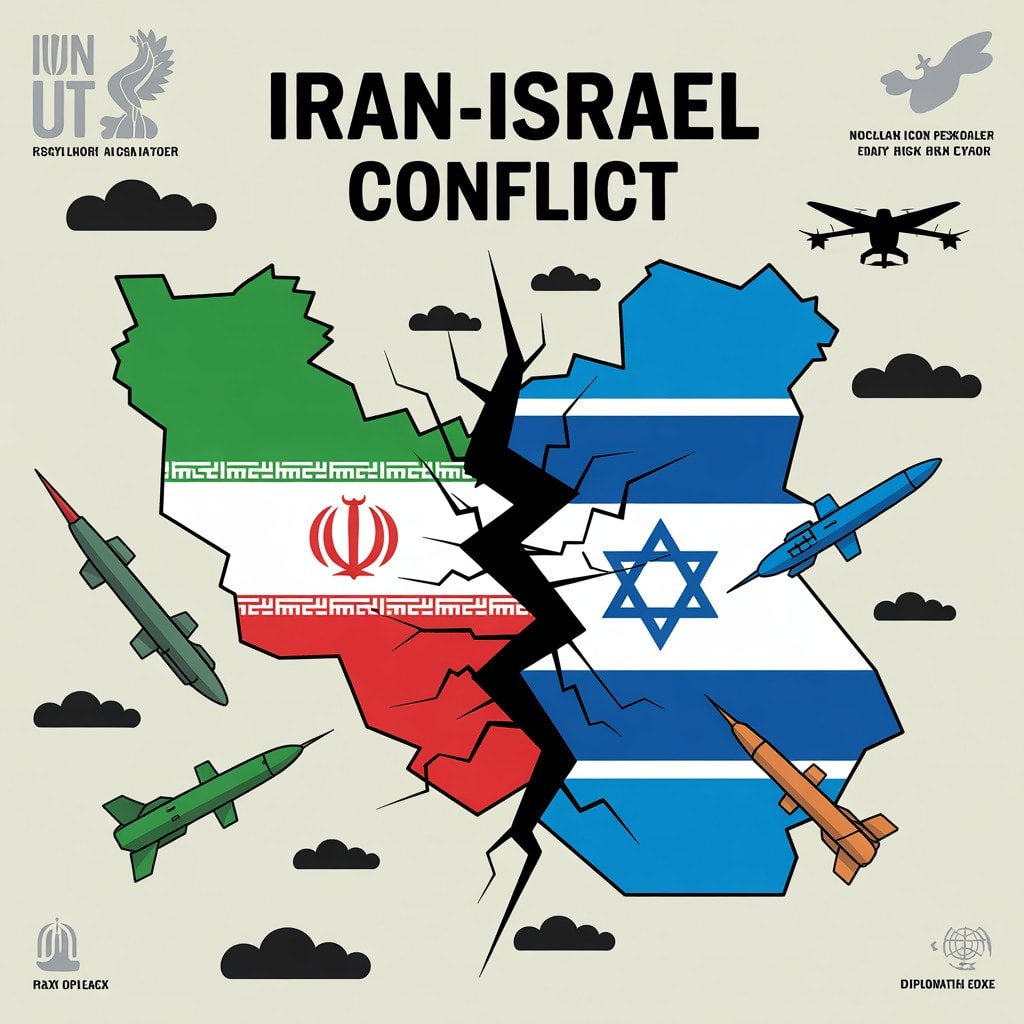
The conflict between Iran and Israel is one of the most enduring and complex rivalries in the Middle East. It is not a traditional war fought on conventional battlefields, but rather a multifaceted struggle involving ideology, regional influence, proxy warfare, nuclear ambitions, and shifting alliances. While the two nations have never officially gone to war, their confrontation plays out across various fronts — from cyberattacks to proxy battles, diplomatic maneuvers to direct military strikes.
Historical and Ideological Roots
The roots of the Iran-Israel conflict go back to the 1979 Iranian Revolution, which saw the overthrow of the Western-backed Shah of Iran and the establishment of the Islamic Republic under Ayatollah Khomeini. Prior to this, Iran and Israel maintained relatively good relations. However, after the revolution, Iran adopted a staunchly anti-Israel position, branding the Jewish state as an illegitimate entity and a symbol of Western imperialism in the Middle East.
The new Iranian regime positioned itself as the defender of oppressed Muslims, especially Palestinians, and made opposition to Israel a cornerstone of its foreign policy. Israel, on the other hand, began to see Iran not just as a hostile power, but as a growing regional threat — particularly due to Tehran’s support for anti-Israel militant groups and its pursuit of advanced military capabilities.
Proxy Warfare and Regional Influence
The Iran-Israel conflict is most visible through the use of proxies. Iran has cultivated a network of non-state actors across the Middle East, often referred to as the “Axis of Resistance.” This includes Hezbollah in Lebanon, Shiite militias in Iraq, the Assad regime in Syria, and the Houthi rebels in Yemen. Iran also supports Palestinian groups like Hamas and Islamic Jihad in Gaza. These groups frequently engage in armed confrontations with Israel, and their existence gives Iran leverage against Israeli interests without direct confrontation.
Israel has responded by launching hundreds of airstrikes, particularly in Syria, to prevent Iran and its proxies from establishing a permanent military presence near its borders. These Israeli operations, often targeting weapons shipments and Iranian bases, are part of what is known as the “campaign between the wars.” The goal is to degrade Iran’s military buildup without triggering a full-scale war.
The Nuclear Question
One of the most dangerous aspects of the Iran-Israel conflict is Iran’s nuclear program. Israel considers a nuclear-armed Iran an existential threat, given the regime’s hostile rhetoric and support for armed groups. Iran maintains that its nuclear program is for peaceful purposes, but evidence of covert activities and enrichment beyond civilian levels has fueled suspicions.
Israel has taken proactive, often covert, steps to delay Iran’s nuclear development. This has included cyberattacks, such as the Stuxnet virus that sabotaged Iranian centrifuges in 2010, and the assassination of key Iranian nuclear scientists. In return, Iran has accused Israel of espionage and terrorism on its soil.
The 2015 Joint Comprehensive Plan of Action (JCPOA), commonly known as the Iran nuclear deal, was an attempt by world powers to limit Iran’s nuclear activities in exchange for sanctions relief. Israel opposed the deal, arguing it was too lenient. After the U.S. withdrawal from the agreement in 2018 under President Donald Trump, Iran began to resume and expand its nuclear activities, increasing tensions once again.
Recent Escalations and Direct Clashes
For decades, the Iran-Israel conflict was largely fought in the shadows. That changed in April 2024, when Iran launched a direct missile and drone attack on Israel for the first time in history, in retaliation for an Israeli airstrike on its consulate in Damascus that killed senior Iranian officials. This marked a significant escalation and crossed a red line, prompting concerns of a wider regional war.
Israel responded with a limited but precise strike inside Iran, reportedly targeting military infrastructure. While both sides pulled back from the brink of full-scale war, the events signaled a dangerous new phase in their rivalry, where direct confrontation is no longer off the table.
Global and Regional Dimensions
The Iran-Israel conflict does not exist in a vacuum. It is deeply embedded in regional and international politics. The United States is Israel’s closest ally and has provided it with military, financial, and diplomatic support for decades. Washington also shares Israel’s concerns about Iran’s nuclear program, although it has sometimes differed on how to handle the issue.
On the other side, Iran has found allies in Russia and China, which oppose Western intervention in the region and support Iran diplomatically and economically. Meanwhile, several Arab states — including Saudi Arabia, the UAE, and Bahrain — have moved closer to Israel in recent years, driven by a shared fear of Iranian influence. These shifts were highlighted by the Abraham Accords, which normalized relations between Israel and several Arab nations.
Conclusion
The Iran-Israel conflict is unlikely to end soon. It is deeply rooted in opposing worldviews and fueled by regional power competition and mutual distrust. As long as Iran continues to expand its influence through proxies and pursues nuclear capabilities, and as long as Israel sees these actions as existential threats, the shadow war will persist — with occasional flare-ups that risk igniting a much larger confrontation.
De-escalation requires robust diplomacy, regional cooperation, and a reevaluation of long-standing policies. Without these, the Iran-Israel conflict will remain a volatile flashpoint in an already unstable region.
Let me know if you'd like a version with citations, a timeline, or adapted for a presentation or report format.
Tools
ChatGPT can
About the Creator
Can Global Peace Exist Without a Global Authority?
Can Global Peace Exist Without a Global Authority? The idea of global peace without a global authority sounds appealing to some people. In theory, nations could manage their own affairs, respect each other’s borders, and resolve disputes peacefully without an overarching institution telling them what to do. Supporters of this view argue that global bodies are slow, biased, and often ineffective. But history and current events raise a difficult question: can lasting global peace truly exist without a central authority to guide it?
By Wings of Time 2 days ago in History




Comments
There are no comments for this story
Be the first to respond and start the conversation.